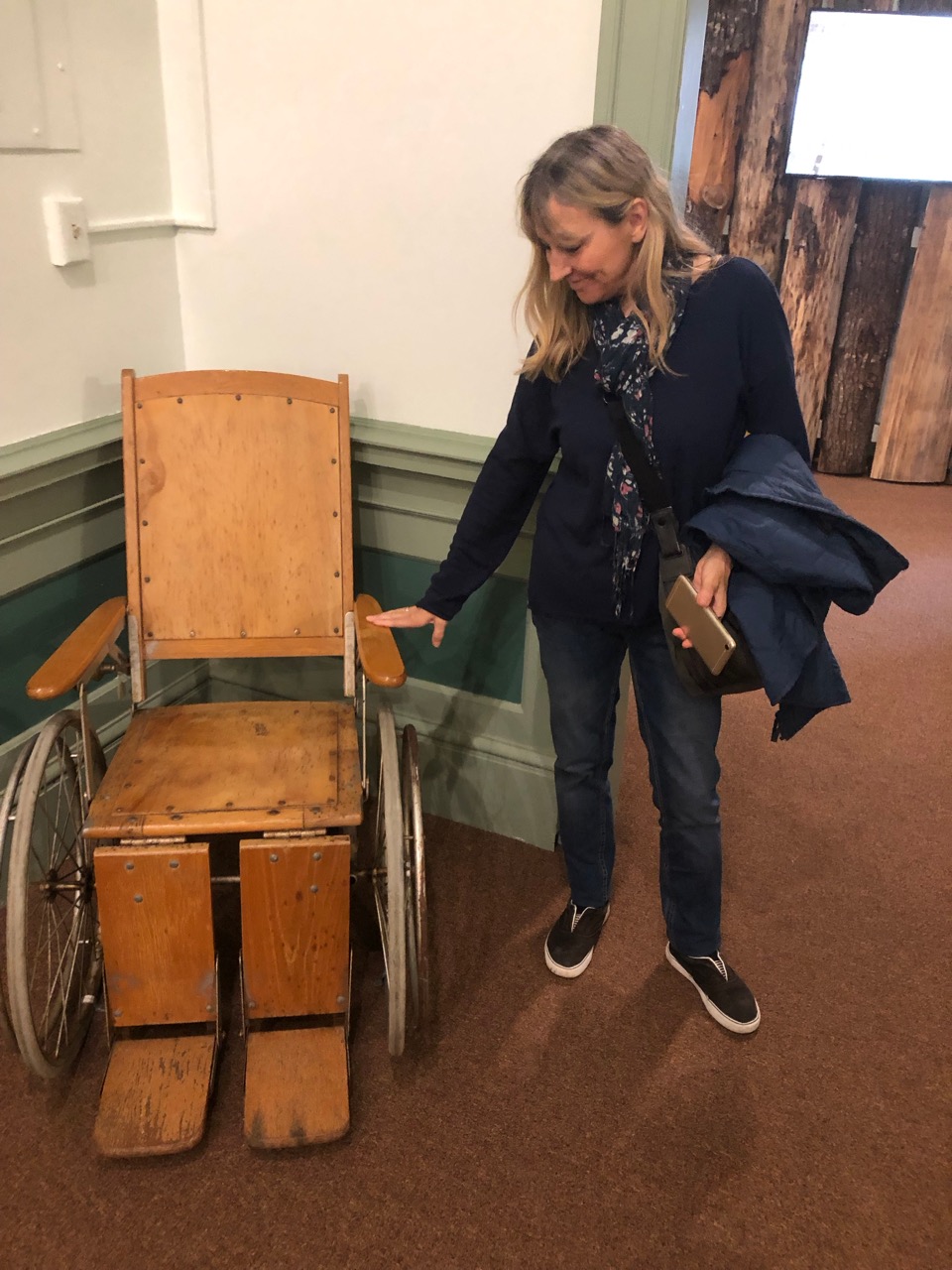
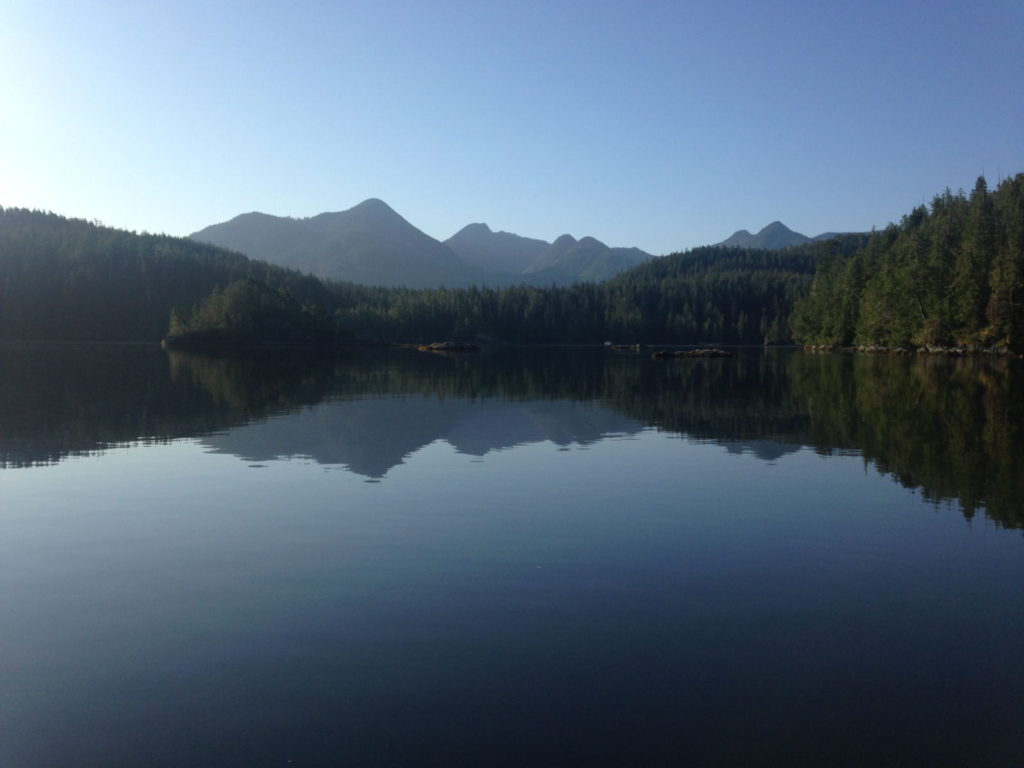
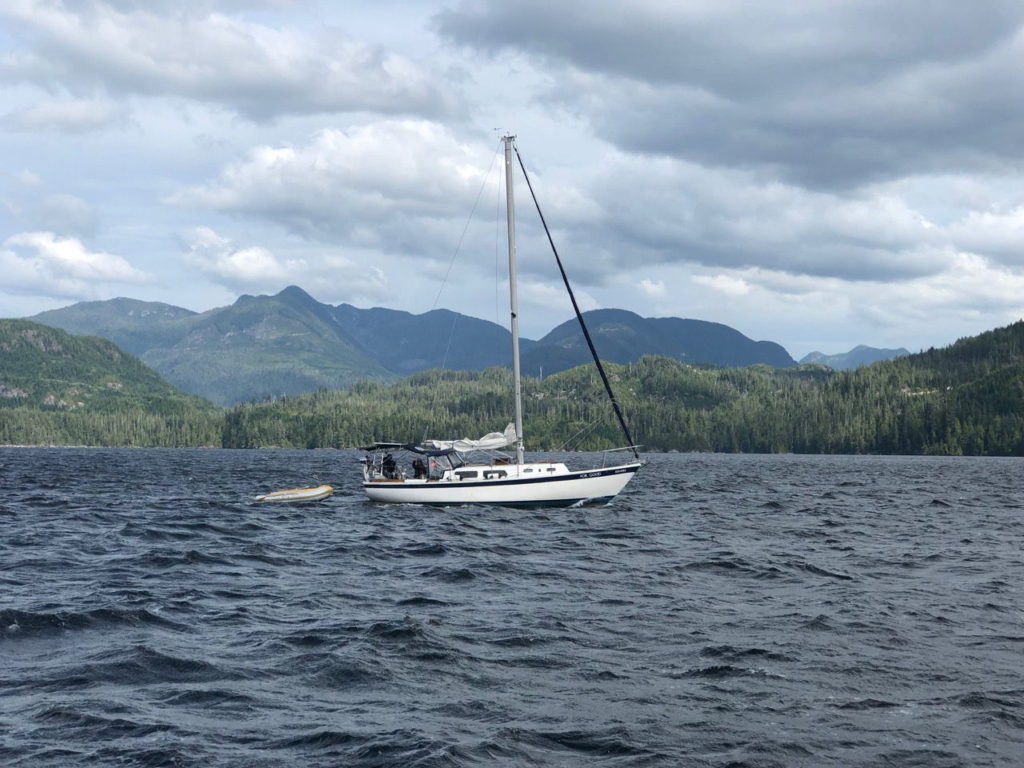
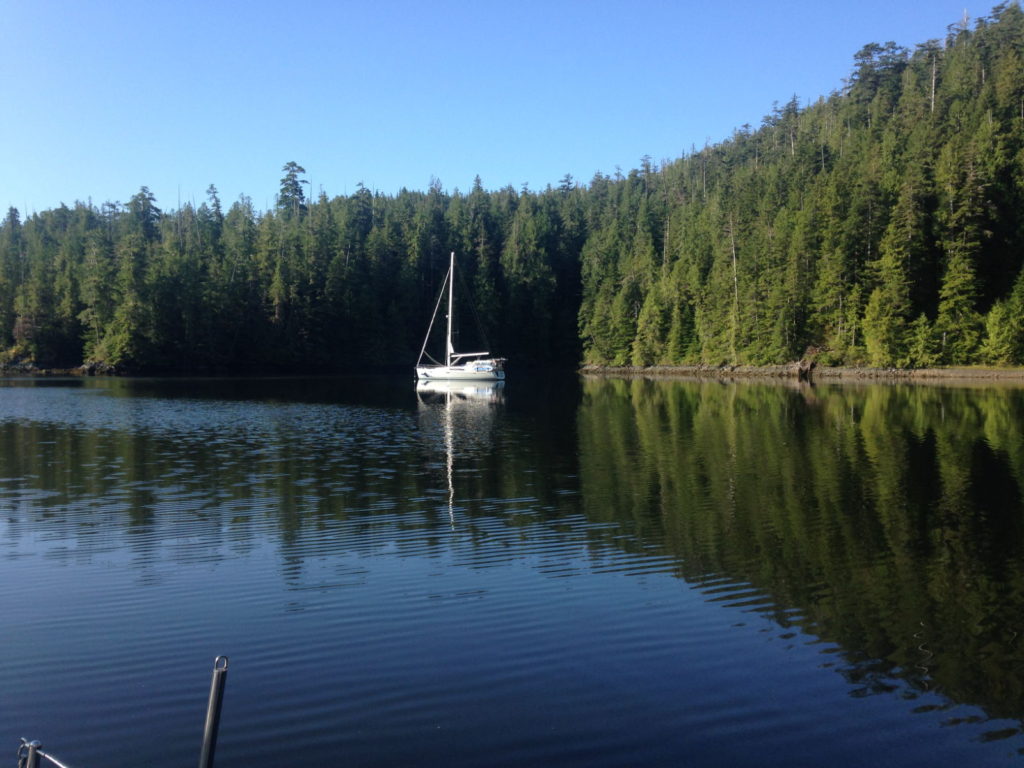
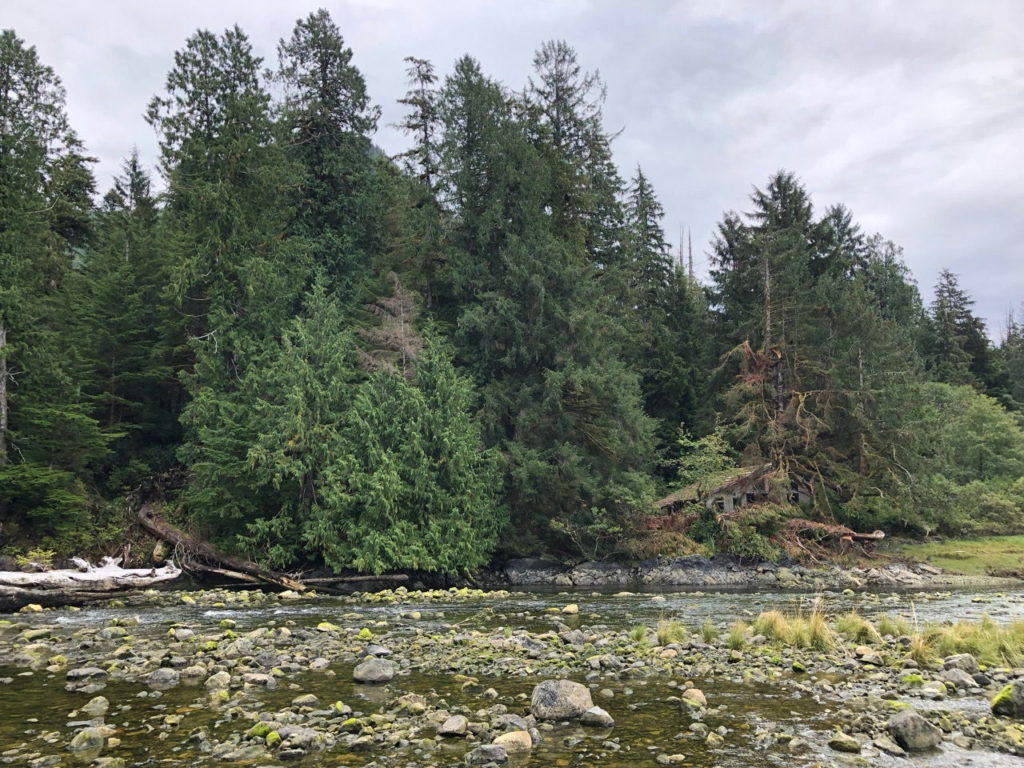
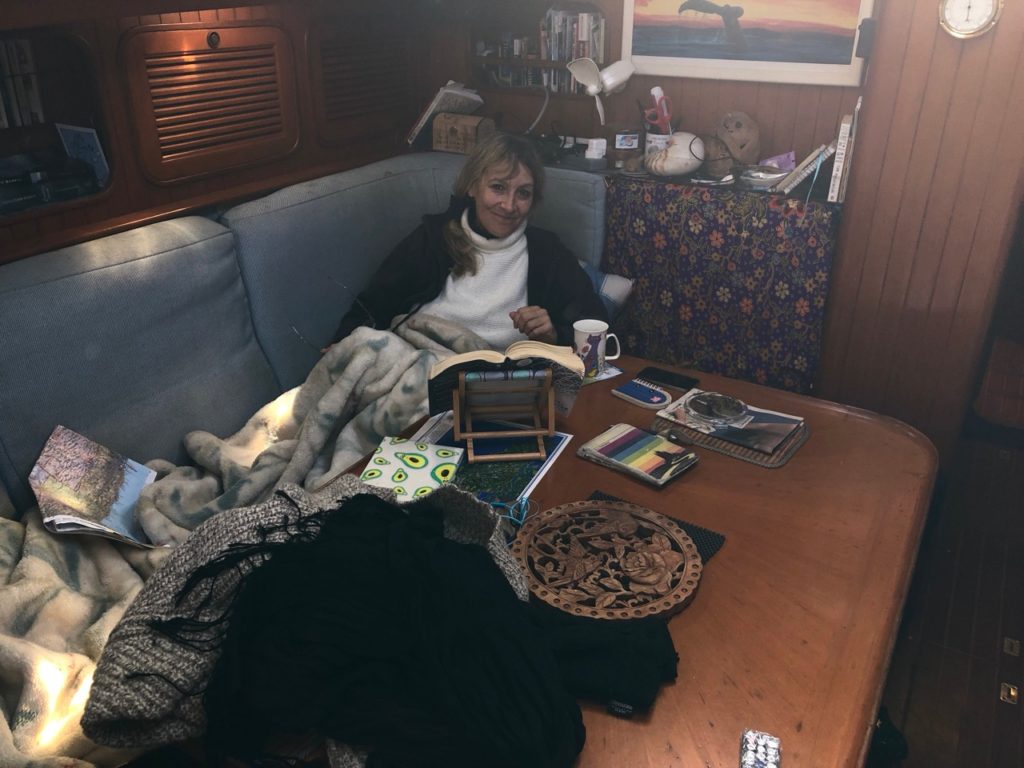
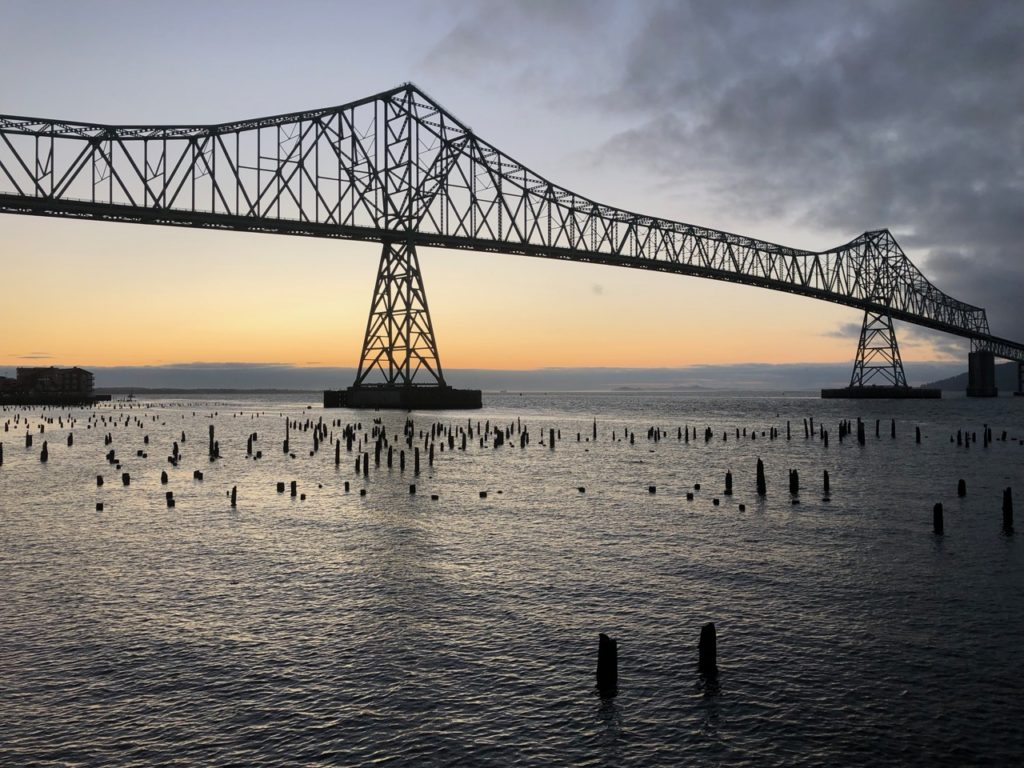
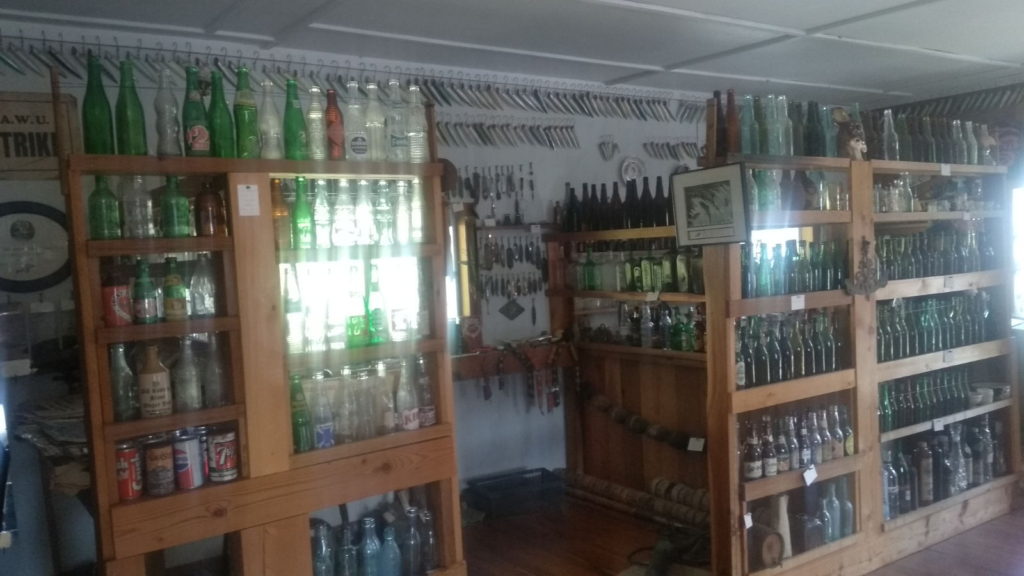
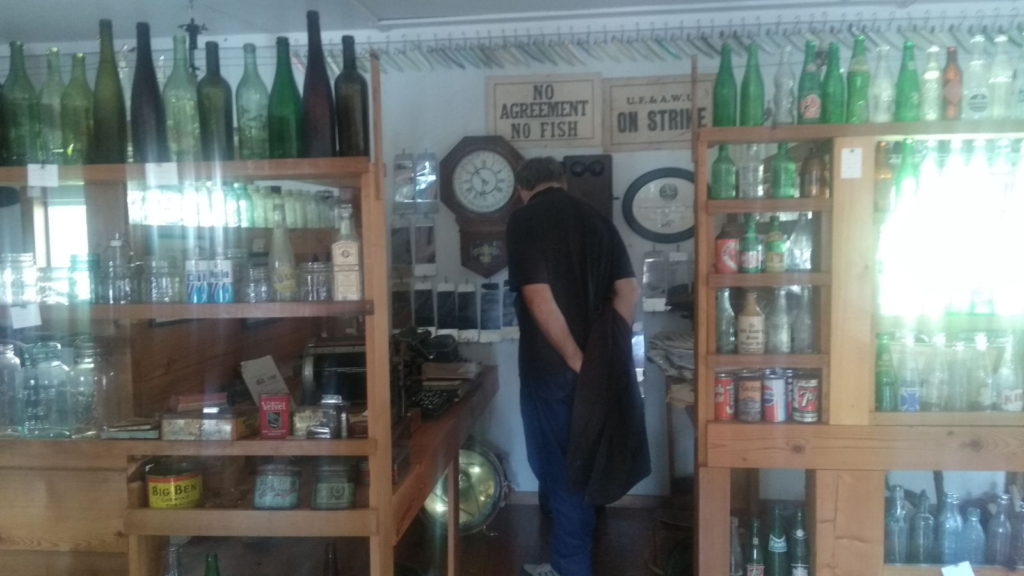
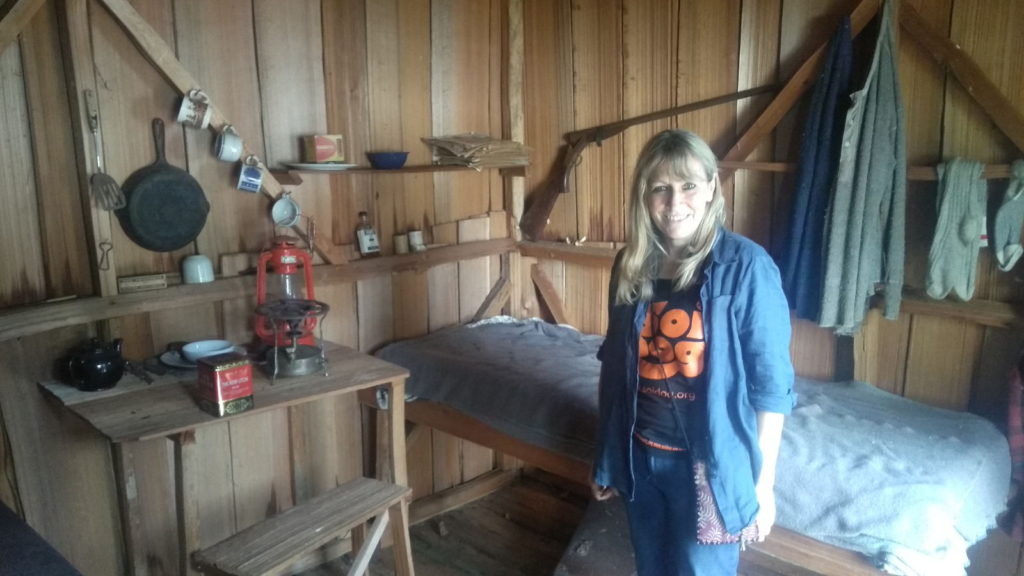
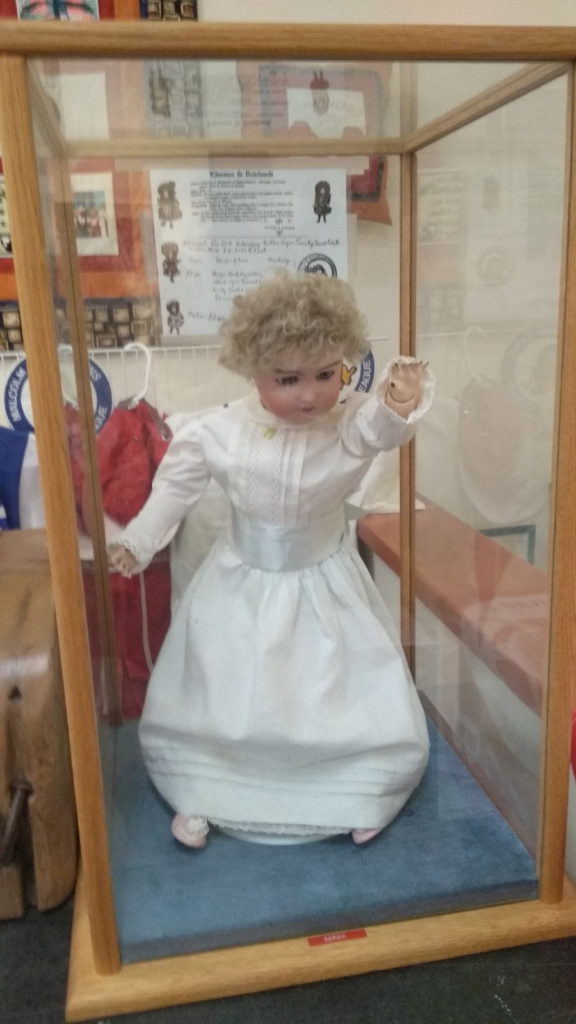
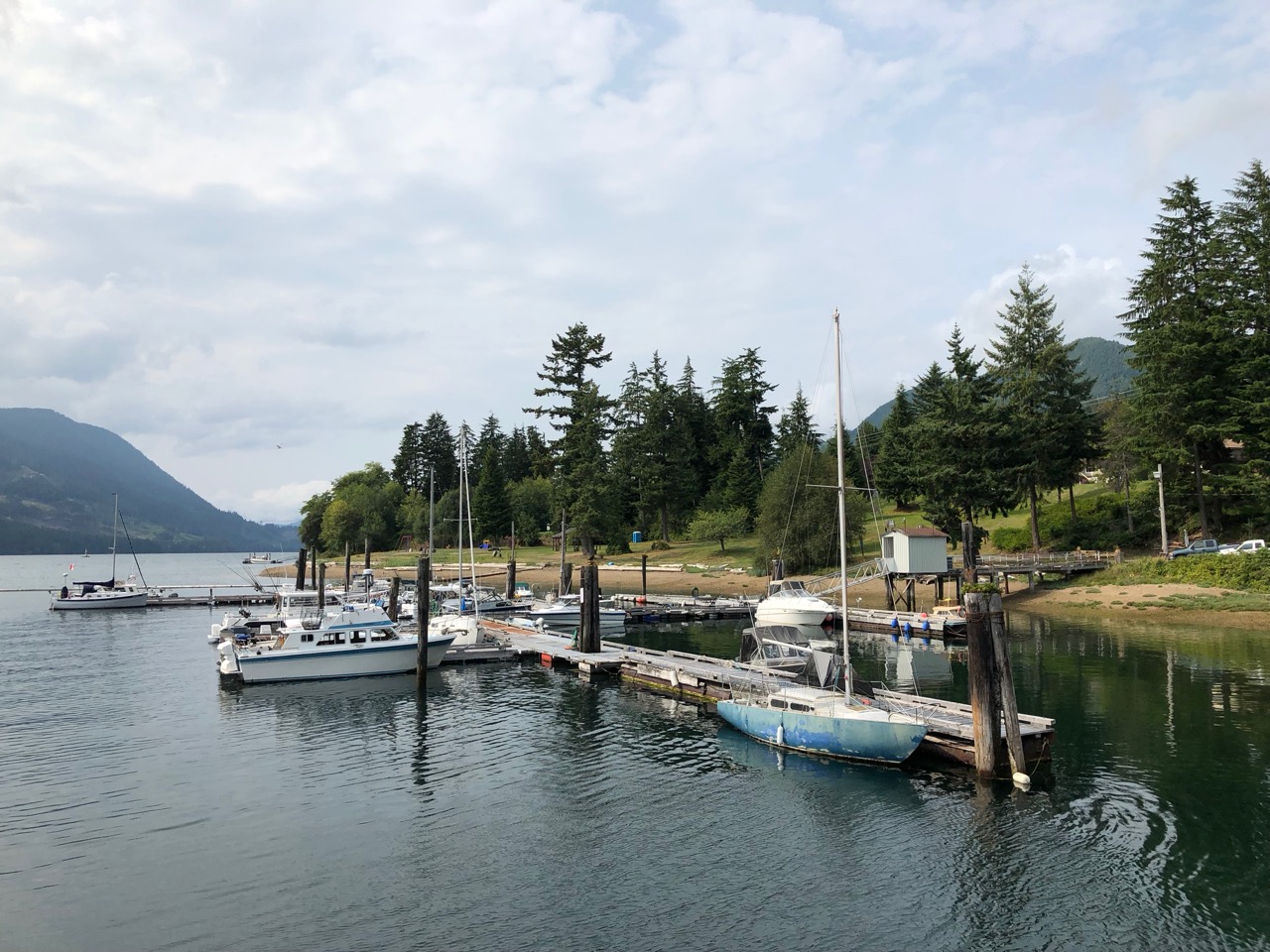
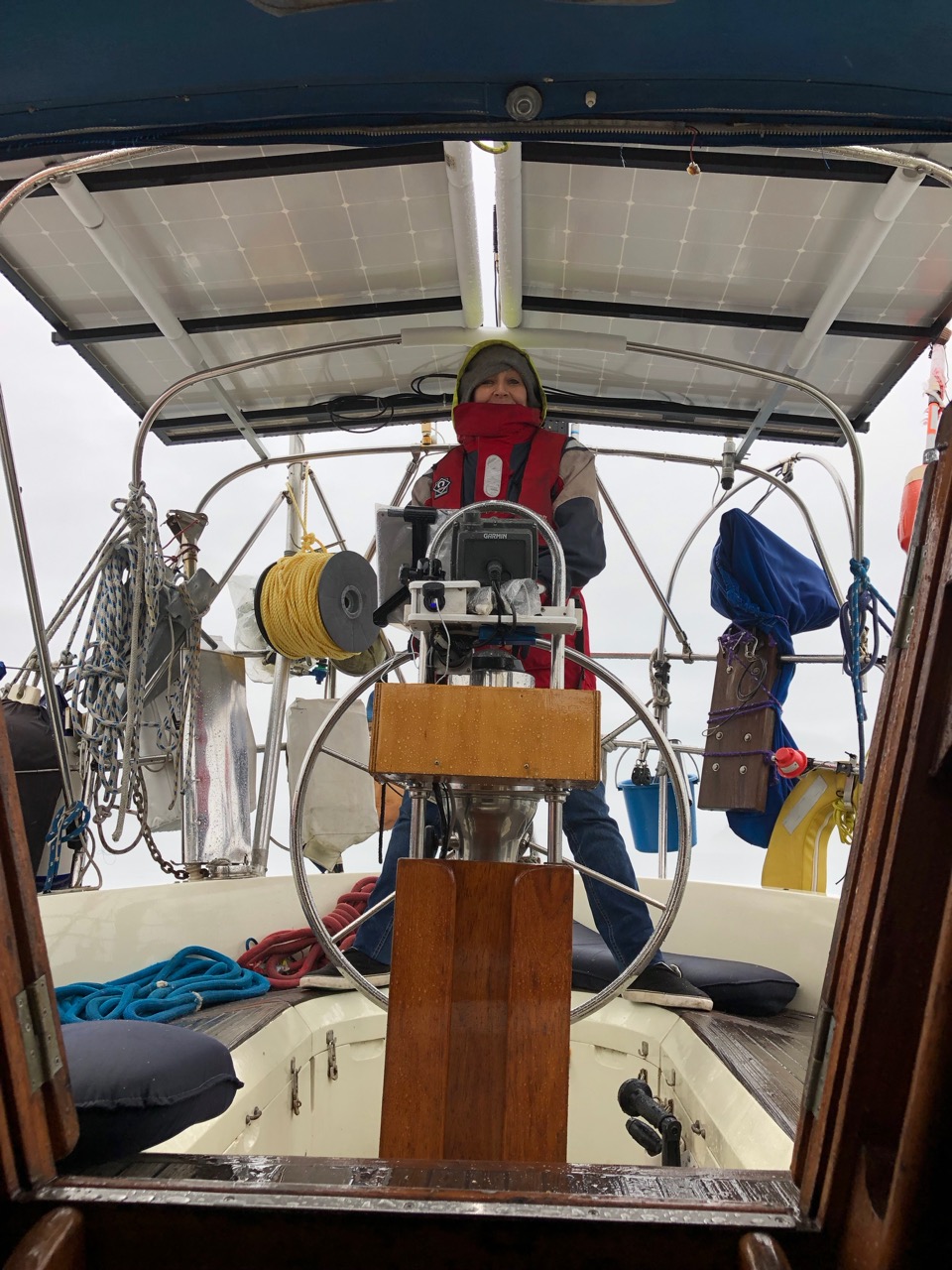
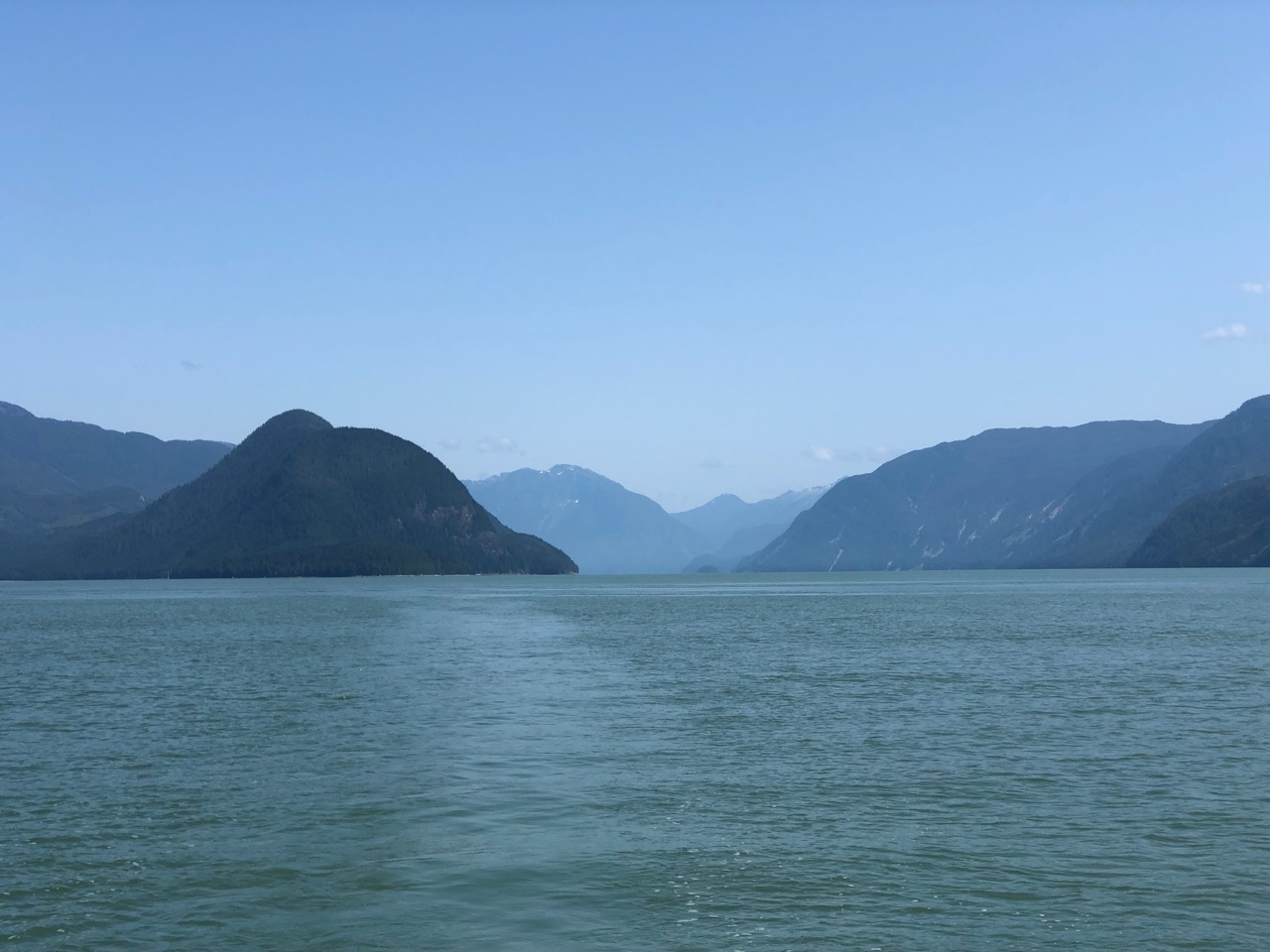
We left Astoria on the 10th September 2019 for Newport. Astoria was good, great shops and a lovely waterfront. The people there have been very friendly. Before we left we visited the heritage museum where Kathy checked out wheelchairs, she liked this model.
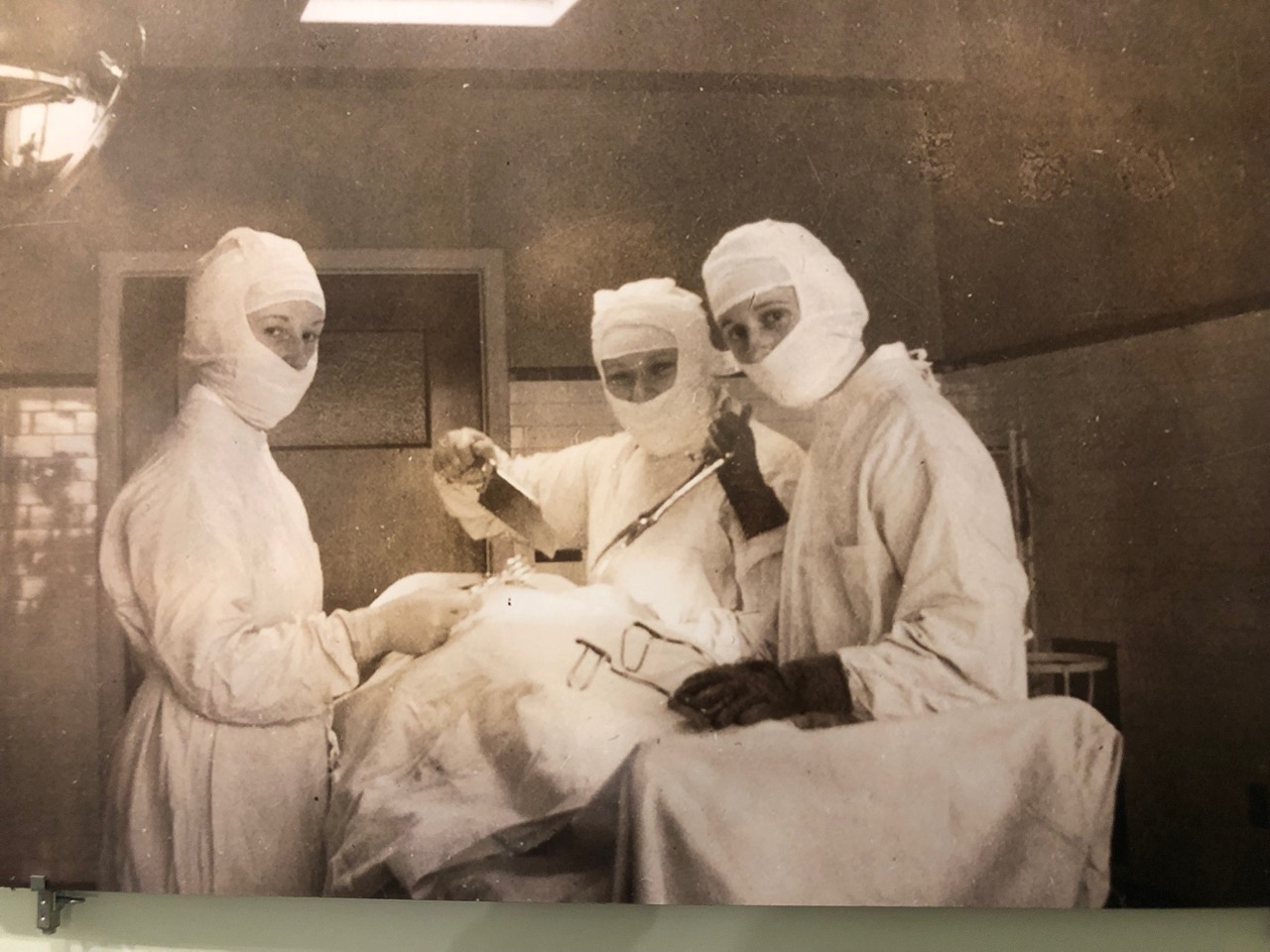
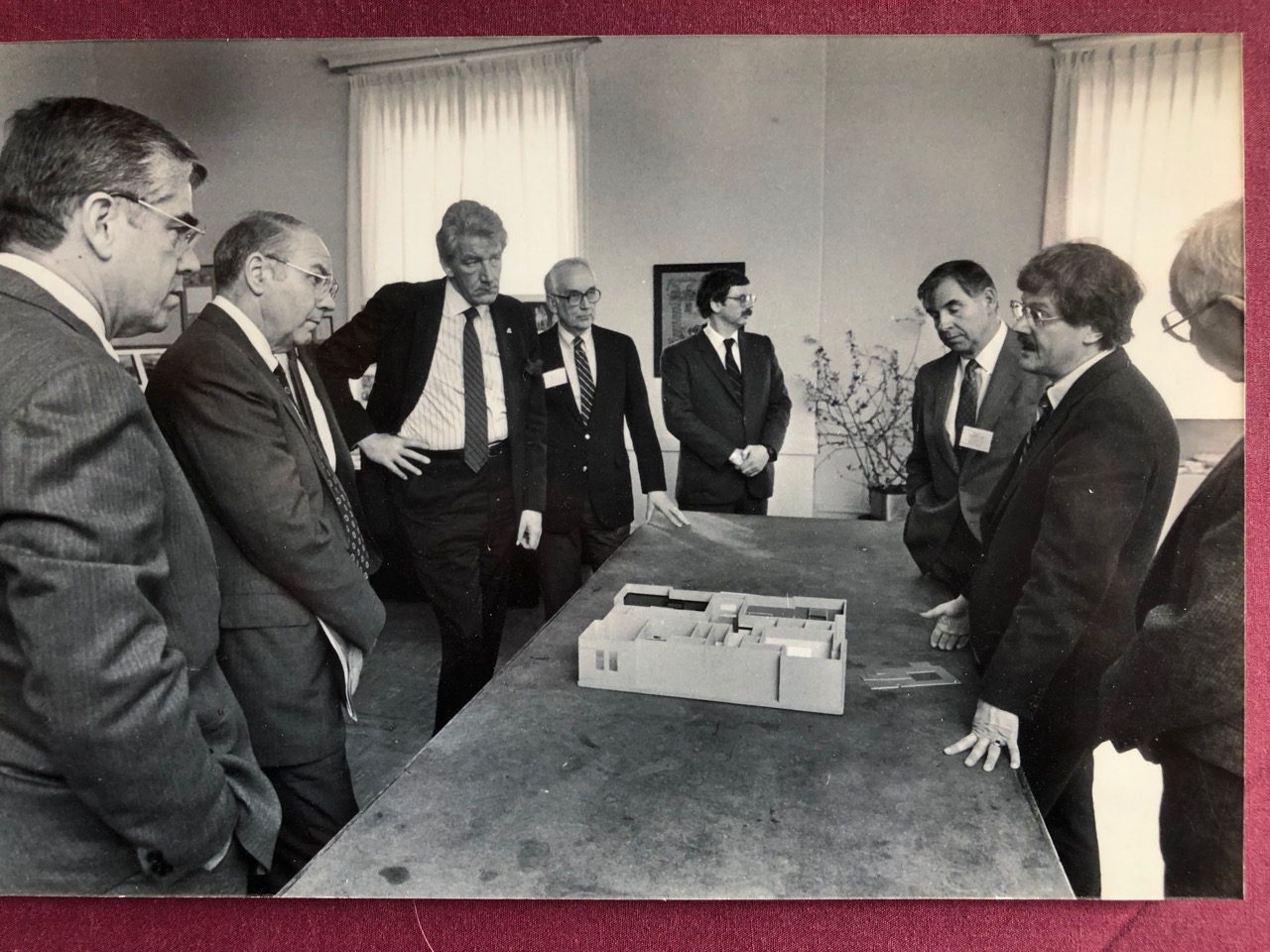
Also in the Museum they had pictures of the old hospital and below the hospital governors meet, this won’t mean much if you’re not from the UK, but Jeremy Paxman doesn’t seemed to have aged at all since then
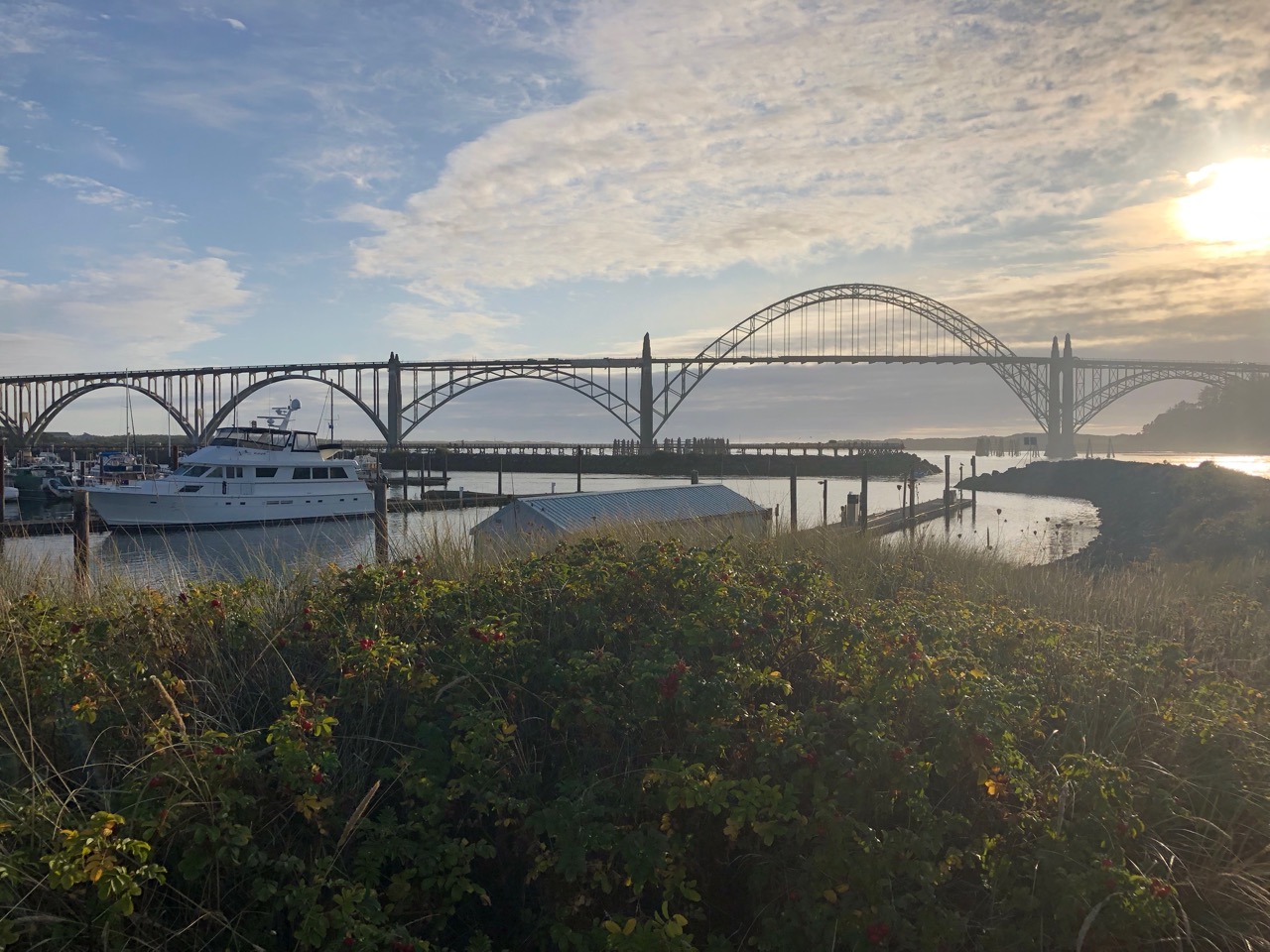
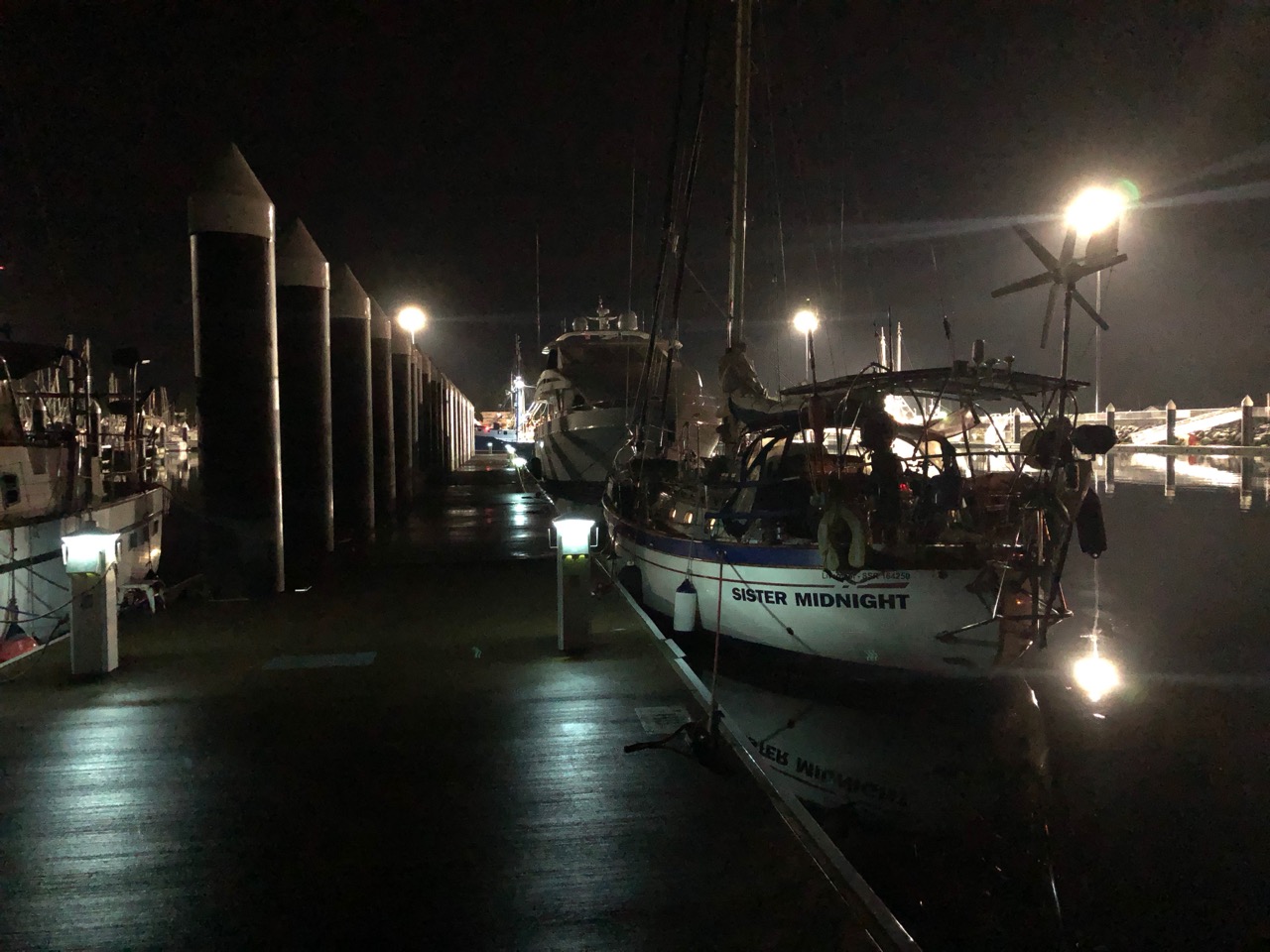
The trip to Newport meant leaving in the late afternoon so we could cross the bar on a weak flood tide. Then an overnight sail to Newport, however the timings meant we had to cross the Newport Bar at the worst time. Thankfully the weather was mild and so although the waves looked scary it was fine in the middle of the channel. Once we were under the bridge it was a short hop to the marina.
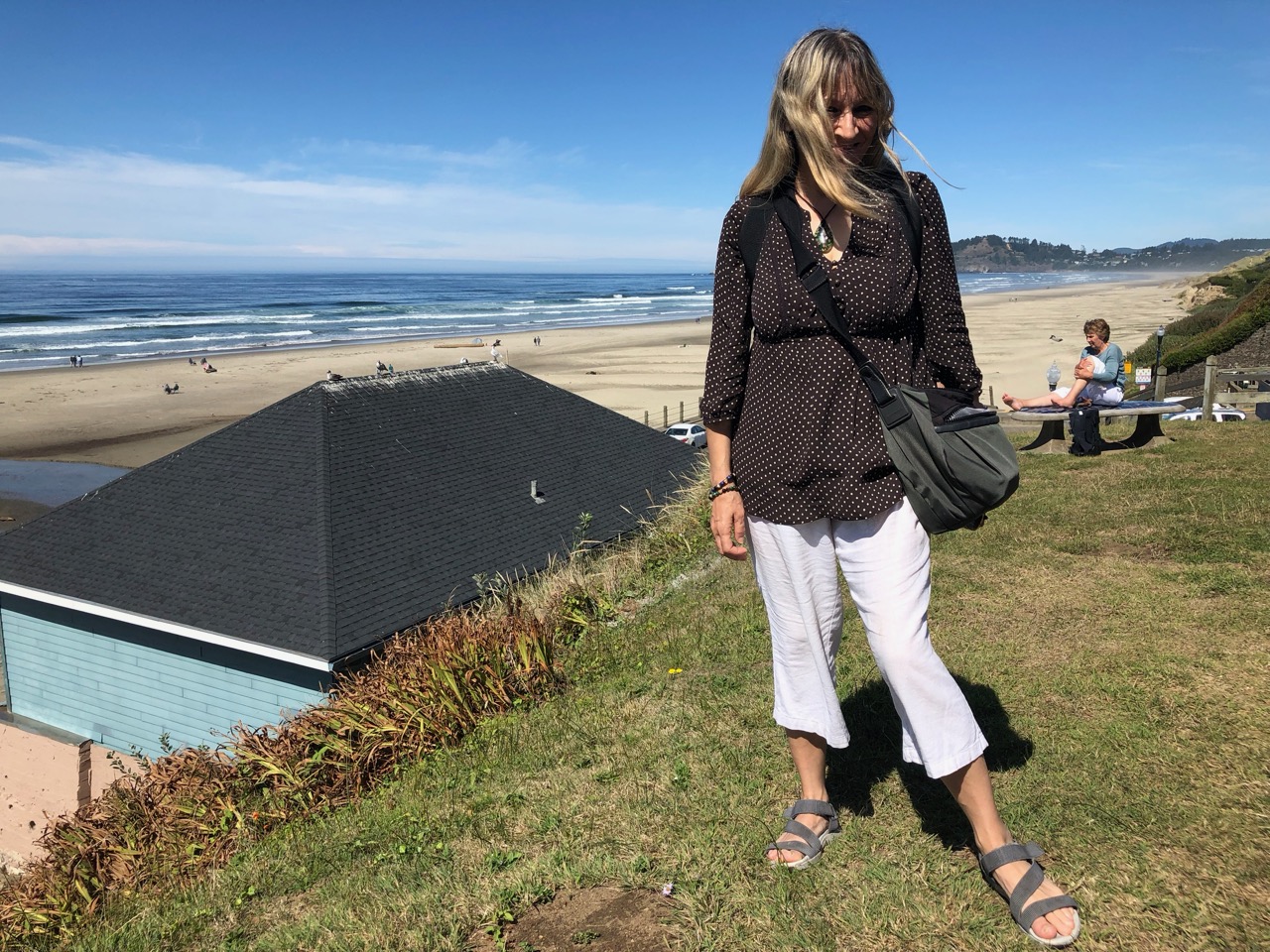
Newport is a lovely town, with 2 lighthouses and a beach. We managed to fit in all the highlights in a day’s walk around town.
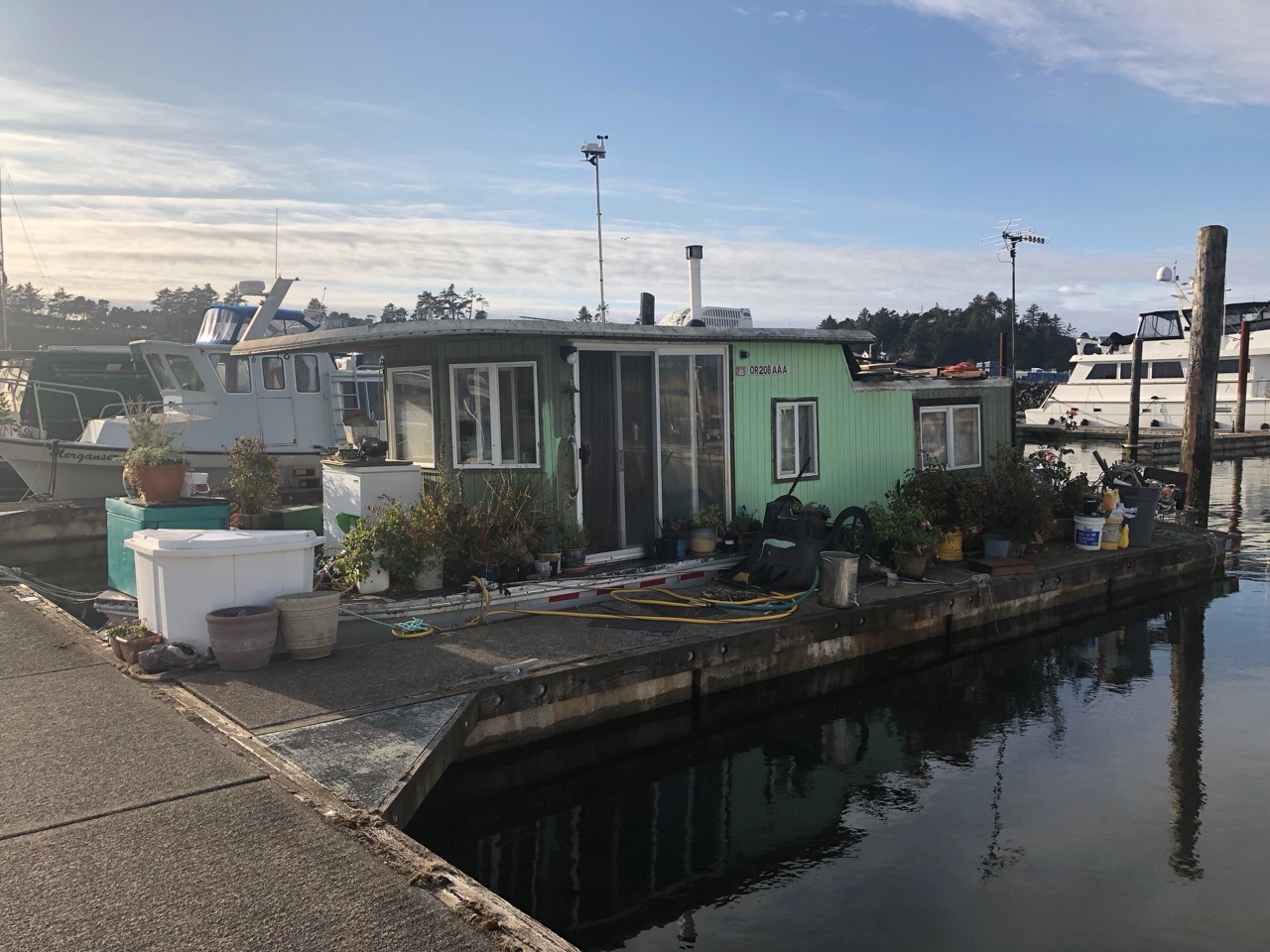
Boats come in many shapes and sizes !
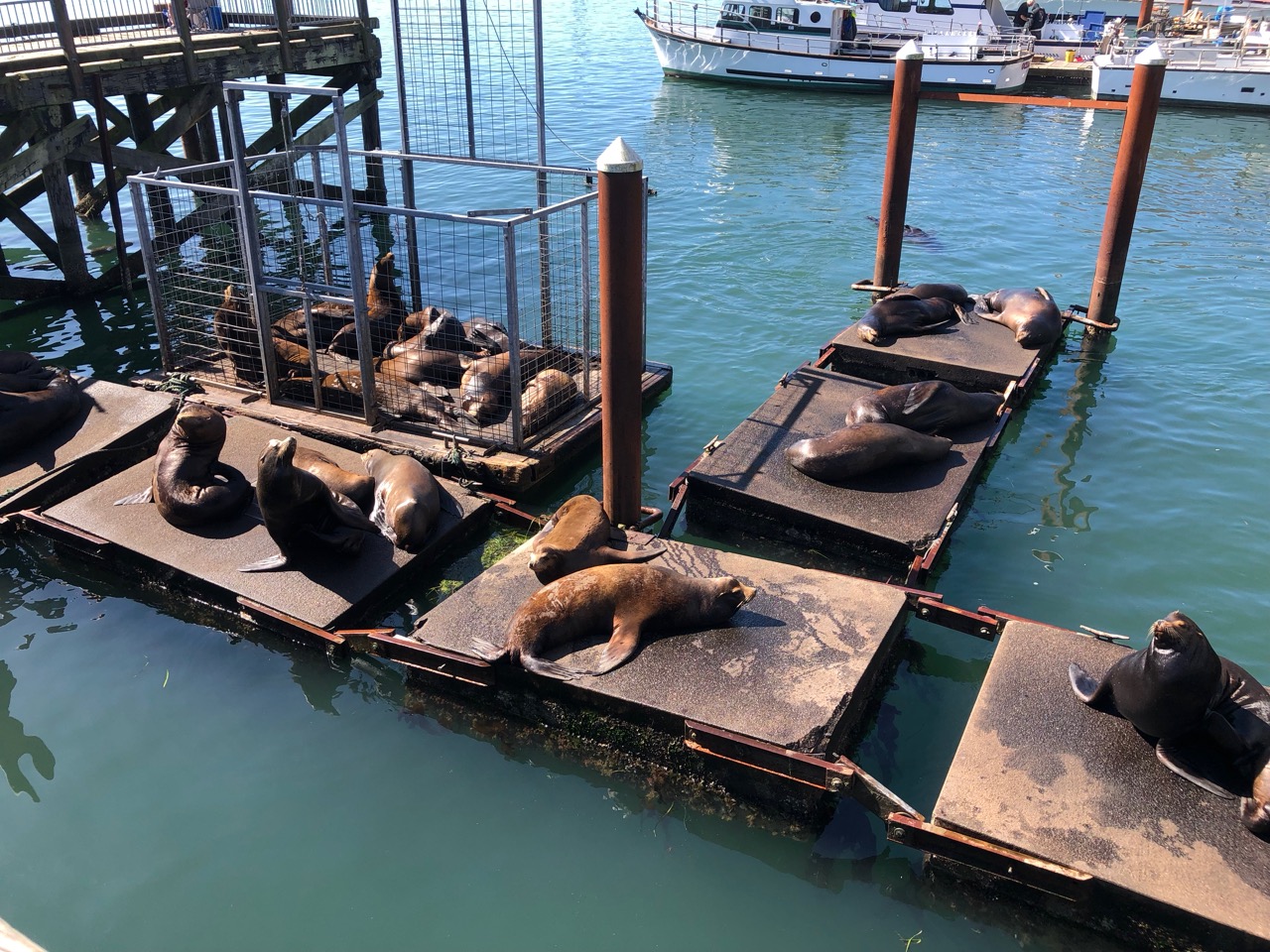
One of it’s main attractions is a group of concrete pontoons built for the sea lions. It’s a tourist draw alright, and quite amusing, however after 20 minutes we decided we should get ready for an early start to get out to Crescent City. The weather forecast wasn’t going our way.
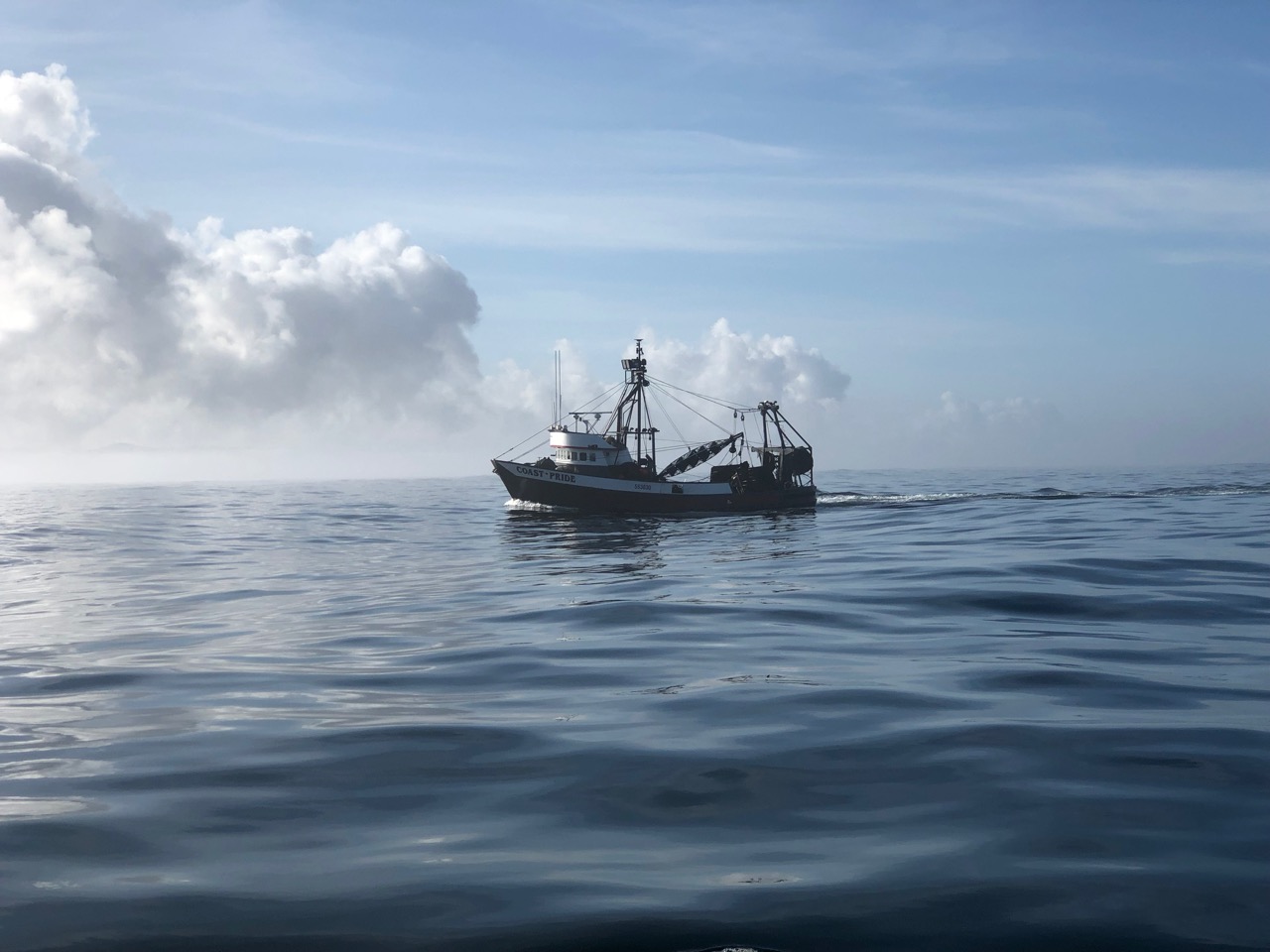
Our trip to Crescent city was uneventful, we sailed half way but the wind turned to the south and we ended up motoring the rest of the way. We saw very few boats on the way, but at night the fishing vessels seem to have very bright lights, I must find out why, but they are like football stadium lights pointing forward from the bow.
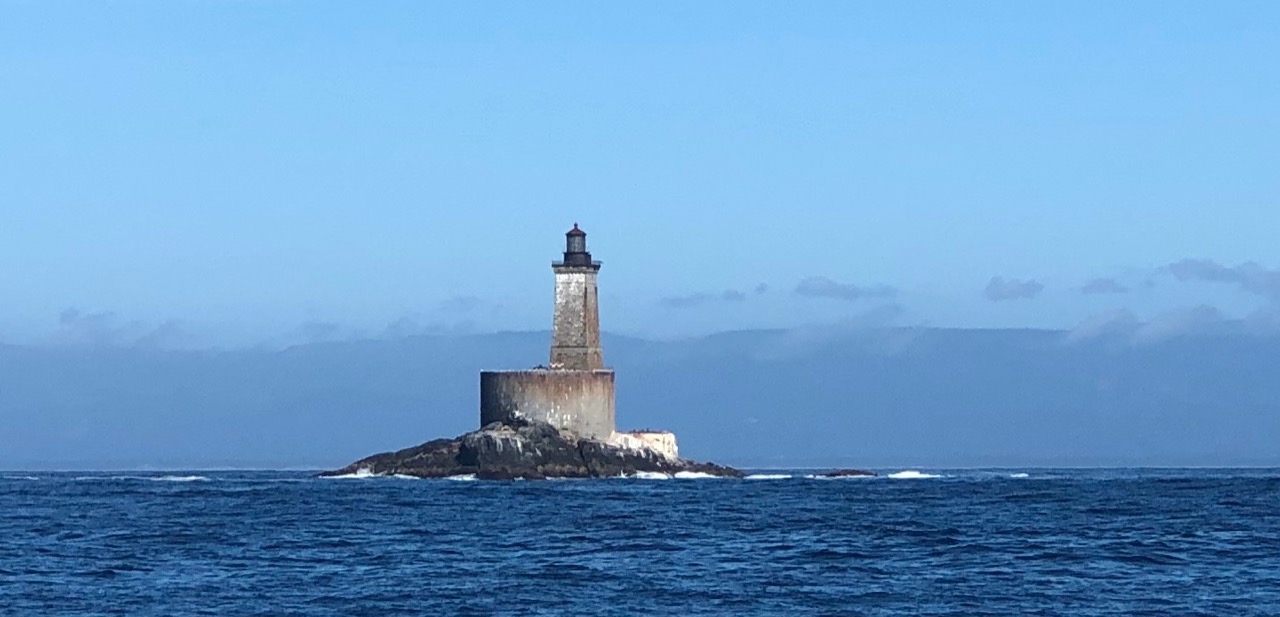
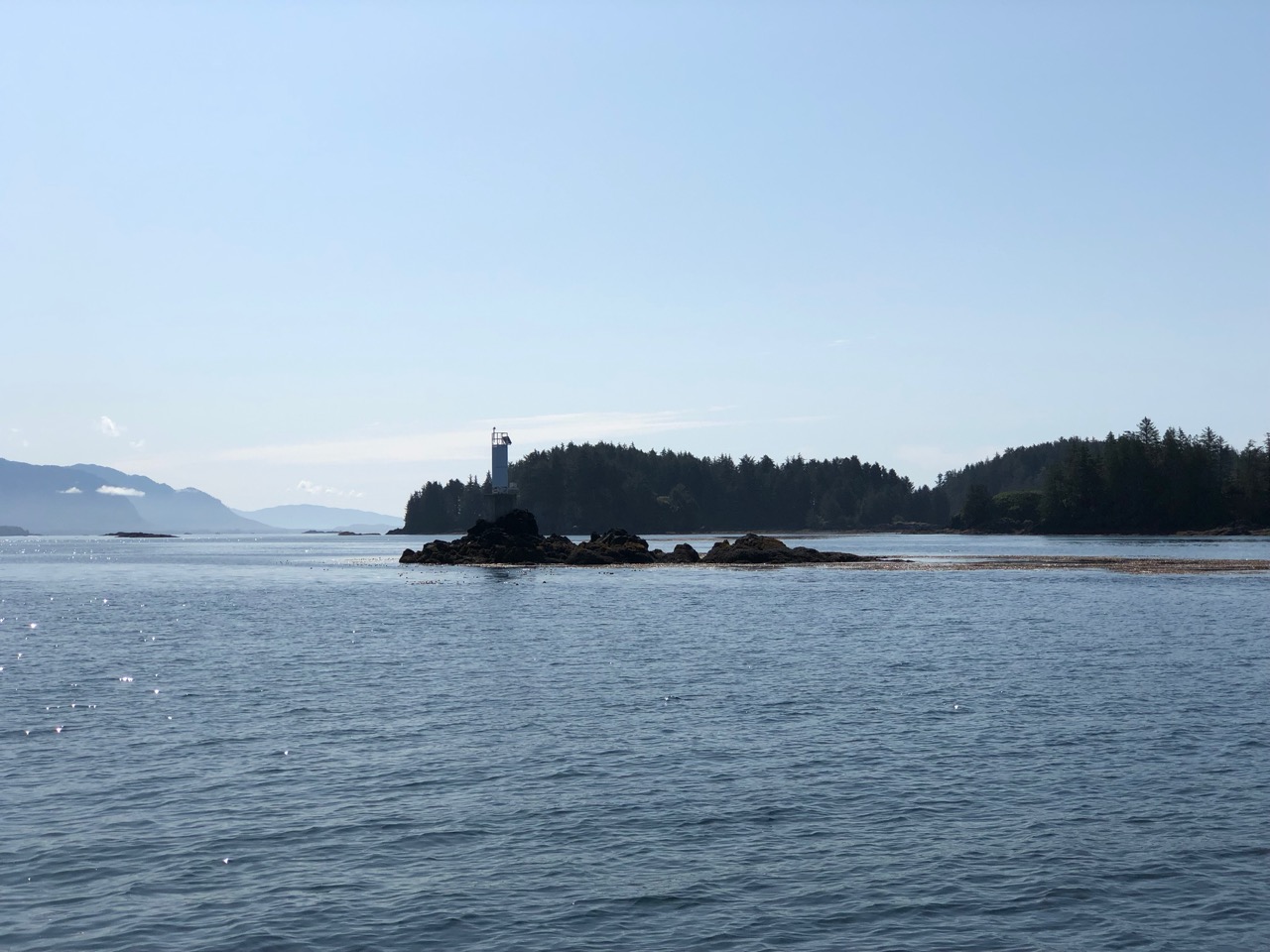
Crescent City is good, as there is no bar to worry about, but plenty of rocks all the same. The lighthouse below, as you approach the harbour isn’t on the Navionics chart, which is a bit worrying.
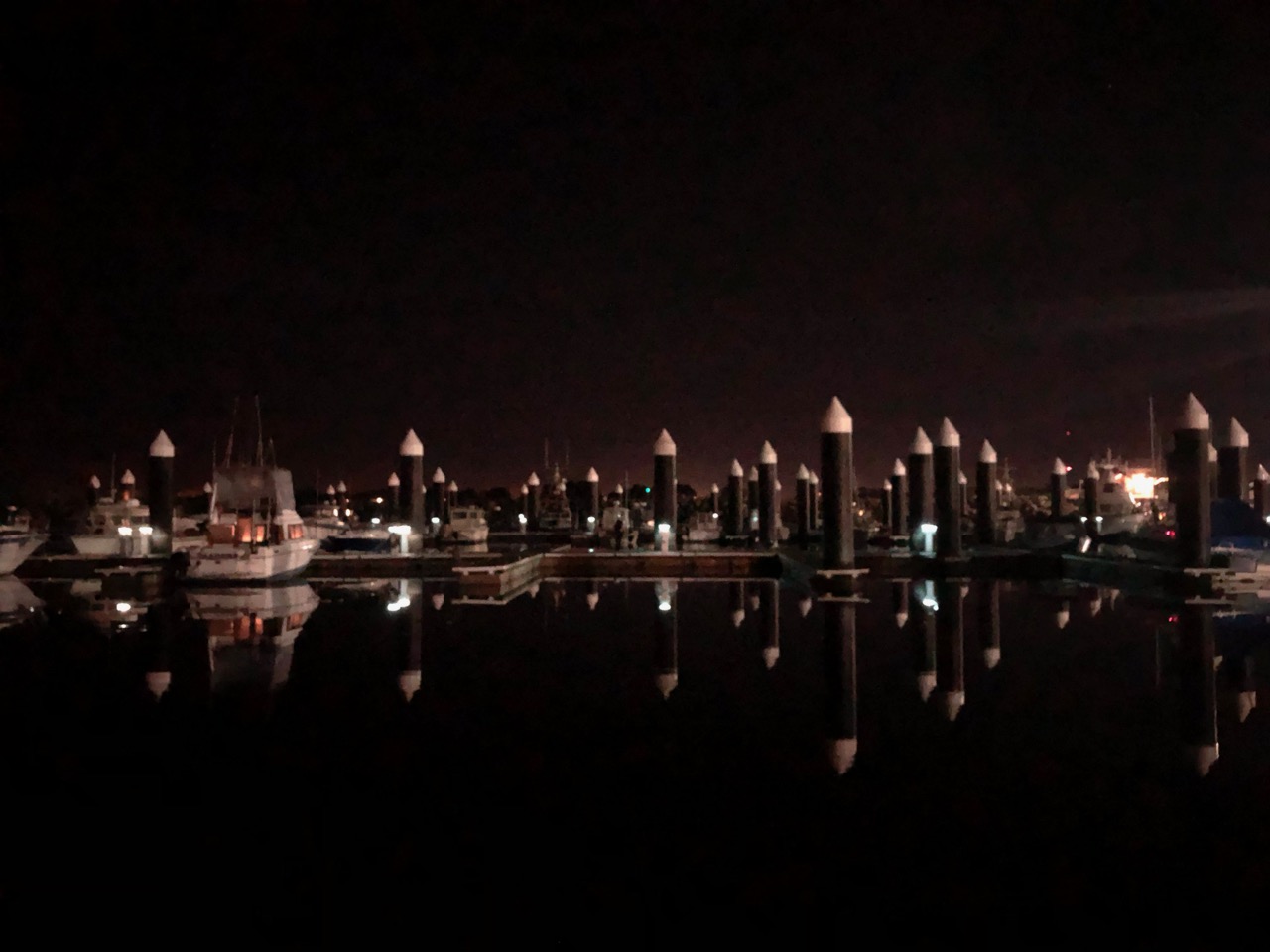
The marina was wiped out by a Tsunami from Japan in 2011 and has been rebuilt to be the strongest on the west coast. The piles and pontoons are very sturdy and twice the normal size.
Looks a bit like a clan gathering!Wide concrete pontoons
We arrived on Kathy’s birthday so went in hunt of a restaurant that might have a vegan offering, sadly Crescent City doesn’t excel in this area, and poor Kathy ended up with an ‘eat all you can’ Salad bar in a seafood cafe. She actually quite enjoyed it, she is going to have to wait until we get to San Francisco for a present from me.
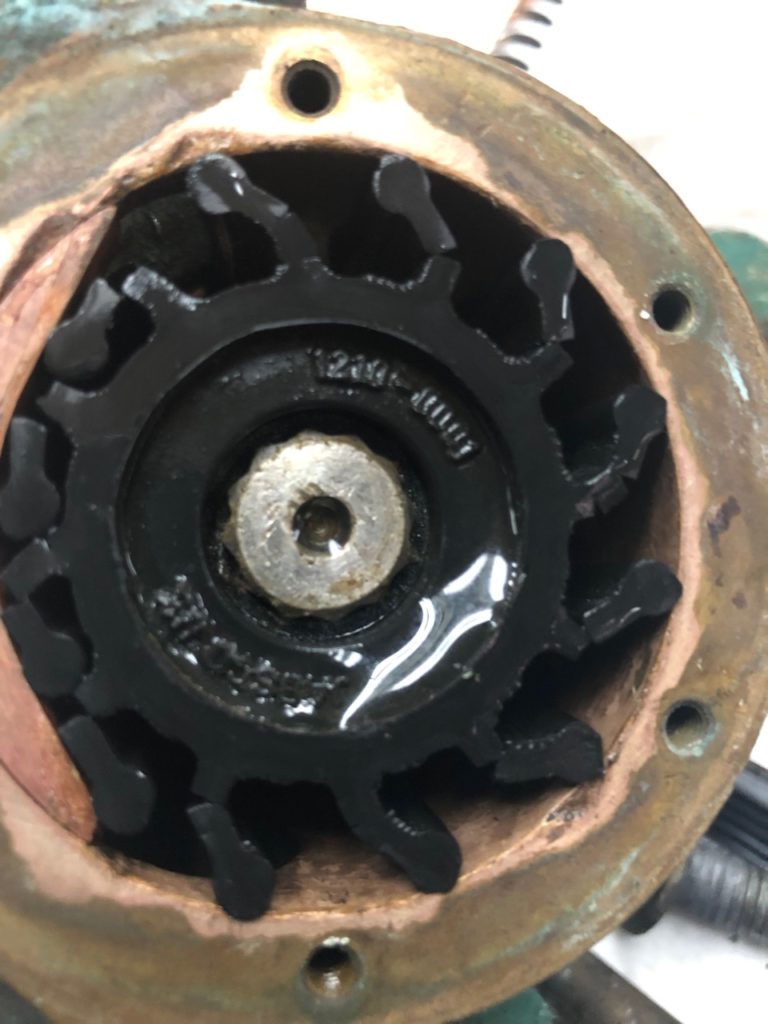
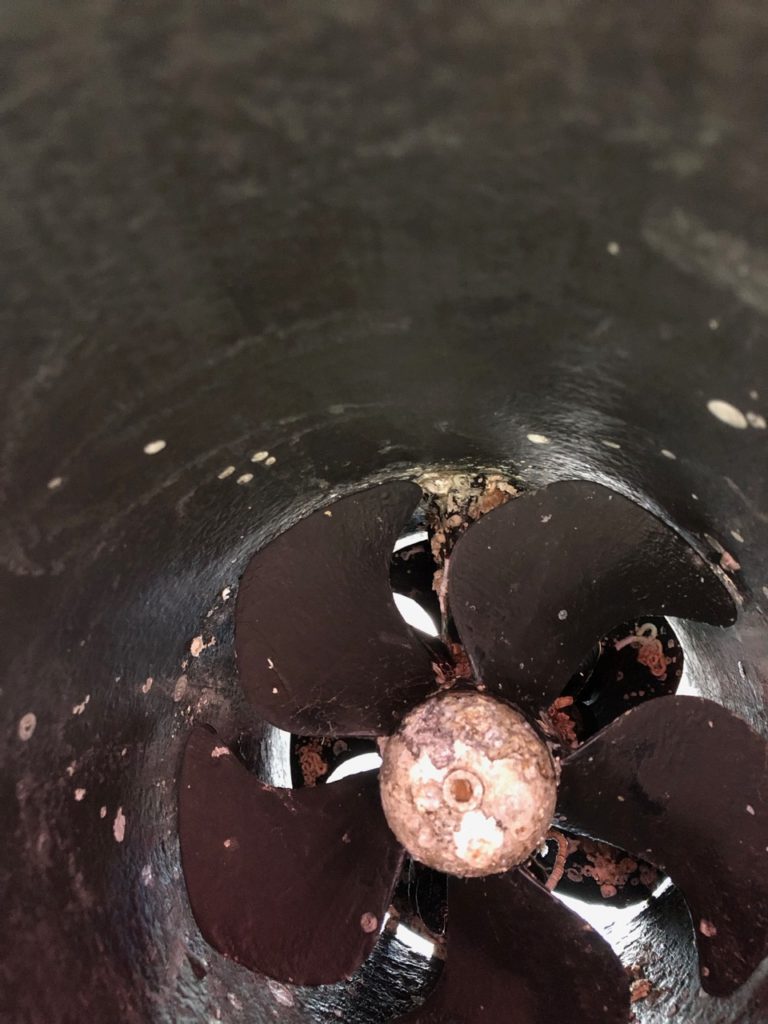
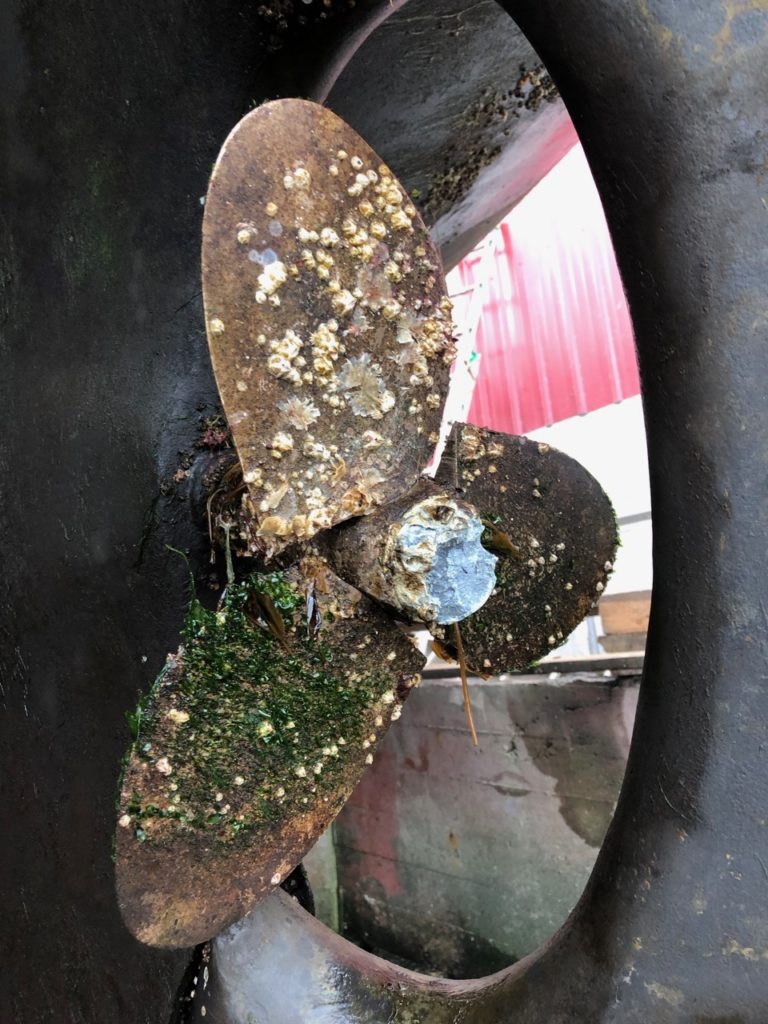
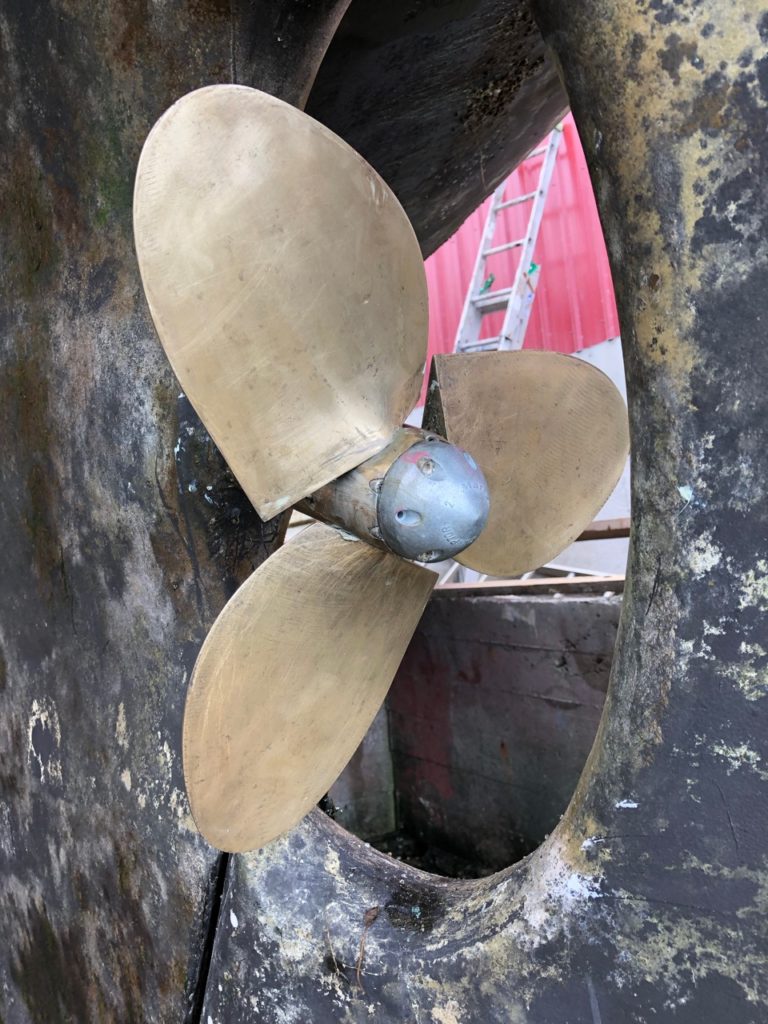
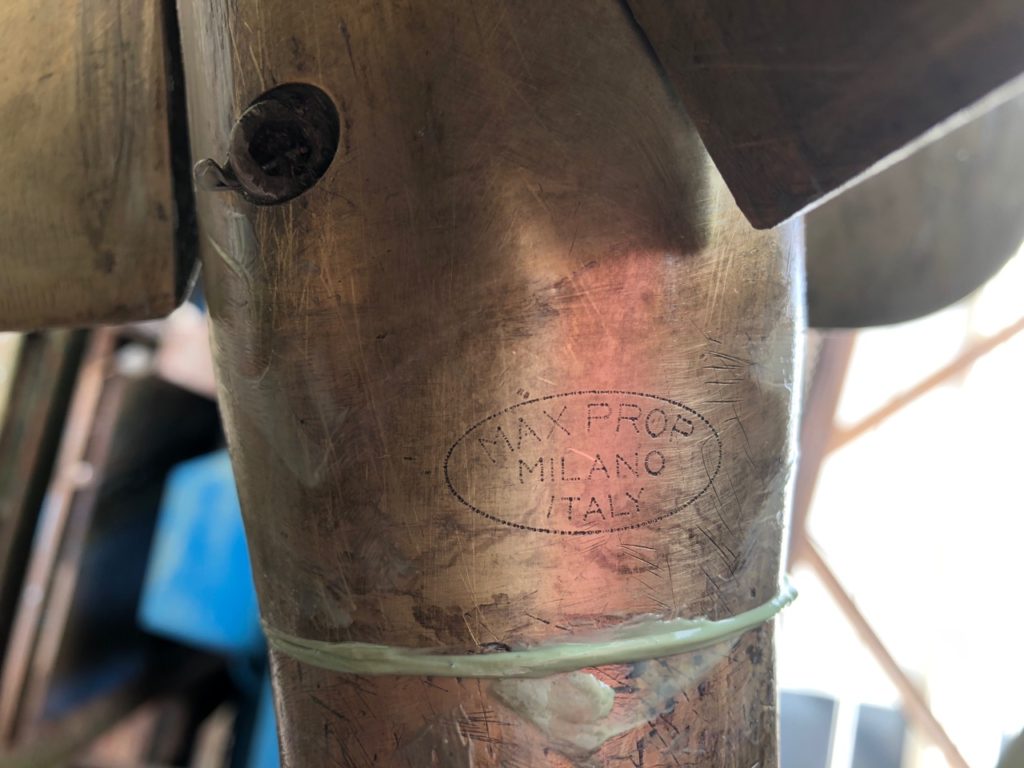
Well the pontoons at CC are great, but we didn’t get to sample any of its other delights (if they exist?), as we needed to head on early the next day in order to escape some strong southerly winds that were on the way. Also it was pouring down and the rain was predicted to last 3-5 days. I took the opportunity to check everything was ok at the back of the engine, gearbox oil and water pump, as they had had a good thrashing since I had them in bits in Sointula. I was very disappointed to find the water pump I rebuilt with the help of John in Sointula was pissing sea water out the back end. We couldn’t continue with this problem. I guessed the Lip Seal had broken, and as this was what we had just replaced, I guess the damaged shaft is the problem, so I need to buy a new pump, at around £300. Fortunately, due to me messing up on the last replacement pump kit order, I had another spare kit which included bearings and a lip seal, I just wasn’t sure if I had the tools to replace it on board. As it turned out it was quite easy and 4 hours later the pump was back on the engine and running fine without any leaks. The oil cooler I replaced also seemed good along with the gearbox oil level. However the Impeller hadn’t fared too well, I’m not sure why, as it was also new back in April, only 200 engine hours ago.
Yikes.
So at 7:30AM we left Crescent City for Fort Bragg / Noyo River. I kept a close eye on the water pump for the whole passage and it seems to be holding up. Hopefully it will get us to SF where I can get a new pump ordered and fitted. We had to motor the whole way, but once around Cape Mendocino the wind dropped and the sun shone bright, it really felt like we had arrived in a new country, suddenly for the first time in a long time it was t-shirt weather. We were assigned a berth, B5, by the harbour master, but ended up mooring three times before we found the correct berth. Mostly due to the complete lack of signage on the pontoons. There is no fuel available here, so I’m going up river in the dinghy to another harbour where I can get fuel tomorrow. We are only two days from San Francisco now, but it may be Sunday or Monday before we get there, as we are going to checkout the state park at Drakes Bay.
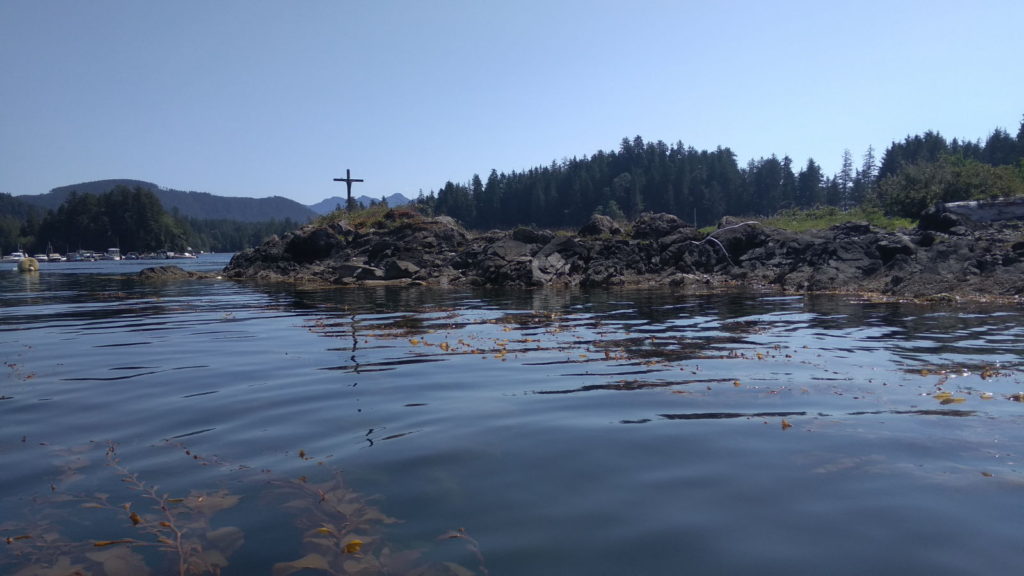
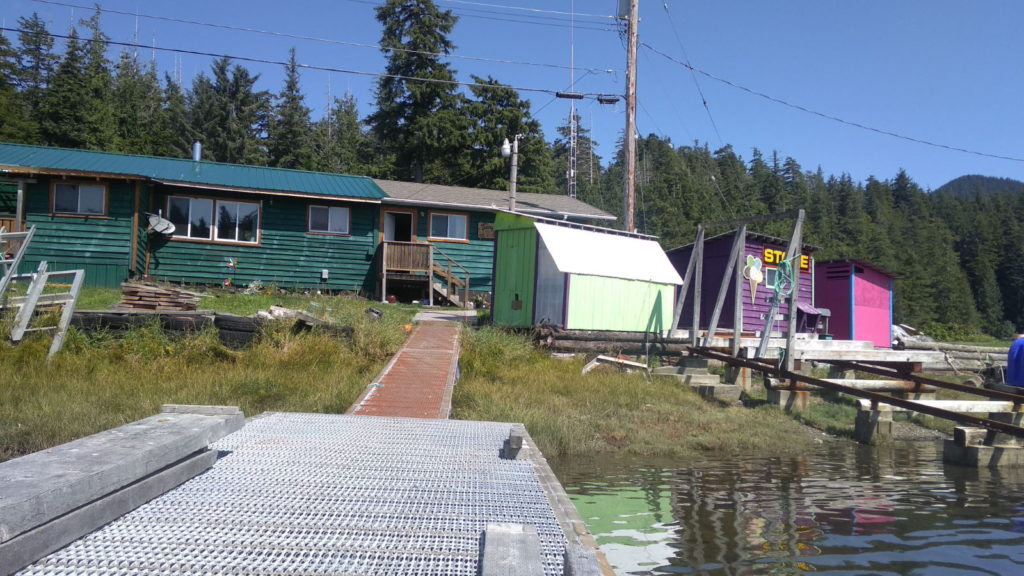
Thursday 15th August – Still in Walter’s Cove, halfway through the month and it seemed we were finally rid of Fogust’s fog. It was blisteringly hot by mid-morning when we got in the dinghy and motored over to the shore on the other side of the cove. Paul wanted to get an idea of the water’s depth for when we leave and also to have a look in the little store in the Kyuquot Native community village which we’d been looking at through the binoculars. The water is crammed with huge, sprawling seaweed plants (kelp) and I was afraid they would get tangled in the outboard’s propeller but at least the water was clear enough to see any large rocks. We tied up at the dock outside the store at the same time as a lone kayaker and had a chat with him. Hailing from The Netherlands, he had been kayaking his way around Vancouver Island for five weeks and had almost completed his journey. He told us that one night he had encountered a mother bear with cubs scarily near his tent while camping in the woods and that he often heard animal noises near him at night. We all went into the store, which was low on stock at that time but we bought cold drinks and chocolate bars and sat on the pontoon to chat some more with our new Dutch friend about our respective journeys.
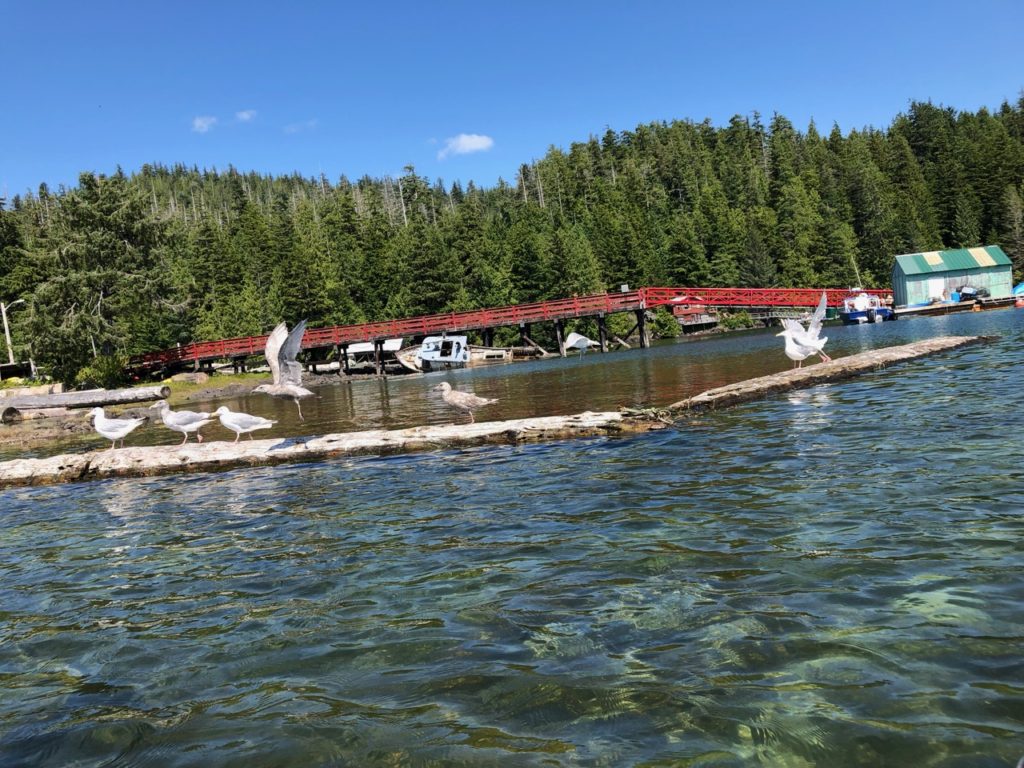
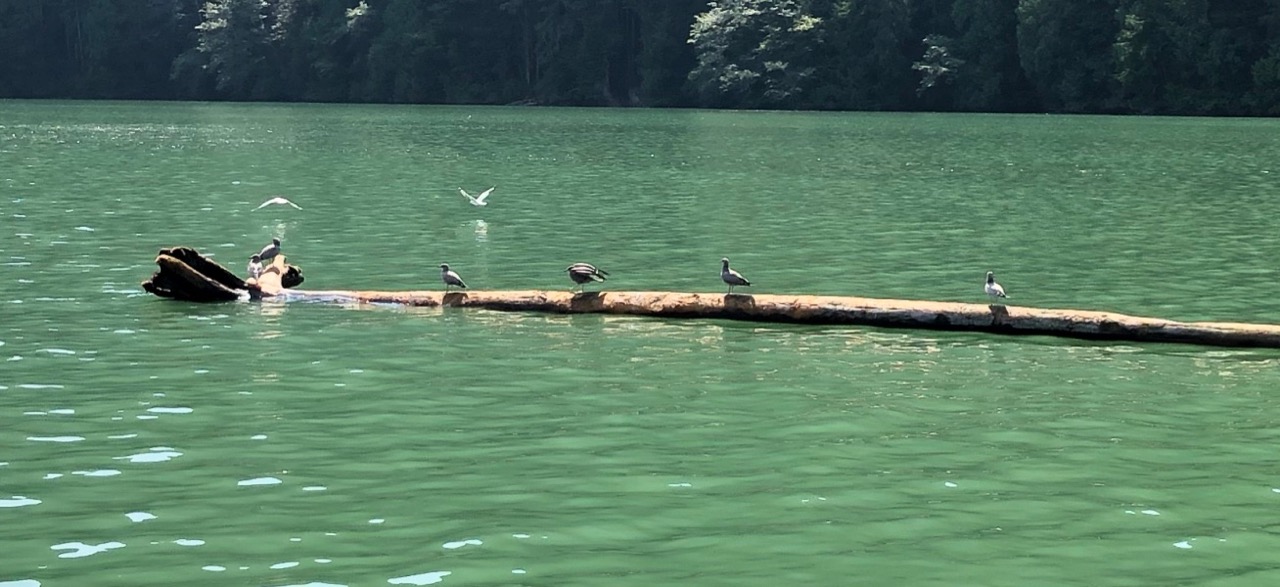
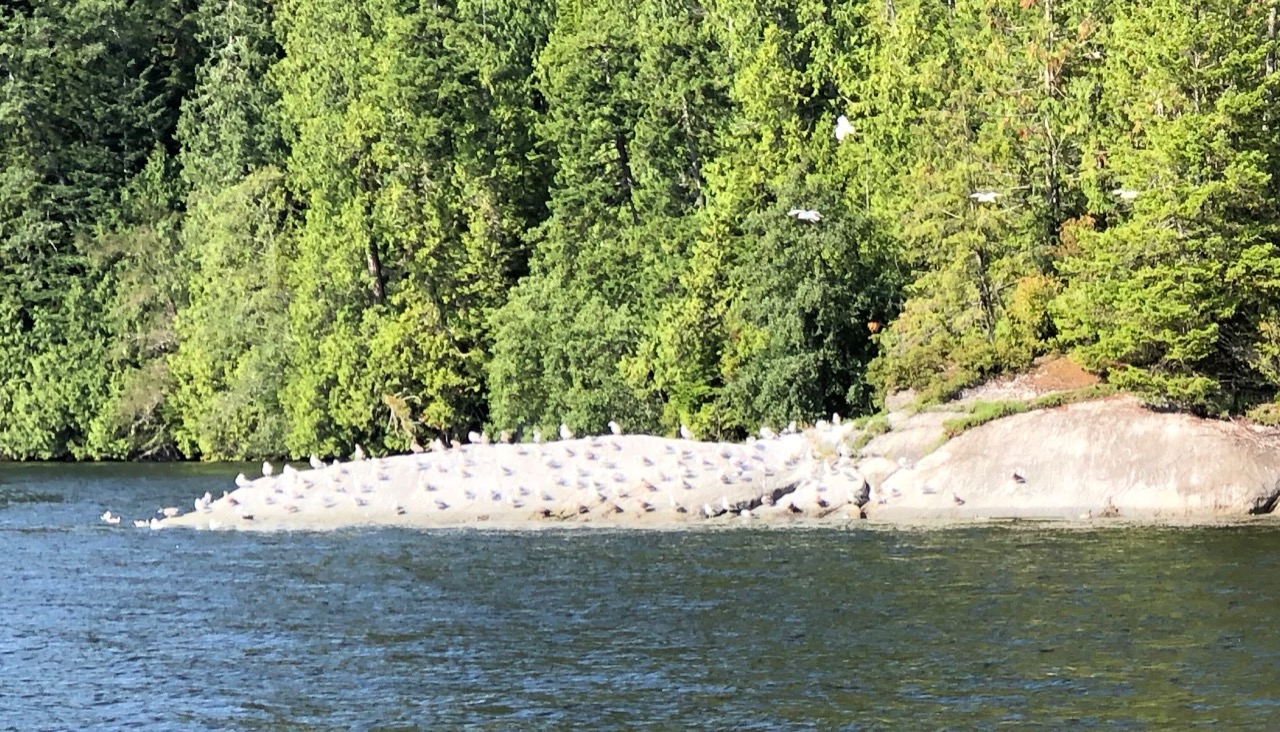
From the dinghyPathway to the little shopSeagulls often form a line up on the logs
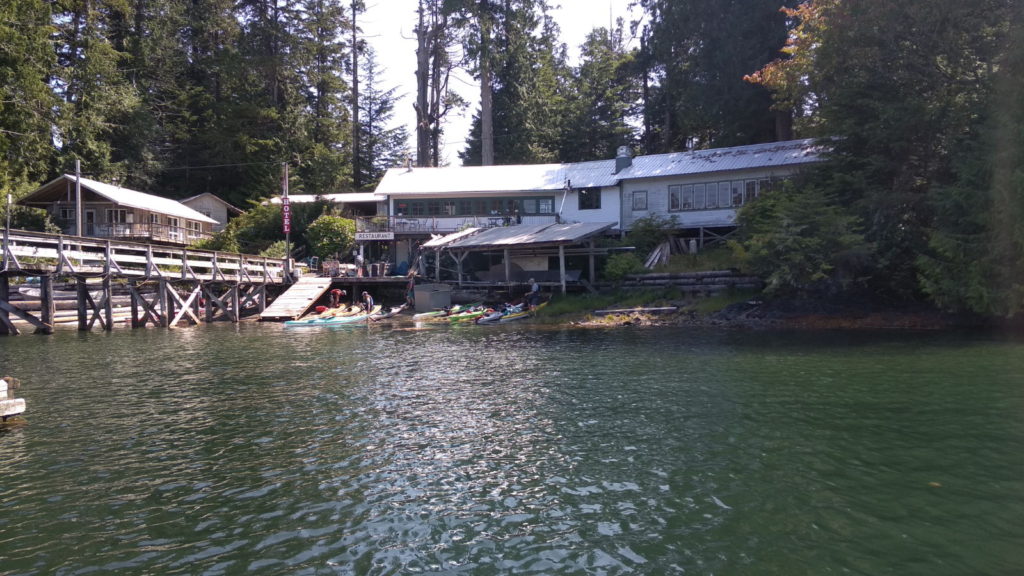
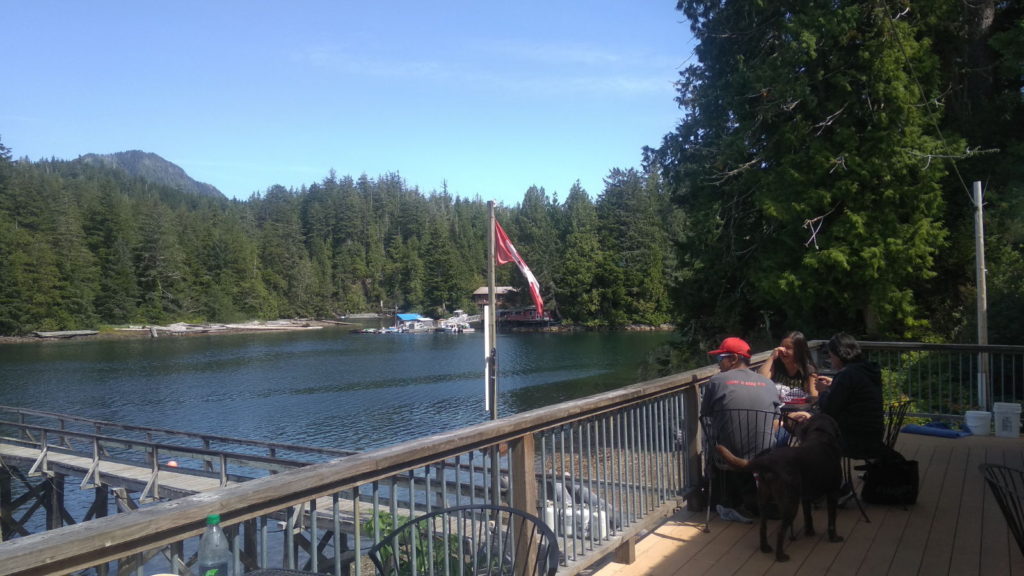
An hour or so later we tied up at Java the Hutt café to make use of their wifi. The owner lives up to his description in Waggoners Cruising Guide as one of the friendliest people on the coast, who makes a point of chatting with all his customers. He told us that the building used to operate as the village school house. Overhearing this, a First Nation lady sitting at a nearby table with her family looked across and informed us she used to attend the school back in the 70s and that she hailed from the village we’d just come from.
🙂 Java The HuttThe family we chatted with, Java the Hutt Cafe
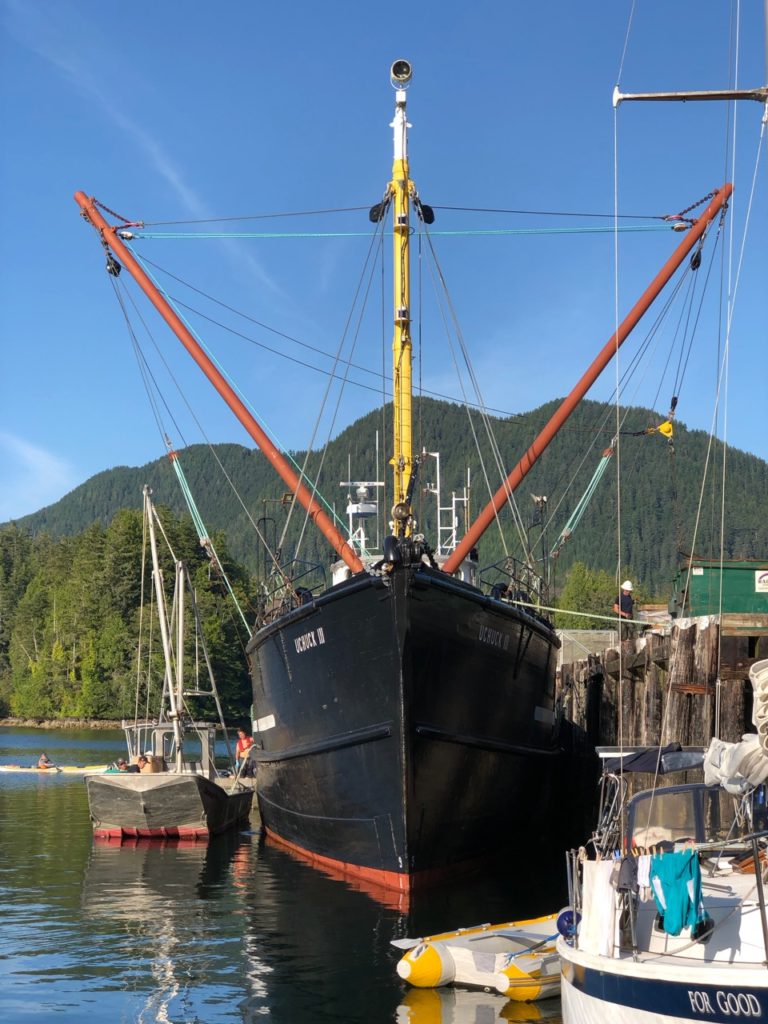
We also learned that everyone looks forward to Thursdays as it’s the day the Uchuck III arrives with supplies for local shops and businesses. For that reason the café would be closing early so we wouldn’t be able to have dinner there as planned. We opted for a late lunch at 4pm instead so that we would be back in time to watch the Uchuck dock just along from our berth. The boat also brings guests for the resort and fishing lodges and later on we sat in our cockpit watching the bustle and activity early in the evening as passengers were met, greeted and taken off to various lodges and boats, while cargo was unloaded onto skiffs and carts to be distributed around the island.
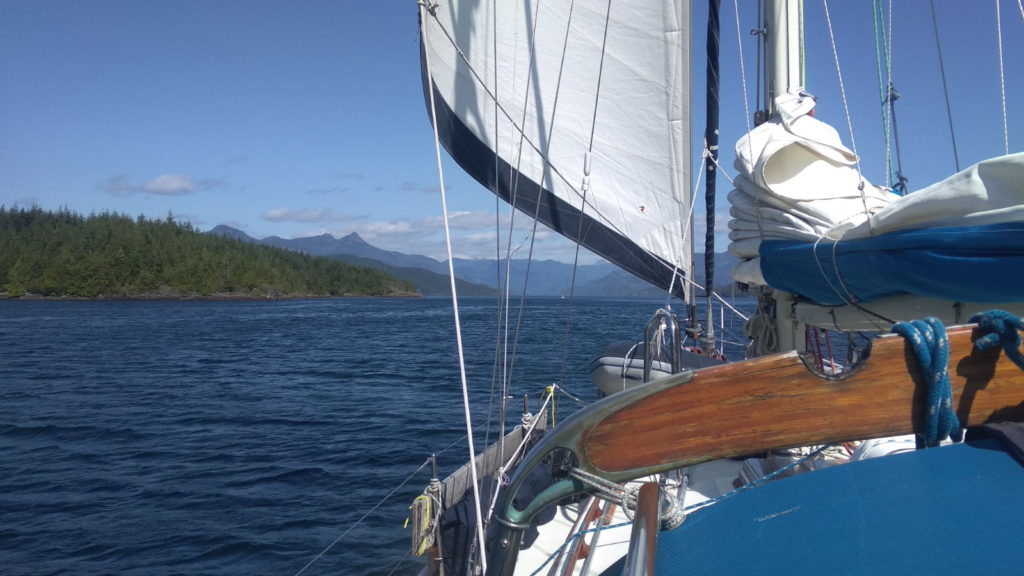
Next day we waited for the shop to open at 1pm and stocked up with a few more provisions before leaving, along with Robert and Vanessa, at 2pm for an anchorage at Dixie Cove. There was enough wind for Paul to get the headsail out, so I made the most of the peace and the gentle motion to sit at the bow enjoying the warmth and the stunning views all around me.
Leaving Walter’s Cove
For Good took the lead on this trip and were already anchored in the outer cove when we arrived at 5 o’clock. We went further in to the inner cove and just as we were setting the anchor, a motor boat sped up alongside us to warn that they were logging in the forest opposite and not to be alarmed by loud explosions. I’m glad he told us because the noise when it came about 30 minutes later was extremely loud and seemed to me to shake the whole boat! Thankfully there were no more after that one. We dinghied over to For Good with some beer to discuss the trip for the following day, getting back to ours just before it got dark. Despite the warmer weather it gets very chilly once the sun goes down, and it seemed ages before we got back into the warmth of the boat.
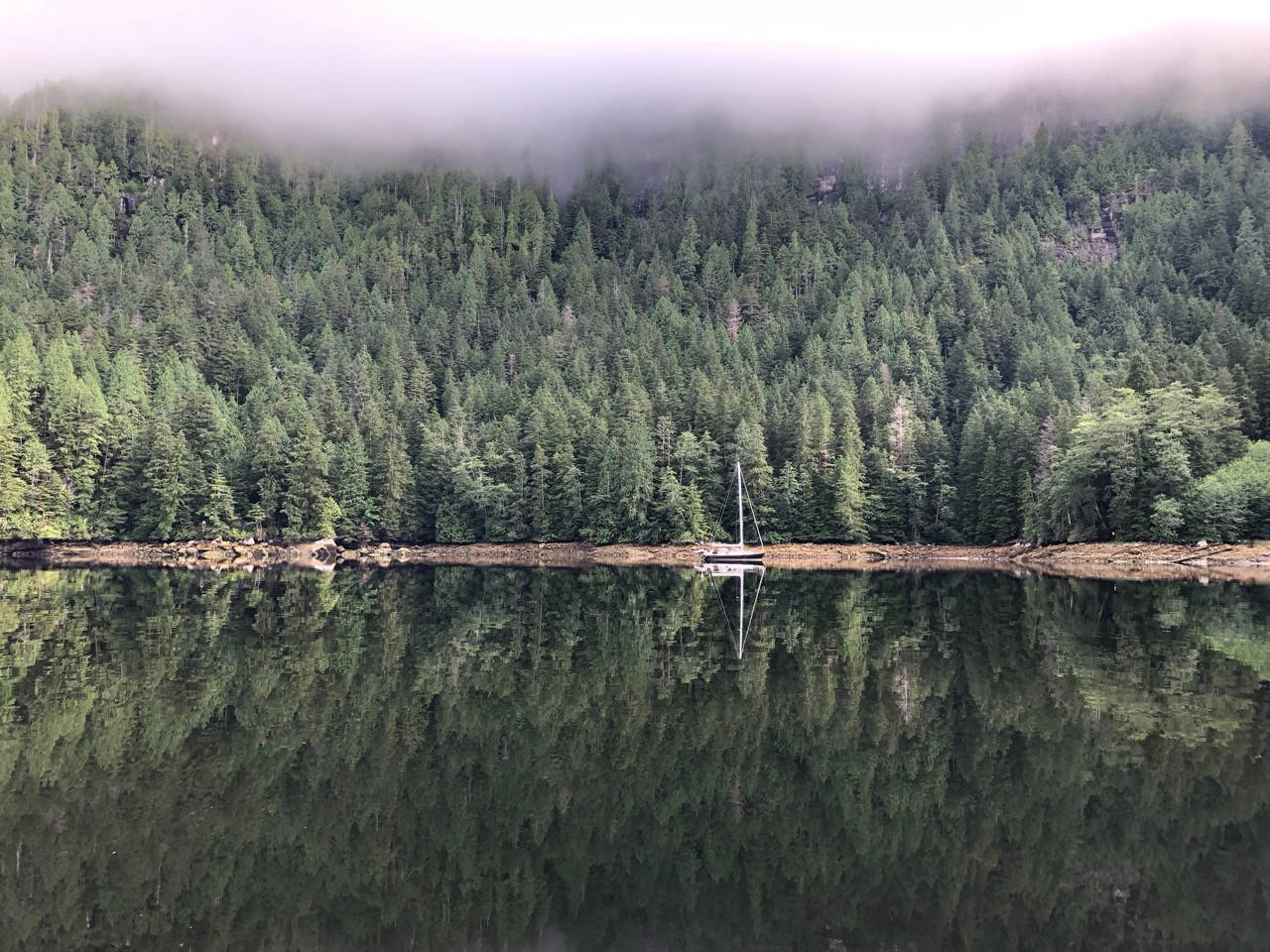
A calm anchorage at Dixie Cove
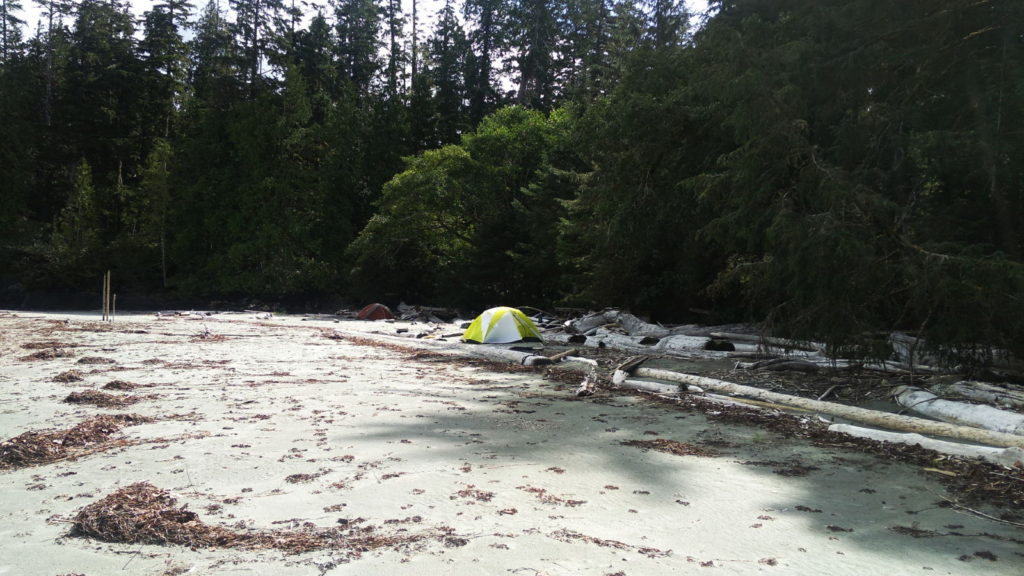
As discussed with Robert and Vanessa, we would be heading for Rugged Point at 10 on Saturday 17th, a short trip to a spot with some good beaches and recommended woodland trails. I was most interested to read in Waggoners that bear and cougar prints had been spotted on the beaches there. Luckily, since we planned to spend some time on these ‘spectacular’ beaches, the weather improved from cloudy to decidedly hot and sunny as the morning went on. At 11 o’clock we anchored opposite a beach with several tents pitched on it.
Tents belonging to a kayaking group
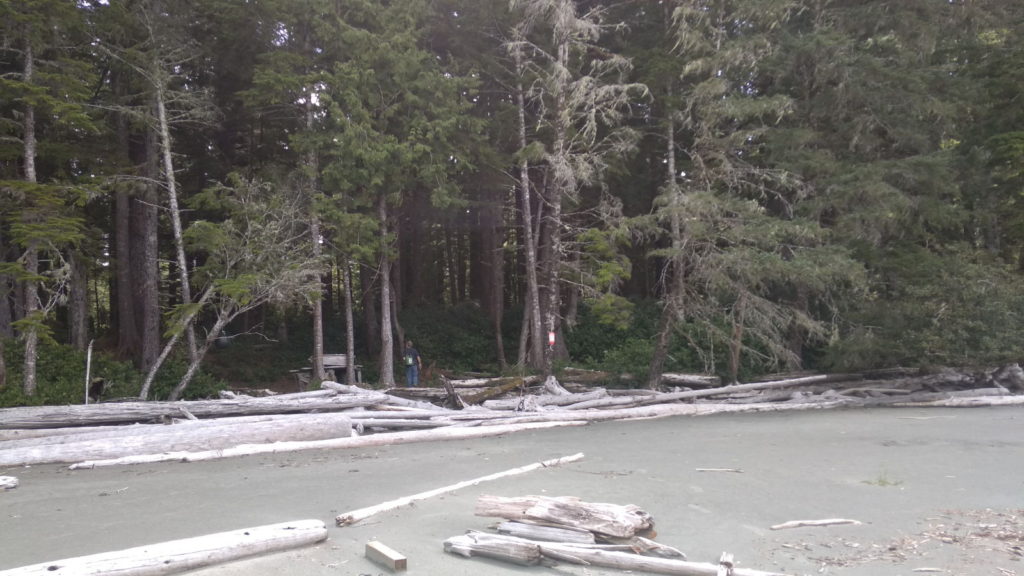
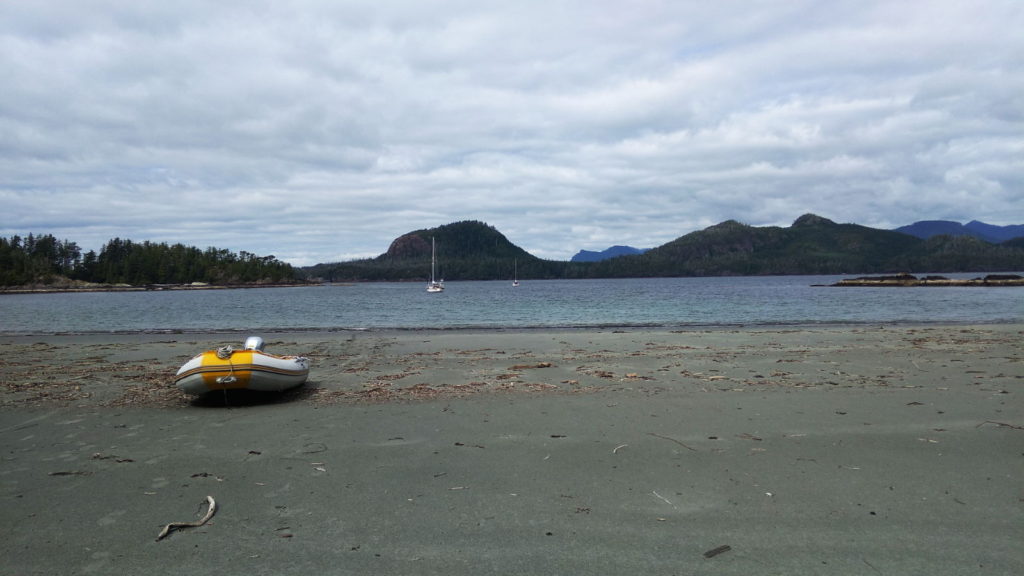
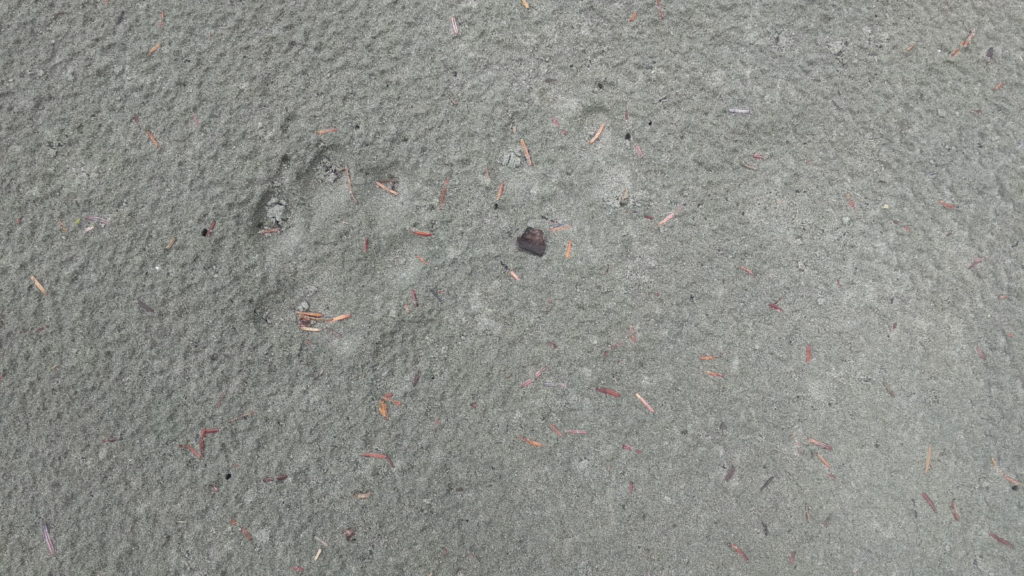
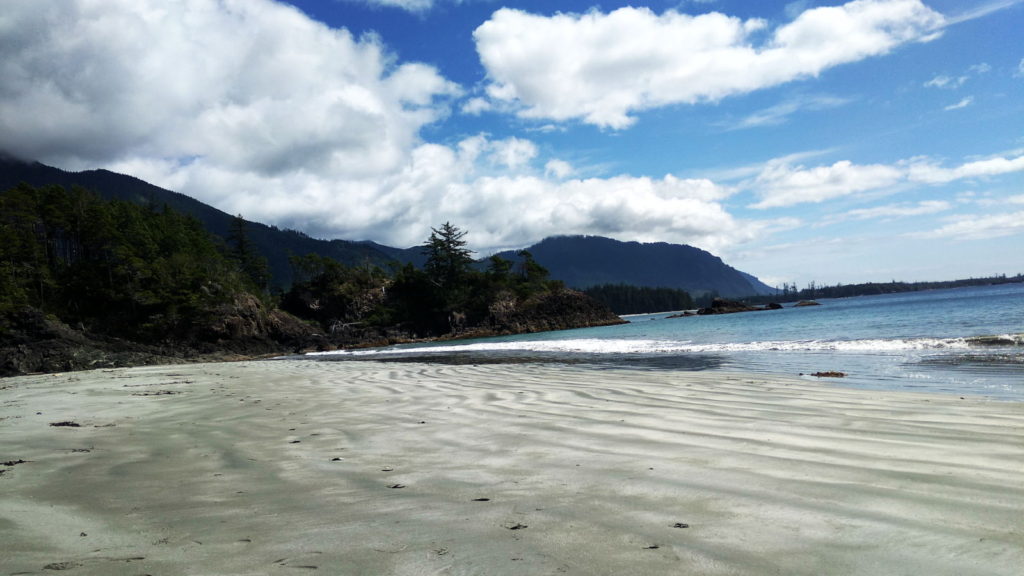
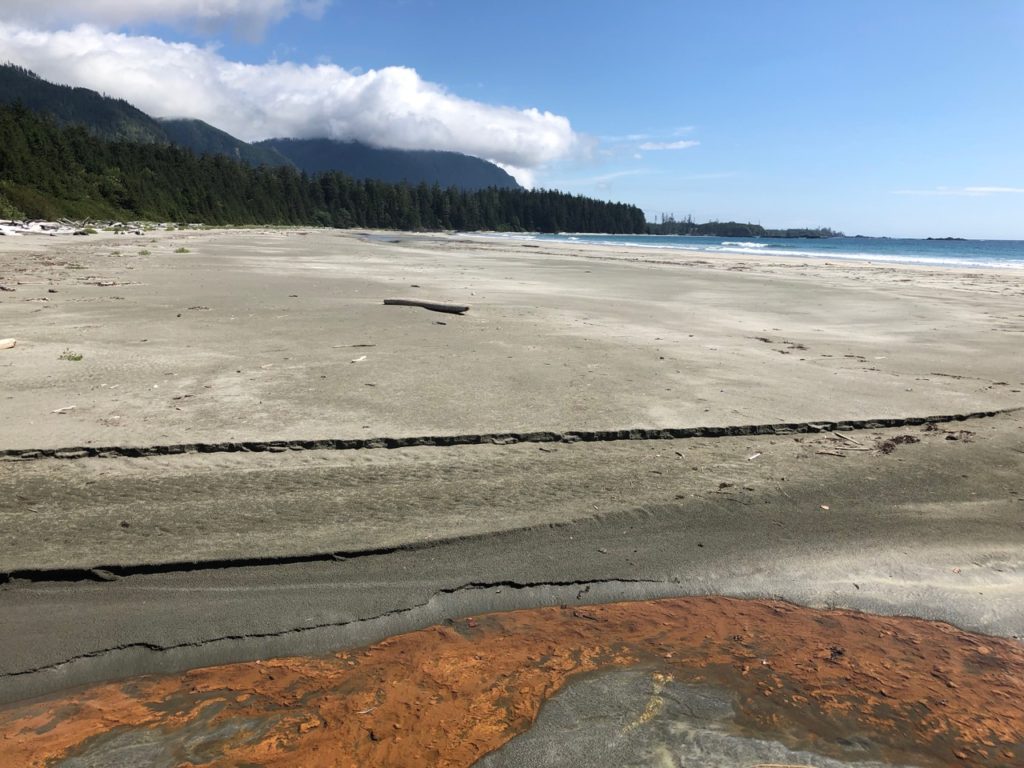
The four of us dinghied over to the long beach, greatly excited to see a black bear ambling along on the adjacent beach. After hauling the dinghies up the beach we discovered the trail entrances weren’t located on this particular one but I was thrilled to see that there were paw prints, which Robert and Vanessa were able to confirm were indeed bear and cougar prints. Before heading off to the next beach, they went back to their boat to pick up their bear spray!
Not dog prints!
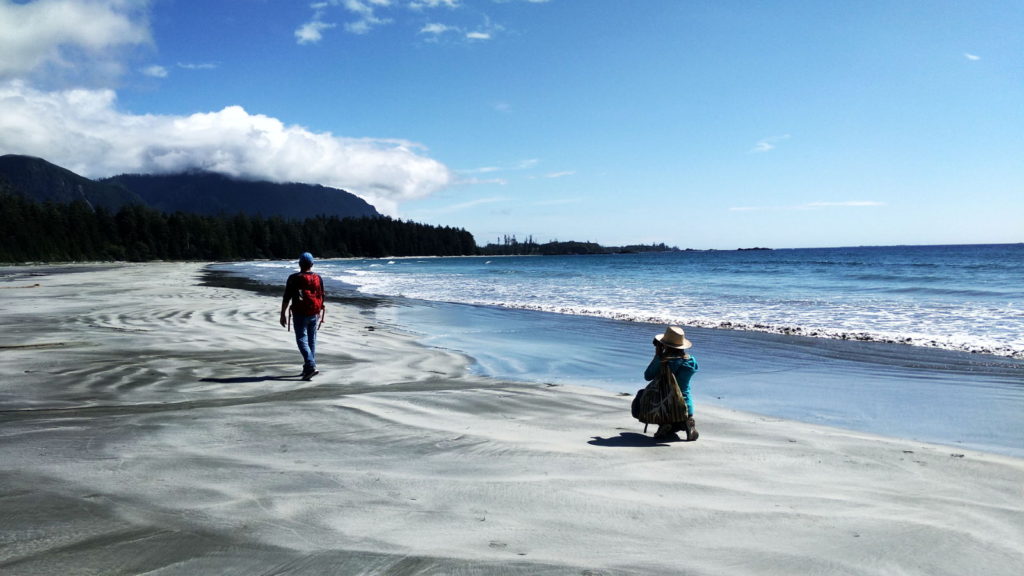
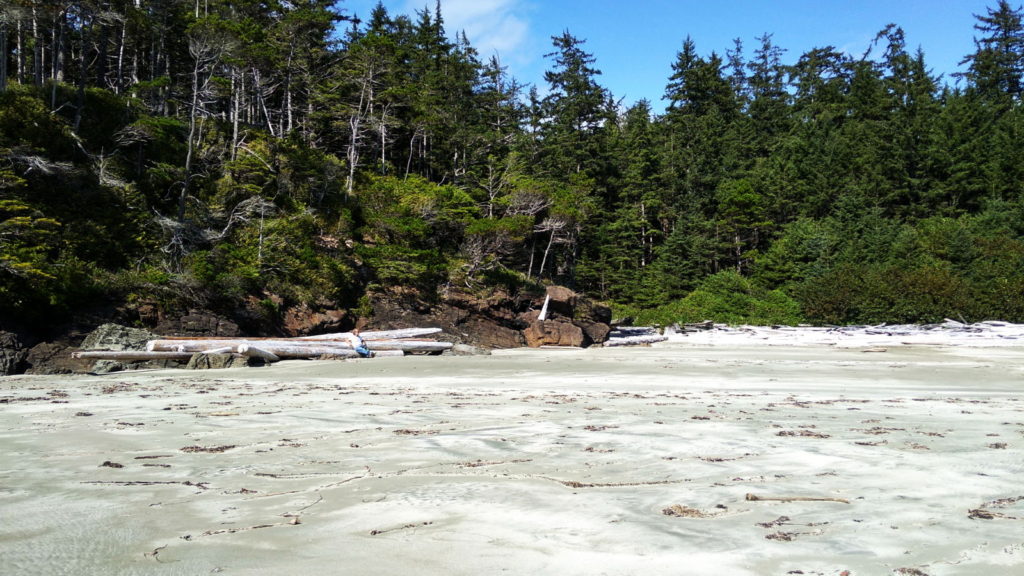
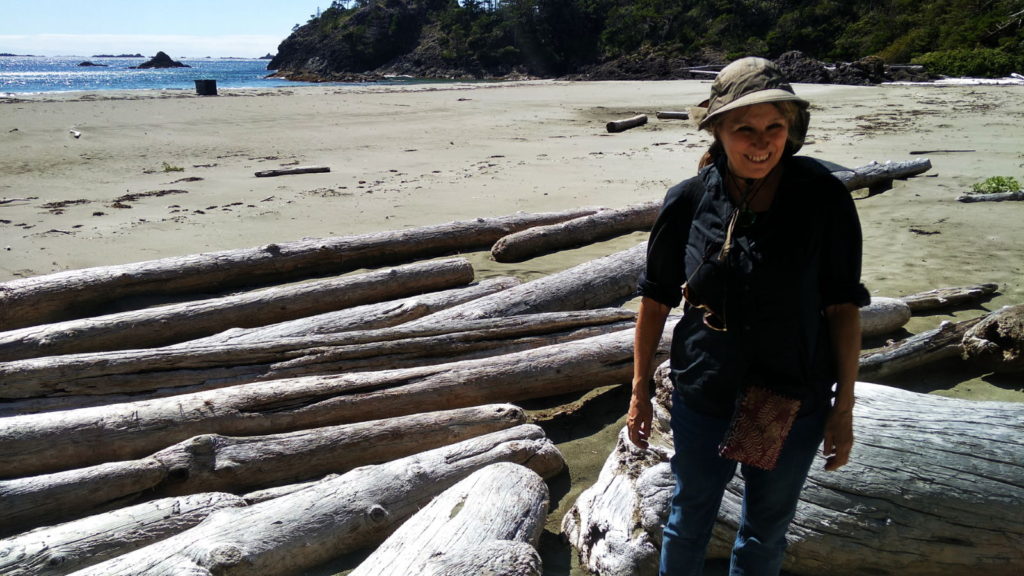
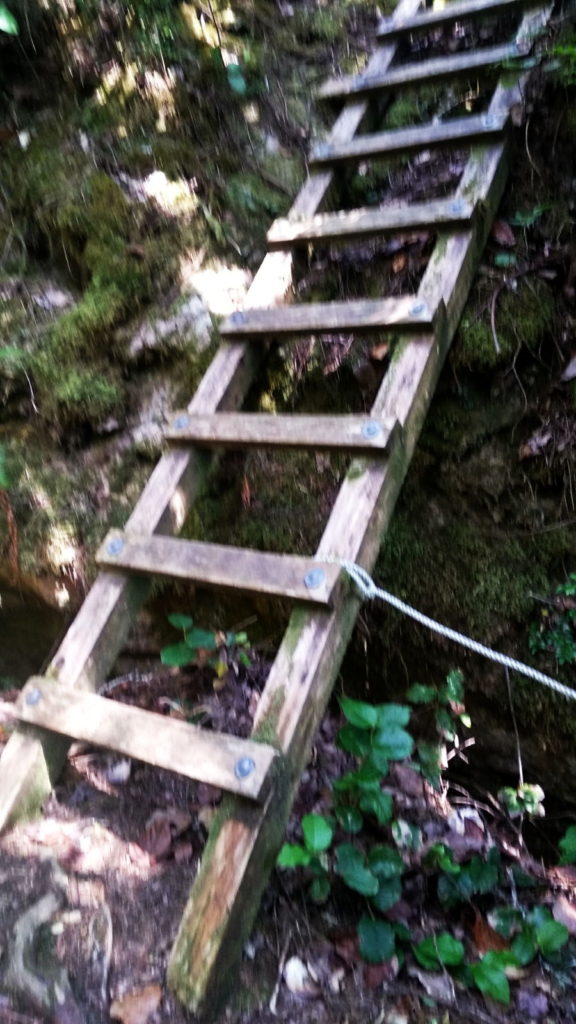
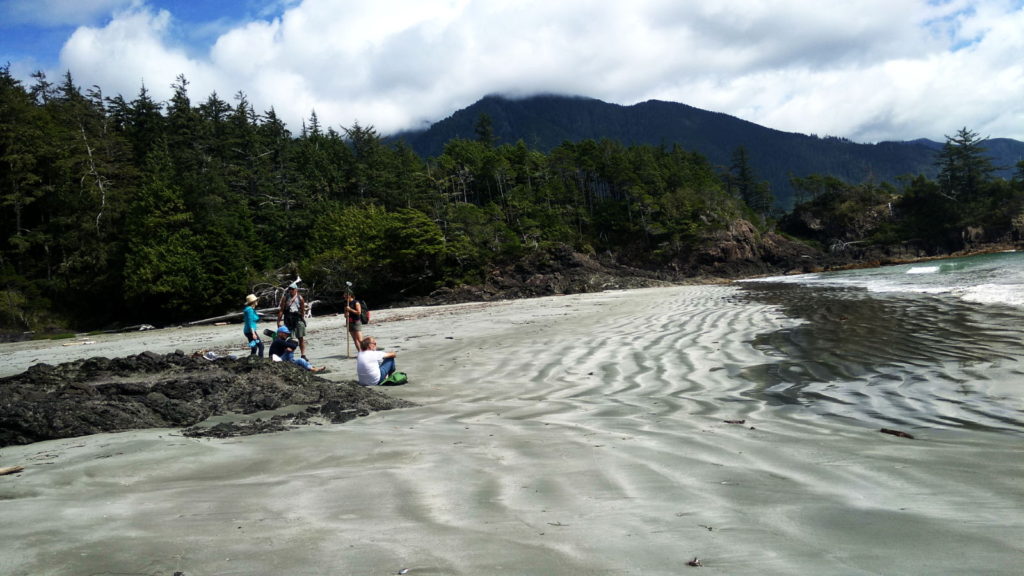
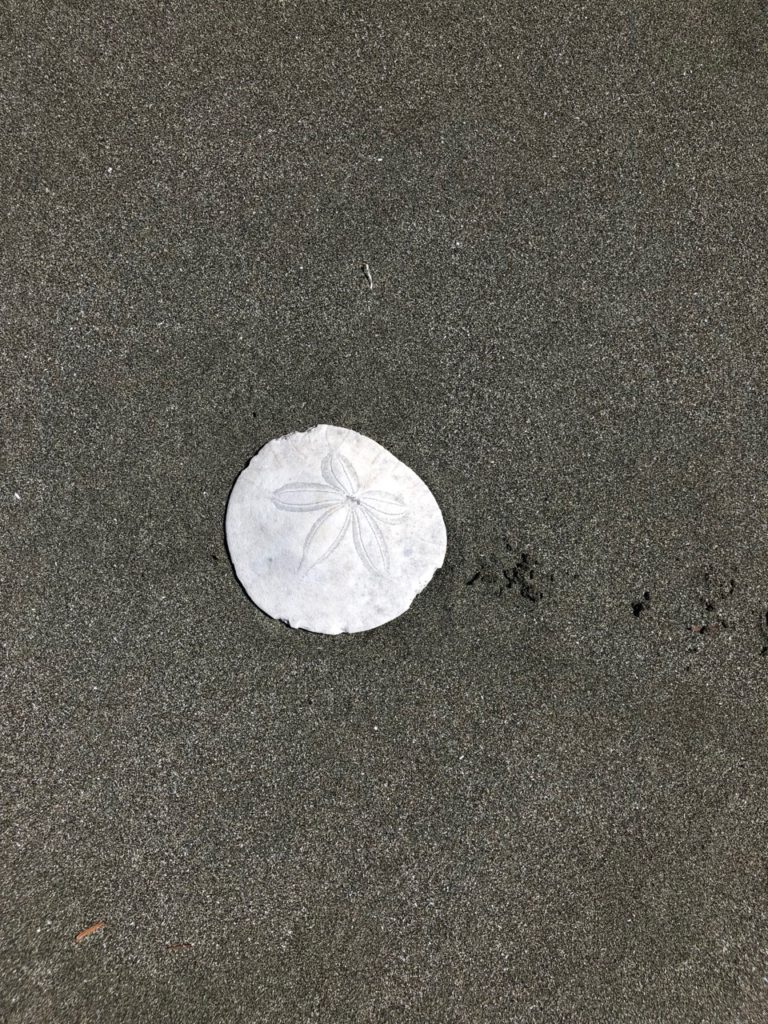
We enjoyed almost four hours of beachcombing, walking, sitting in the sun, chatting to other visitors and taking pictures. The trails involved pulling ourselves up by ropes on some of the steeper parts! Back on the beach we were keen to find a sand dollar. A lady we spoke to had informed us she had seen one nearby. Vanessa described them to us and not long after, she found one which she was kind enough to give to us as a souvenir. Hard to believe it’s actually the skeleton of a type of sea urchin; it looks so much like someone decorated a stone with an exquisite flower. Robert said he thought one of the animal prints looked like it might be a wolf; I marvelled at the fact that we had been walking in the same habitat of so many wild creatures.
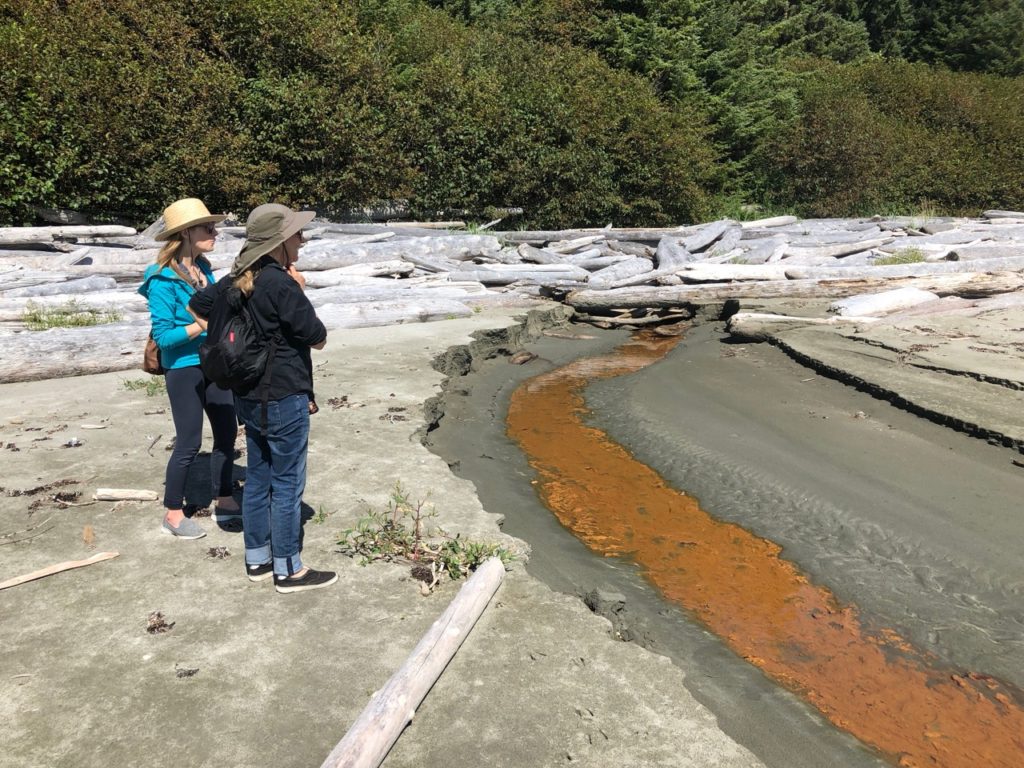
One of the beaches at Rugged PointRobert and Vanessa, Rugged Point Paul taking a breakOne of the climbing aids on the trail
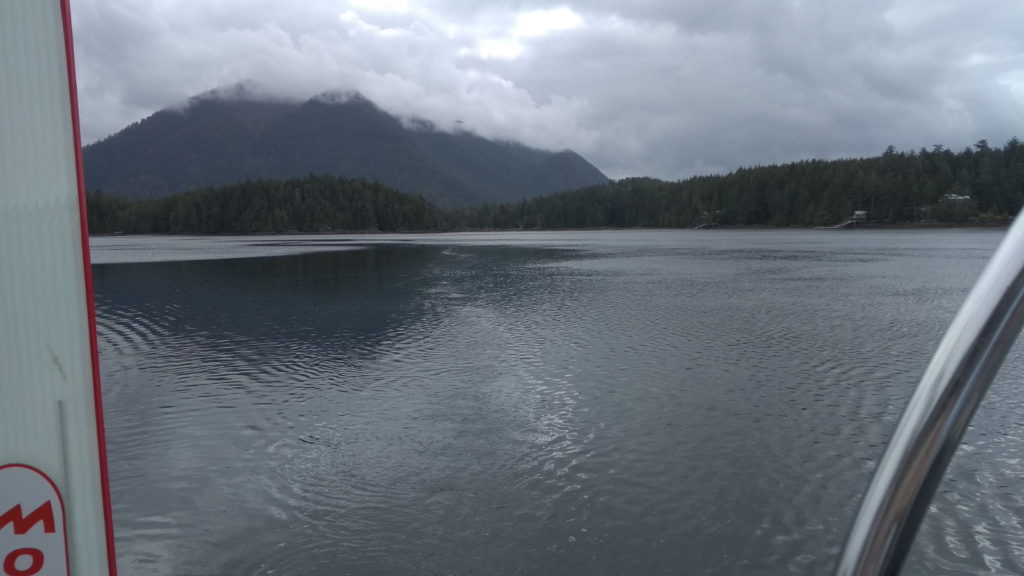
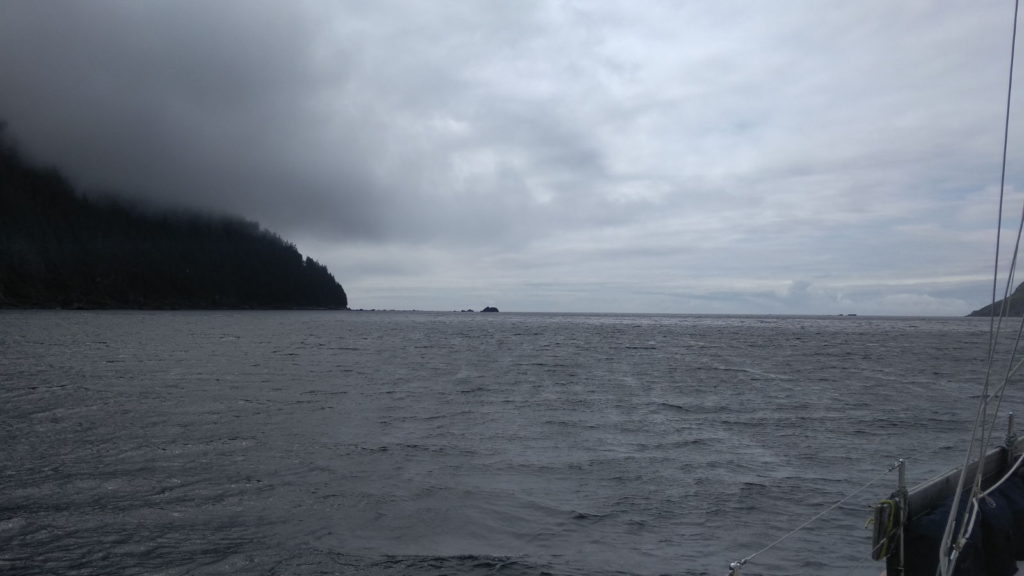
Early on Sunday morning, the fog I thought we had seen the last of, returned and caused some uncertainty about whether we should move on or not, especially as the coastguard had warned of gales in the area. Then it started to rain! Still, we concluded it was ok to go (despite Paul’s casual remark that in the worst case scenario we would just be blown onto some jagged rocks). The waves bounced us around immediately we left the shelter of the anchorage. From our skimpy beach clothes of the day before, we now had to pull on thermal layers, oilies and hats and gloves. Before long, the waves were pushing and pulling us in a side-to-side motion that was annoying but bearable and we’d certainly endured worse. I just hoped Robert and Vanessa weren’t finding it too uncomfortable. We listened to every weather forecast that came through (often too distorted to make out) and discovered it looked likely the rough conditions would continue for a few more days but would probably get no worse.
After negotiating our way through a narrow gap and avoiding the many rocks in the area, the shelter of the anchorage, as always, provided respite from the elements and by 1 30 we were settled and secure in Nuchalitz Provincial Park. It was too overcast and chilly to go exploring so once Paul had been over to see how For Good had fared on the journey, we shut the hatches and got on with the enjoyable pastime of relaxing.
Tahsis, the port of call for Monday 19th had a
very enticing description regarding facilities on offer in Waggoners. We could
expect wide ‘cell’ coverage (note how I have become used to using that word
instead of mobile), WiFi, shore power, water, fuel and a huge supermarket. All
things we take for granted during daily life in the UK, which although are not
missed terribly when they aren’t freely available, does make you appreciate
them after a period of doing without their benefits. Robert and Vanessa left
the anchorage at 9am but as Paul wanted to have a look at the abandoned First
Nation village referred to in the book, we said we’d meet them in Tahsis. I
hoped I hadn’t made a mistake electing to stay on board to catch up on other
things as he dinghied off to explore, especially as he was gone for quite a
while. It turned out the abandoned village wasn’t much to look at but he had
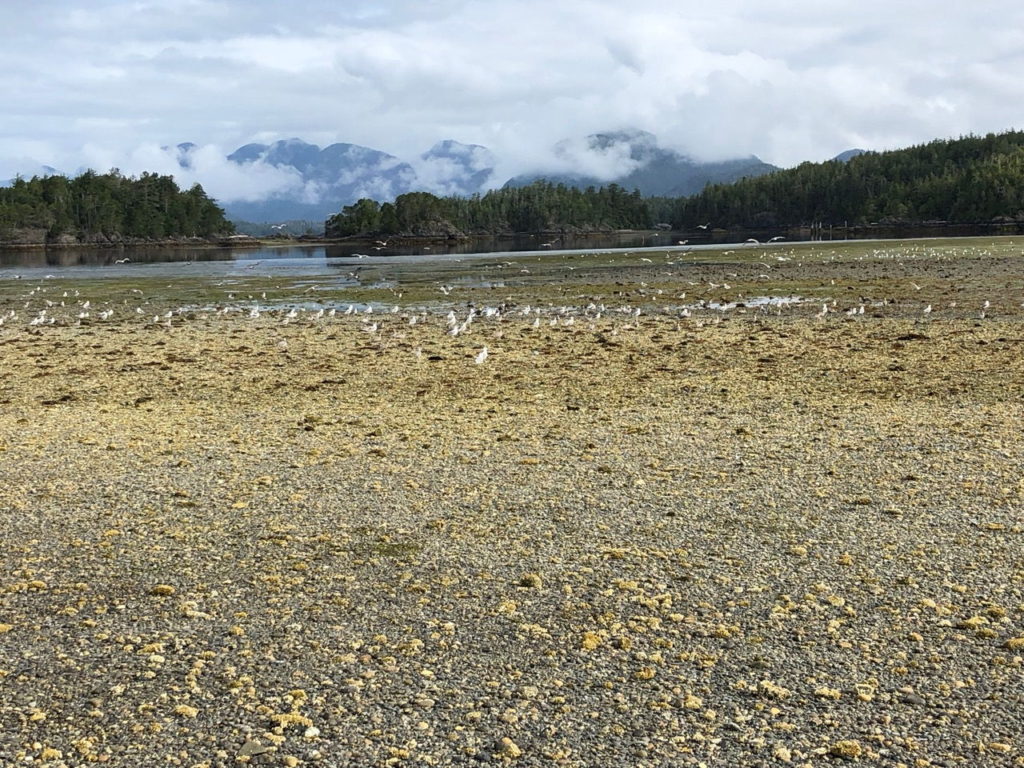
loved walking on the sand spit at low tide, observing the sea creatures, birds
and shells.
I offered to make some toast when he returned. We’d been doing this the old fashioned way, using the grill part of the oven: you know…it involves actually having to turn the bread over to brown the other side! Halfway through, however there was a small whoomph-like explosion which kept repeating after more attempts to light it. Paul concluded later that it was broken and a bit too risky to fix. We improvised and used an oven shelf atop the flames on the gas rings. Never mind, we said, at Tahsis we could bring the toaster back into use using the shore power. There was no wind so we motored all the way, passing tiny communities nestling at the bottom of steep-sided mountains.
Leaving NuchalitzOn the way to Tahsis
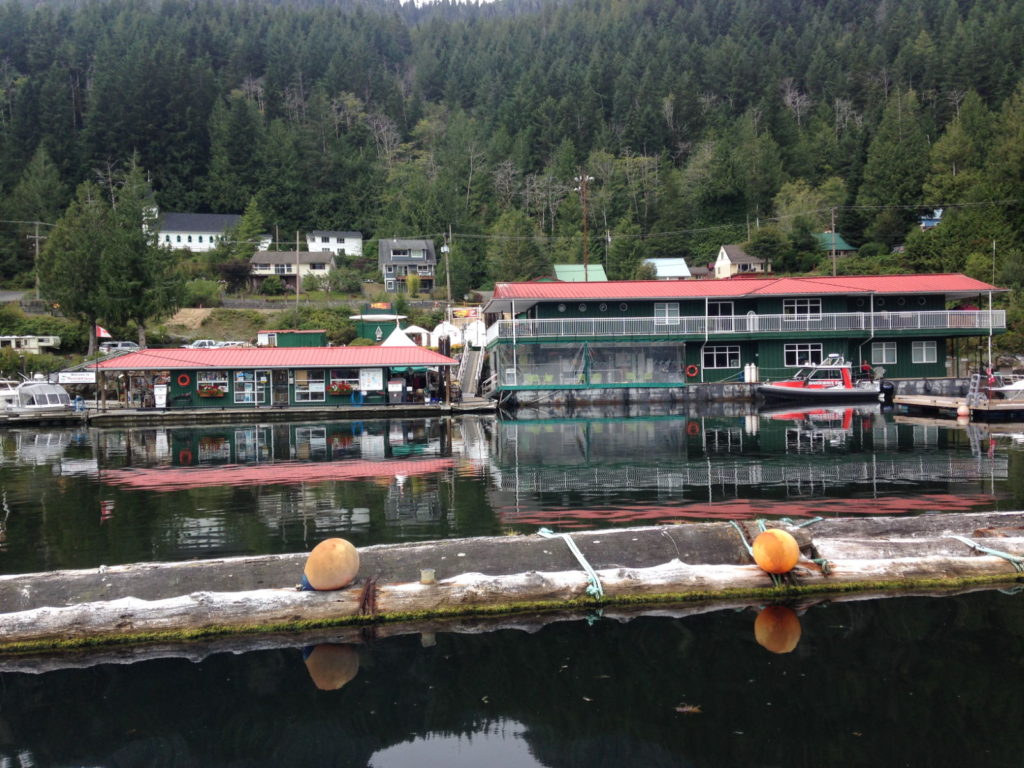
Just before two we could see Westview Marina in the distance and I thought then that it didn’t seem as big as I had expected. Paul called ahead to check they had room for us and they provided directions for the fuel dock. We had to look for a green building with a red roof, which to someone who is red/green colour blind isn’t a whole lot of use. Robert came to greet us as we were filling up to tell us we’d be berthing just behind them on the pontoon. It was only a short distance away. Robert took our lines and we tied up. Now for the chance to catch up on internet stuff, I thought, expecting to see the Rogers telephone signal displayed on my phone. It wasn’t there – in fact no provider was displayed, and for WiFi it seemed we’d have to go to the café, while connecting to shore power would prove too expensive just for the the luxury of toasting bread. Things didn’t improve much after that…
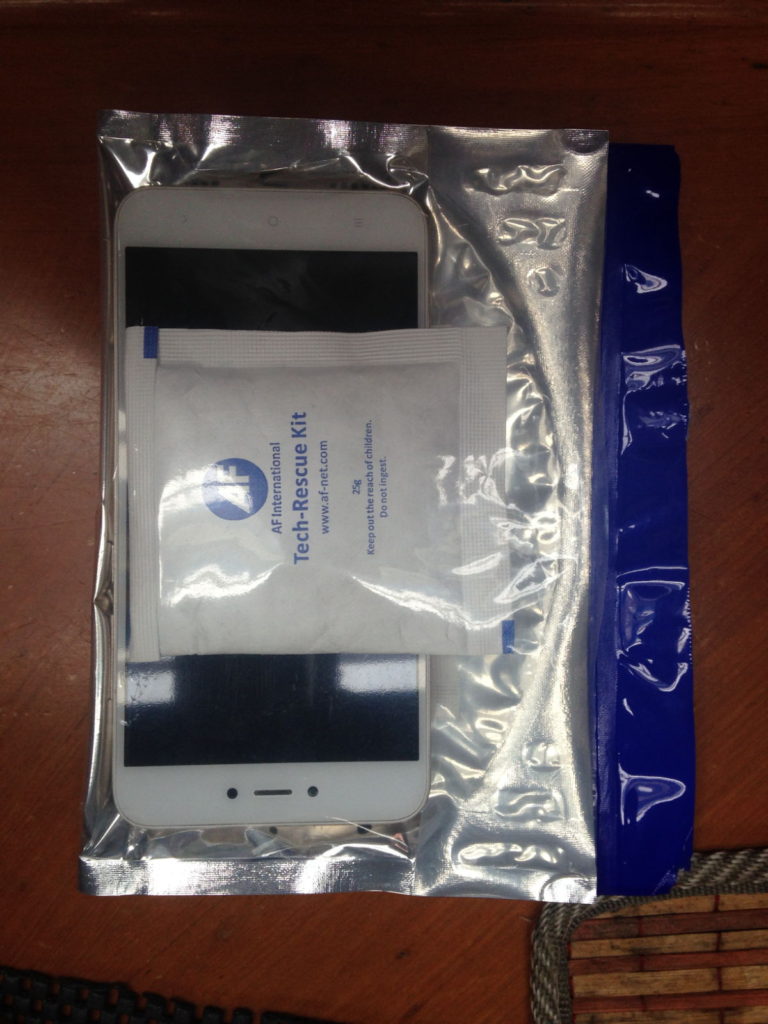
We arranged to go with Robert and Vanessa in the marina’s courtesy car to the supermarket at 4 30. Paul went on ahead to find the rubbish bins while I went to the restaurant to check out their menu for dinner later. Stepping out into the bright sunlight, I spotted Paul on the bridge leading to the car park and strode out to catch up. I didn’t notice the gap between the restaurant building and the pontoon and walked on assuming I was on solid ground. I must have stumbled through the gap with my right foot, tried to regain my balance and only succeeded in tumbling back so that my right side hit the restaurant wall and then all of me sank into the water. As often reported in such accidents, it seemed to happen in slow motion but was probably very fast to the onlookers, including Paul, who rushed to grab my hands and pull me up as soon as I resurfaced from the narrow gap. I still had my bag on my shoulder and could taste salt water in my mouth. My first thoughts were about what might be in the water and did I swallow any before wondering if my phone was in the bag. Once I was back on terra firma and had assured the small gathering of people that I was ok, Paul checked my bag to confirm my phone was indeed inside it. Restaurant staff appeared with two towels to wrap round me and Paul led me away from the scene of my mishap back to the boat. All I wanted to do was wash the water off me and rinse my mouth out, remembering with horror that a fish-gutting table had been fairly near the spot where I fell in. I was aware of a vague pain in my left leg which intensified as the evening went on but it felt good to be clean again. My phone was put into what I termed the ‘intensive care bag’ (pictured below) which someone had given Paul as a gift due to his propensity for dropping tech equipment in the water. I was surprised that it had come on at all, but time would tell if any permanent damage had occurred. (Update – Paul refused to give up on it and finally managed to fix it completely on September 5th.)
Scene of my tumble in the middle of the picture between the steps and the slope (fish gutting station on the far left)
A little later than planned, we met Robert and Vanessa in the car park and piled into the 4×4 car for the short drive to the centre of Tahsis. Despite my little accident I was looking forward to stocking up on provisions and maybe finding a bar to have a much needed drink. When we got there we were all disappointed to see that the ‘supermarket’ was little more than a store with the usual hiked up prices and limited stock. We picked up some basics anyway and decided to go back to the marina’s ‘Island Attitude Coffee Café’ for a drink and something to eat once the shopping had been put away. My leg was hurting pretty badly by then but I guessed it was just bruised or strained from the bashing it had taken. We all enjoyed the food and had a great evening chatting about the day’s events and future stops before I limped back to the boat. Paul managed to get us a bit of Wi-Fi so I was finally able to make contact with family and friends.
Next morning, waking at 4 45 I felt nauseous and immediately
wondered if it was due to anything I had inadvertently ingested from the sea
water but Paul laughed away my concerns about parasites and worms. He did tell
Robert and Vanessa we wouldn’t be leaving until I felt a bit better though and
recommended they go on ahead. By midday, still limping a bit but not as queasy,
we negotiated the boat out of a fairly tight spot and motored away from Tahsis,
en route to Ewin Inlet.
It was a cool and cloudy day and Paul said it was cold in
the cockpit. I stayed below still fighting off occasional waves of nausea. Robert
called on the radio to let us know there was a black bear on our port side. I
came up to look and could see it so clearly I was even able to make out the
wind blowing its thick fur. They came over in the dinghy once we were all
anchored and we sat in the cabin drinking and chatting late into the evening as
it rained heavily outside.
Anchored at Ewin InletFor Good, Ewin Inlet
We spent all of Wednesday 21st August at Ewin Inlet in order to sit out a spell of rough weather. Looking through the binoculars early in the afternoon, we spotted that the Beneteau anchored near to us had two cats on board, playing on top of the boat’s canopy. During his kayak trip, Paul had a chat with the co captains, Carla and Kevin and returned to tell me they had invited us, along with Rob and Vanessa for drinks later that afternoon. We hitched a ride with them for the short dinghy trip over and spent a pleasant evening on board their boat Gargoyle getting to know Carla and Kevin and their delightful Devon Rex cats, Sam and Dean. I wished I had taken my other phone across to get pictures of the cats, but I’m even more wary of damaging devices now. They had such striking eyes, and were very entertaining with their playful antics. They make great boat cats I’m told ;-)…
Four boats in the Ewin Inlet anchorage planned to journey to Hot Springs Cove the following morning. One of these had arrived late the previous afternoon. The guy on board told Paul he’d been having engine trouble and had had to return to the inlet to work on the problem. Paul spoke to him before we left to check he had got it sorted and to let him know we were all leaving shortly in case he needed help. It turned out he would be heading our way too, later in the day and it seemed likely we would all meet up there at some point. It was a beautiful sunny morning but we’d heard it was quite rough further out in the Pacific. Gargoyle left first and Kevin told Paul he would let him know if conditions were rough out there. For Good were next, and we weighed anchor just after 10.
And then there was one
We estimated it would be a 6 or 7 hour trip and Paul was keen to get sailing so the mainsail was hoisted as soon as we had cleared the inlet. As the day went on, nice as it was to be without the noise of the engine, the waves were high enough to be causing a ‘pitching and tossing’ motion and through radio chats with Robert, it became clear they weren’t having a very good time of it on For Good. Their engine had failed and it was too choppy for them to set their sails in the strong ocean swell. Noticing they were falling further behind, we turned around to check they were ok. It was decided the best course of action would be to abandon plans for Hot Springs Cove and make for the closer destination of Hesquiat Bay. At 6pm both we and For Good anchored there while under sail. That was a first for me and I hadn’t heard Paul tell me we’d be doing it so it caught me on the hop a little. It had been a long day for all of us and it felt good to be secured for the night. We agreed to see what conditions were like before making a decision about where and when to move on.
Hesquiat Bay
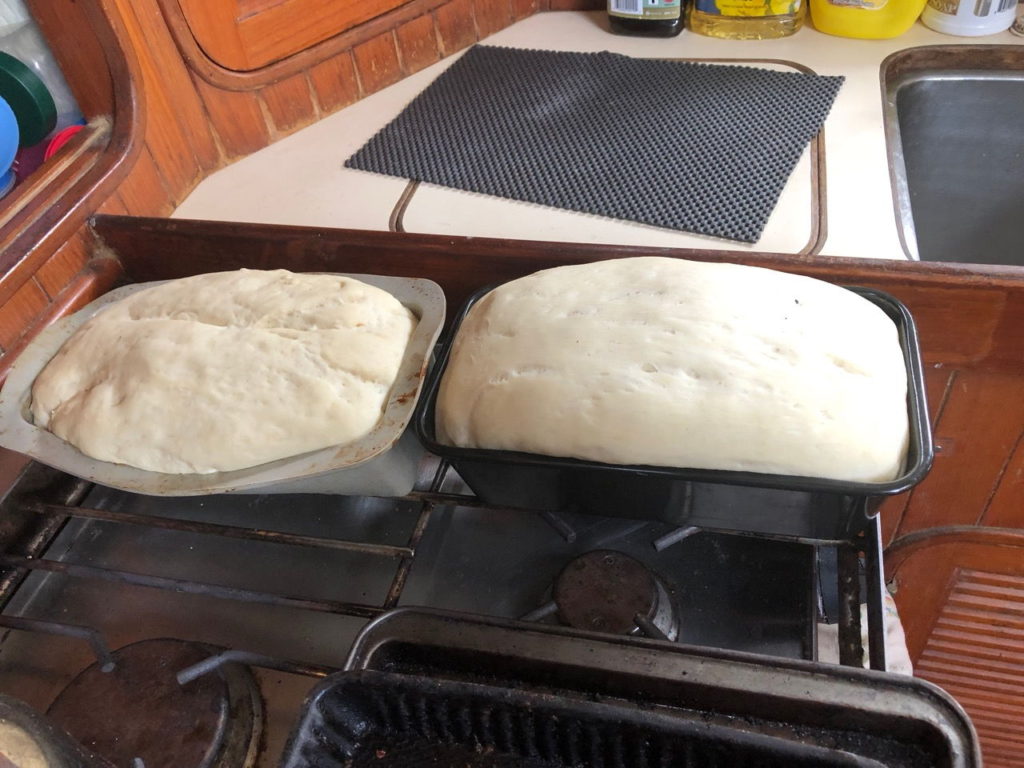
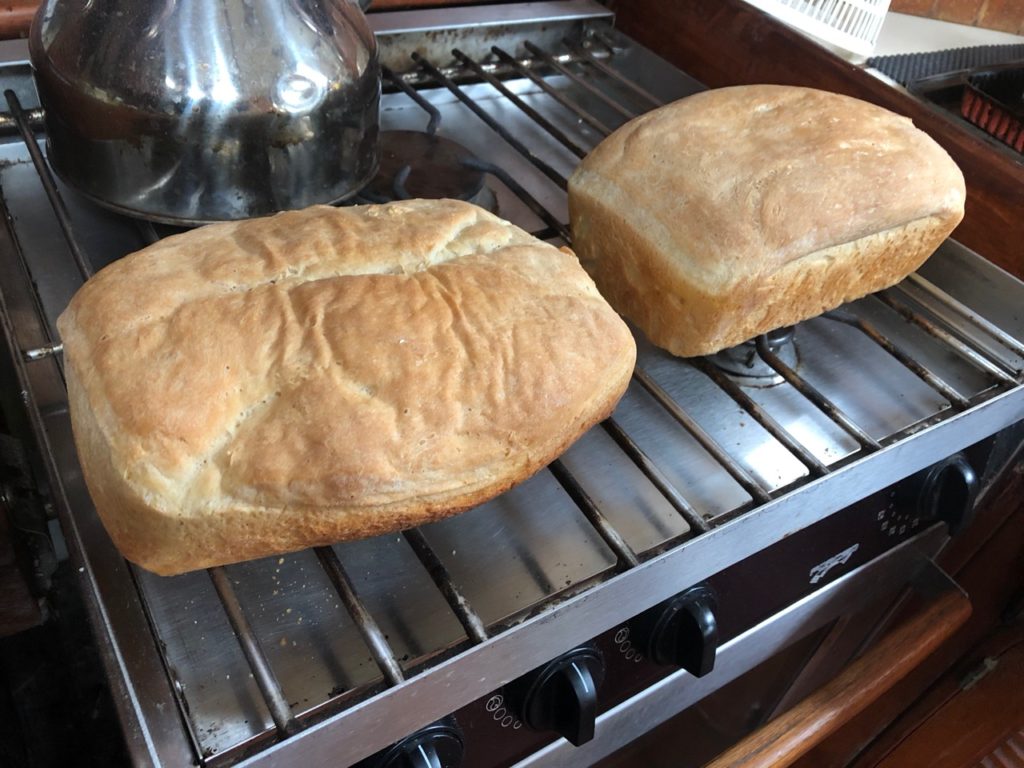
Friday 23rd August dawned with uncertainty about what to do. There was only a small window of opportunity weather-wise in which to leave for Hot Springs Cove even though it’s only a short distance away. Robert was still working on the engine problem so we thought it best to stay where we were for another day. We watched a black bear from the cockpit for a while but it was turning out to be a grey, chilly day. Paul took the dinghy out to explore the possibility of an alternative anchorage and I took the opportunity to make some bread as we were running low. Last time I had made bread it hadn’t turned out terribly well but we suspected it had something to do with the yeast not being fresh. This time, both loaves came out really well. We planned to give one to Robert and Vanessa that evening but they decided on an early night in preparation for the next day’s journey. We had a film night instead! Paul discovered he had downloaded Gandhi as well as a few other films we’d forgotten about. I only lasted an hour before falling asleep, and it’s a three hour film so it looks like we’ll have to watch in in ‘episodes’.
Bread dough ‘proving’
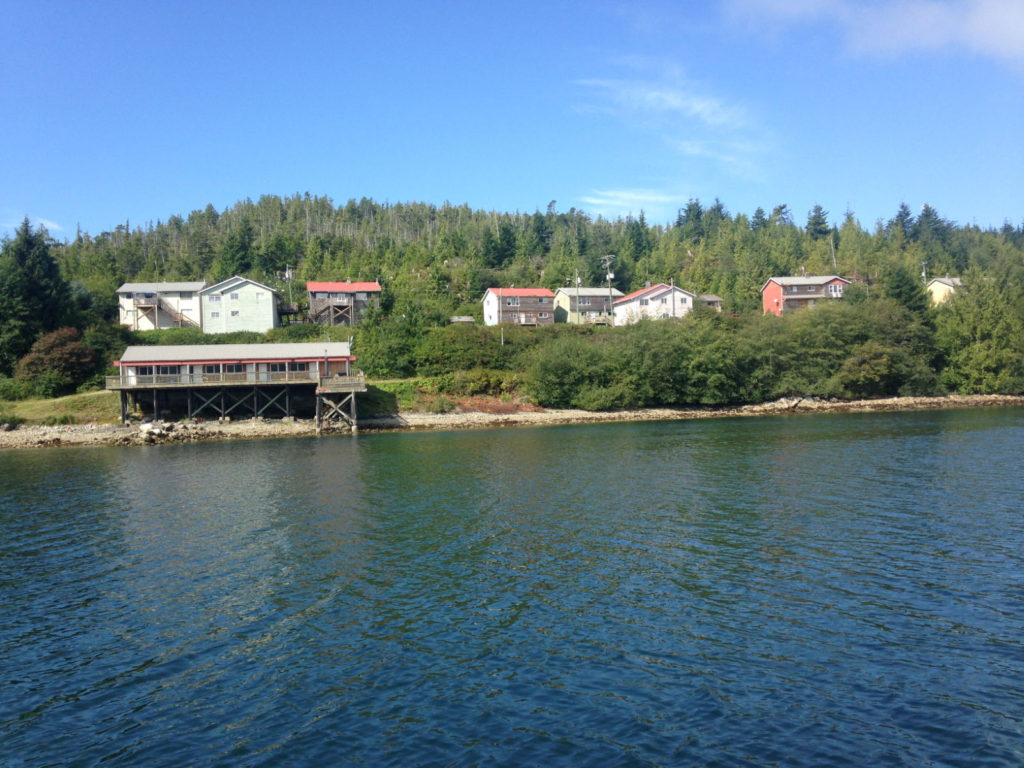
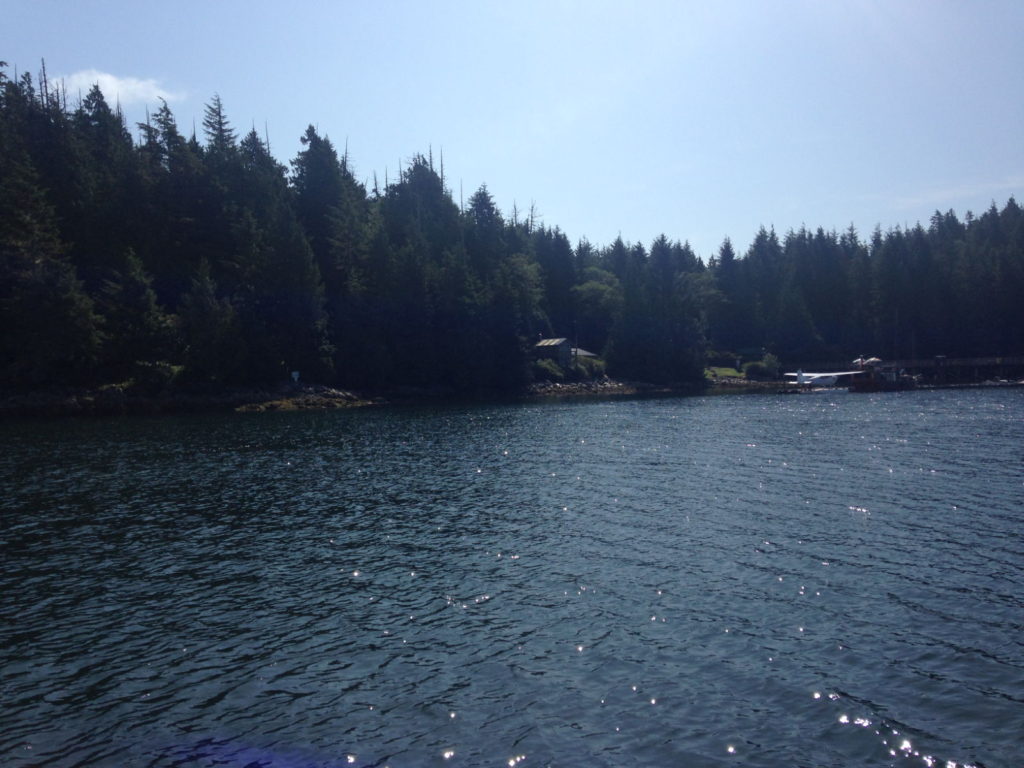
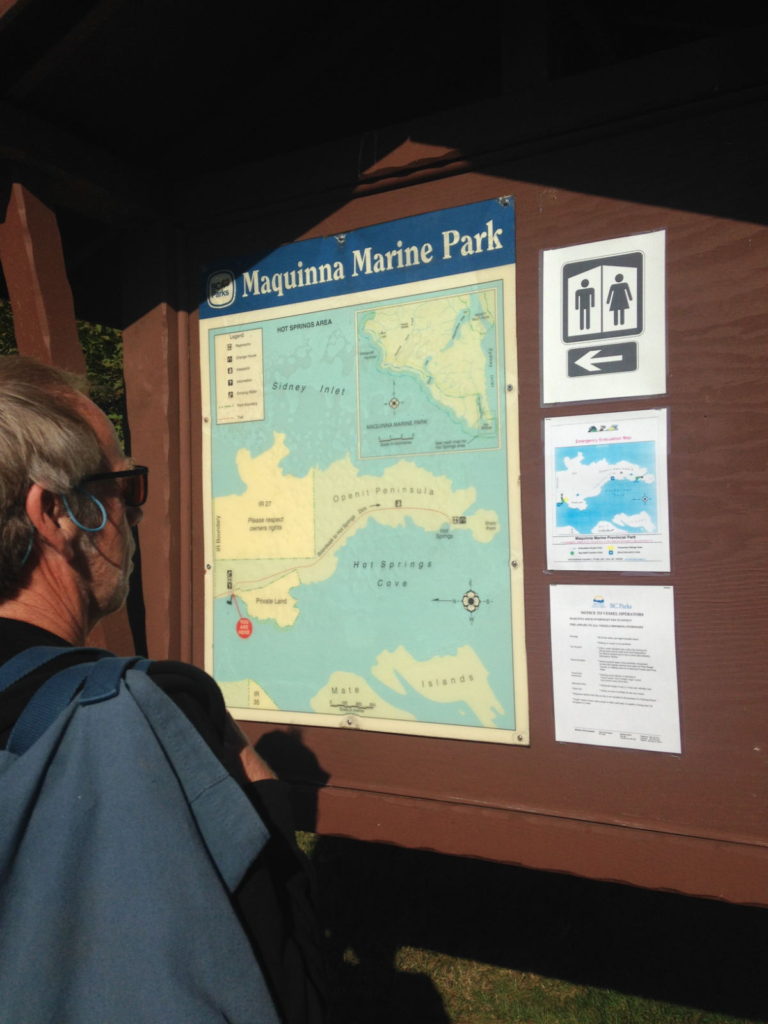
The weather didn’t look too promising the next day; chilly, foggy and wet. Robert called at 8 30 to say they were setting off for Hot Springs Cove and would see us there. We set off at 9 and the weather had improved by 10 with rays of sunlight making the waves sparkle and it got steadily sunnier and warmer from then on. Paul pointed out that we were now leaving the wilderness behind and were heading towards more built-up and populated areas. Hot Springs Cove, however, didn’t appear to be crowded despite its description as a popular tourist destination. We did see tour boats, float planes and a few other anchored yachts, but there was plenty of room for us in its picturesque cove. We anchored near to the shore on the First Nation village side. On the other side we could see the camp site and the entrance to the park with a boardwalk leading to the hot springs.
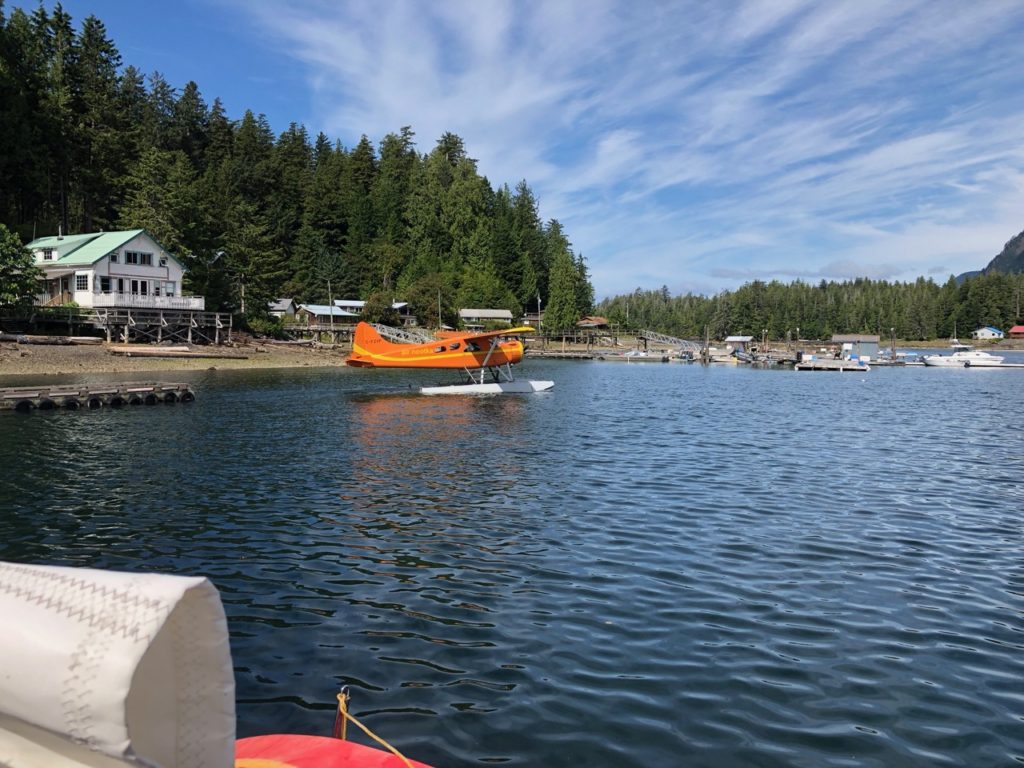
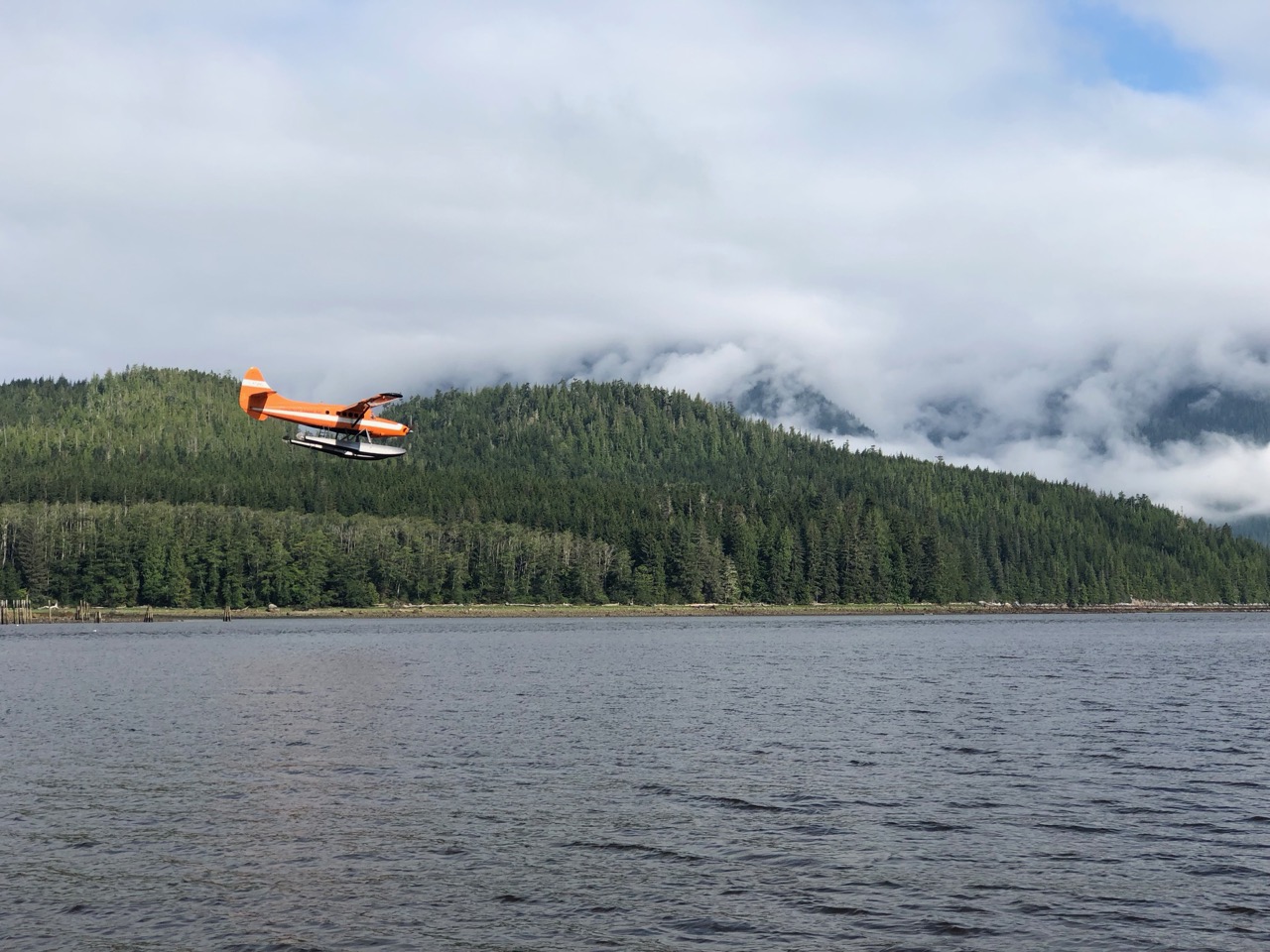
View from the anchorage at Hot Springs CoveA float plane landing near the entrance to the park
Although it was midday, we decided to wait until late afternoon to do the 1.25 mile long walk to the springs, following the advice in Waggoners that this would avoid the summer day tripper crowds. We were glad we did when Robert and Vanessa returned from their earlier trip and said it was hard to move freely at the springs for all the people gathered there. We set off at 5 30 when the temperature was pleasantly warm after the heat of the day and the light was beautiful from the sinking sun.
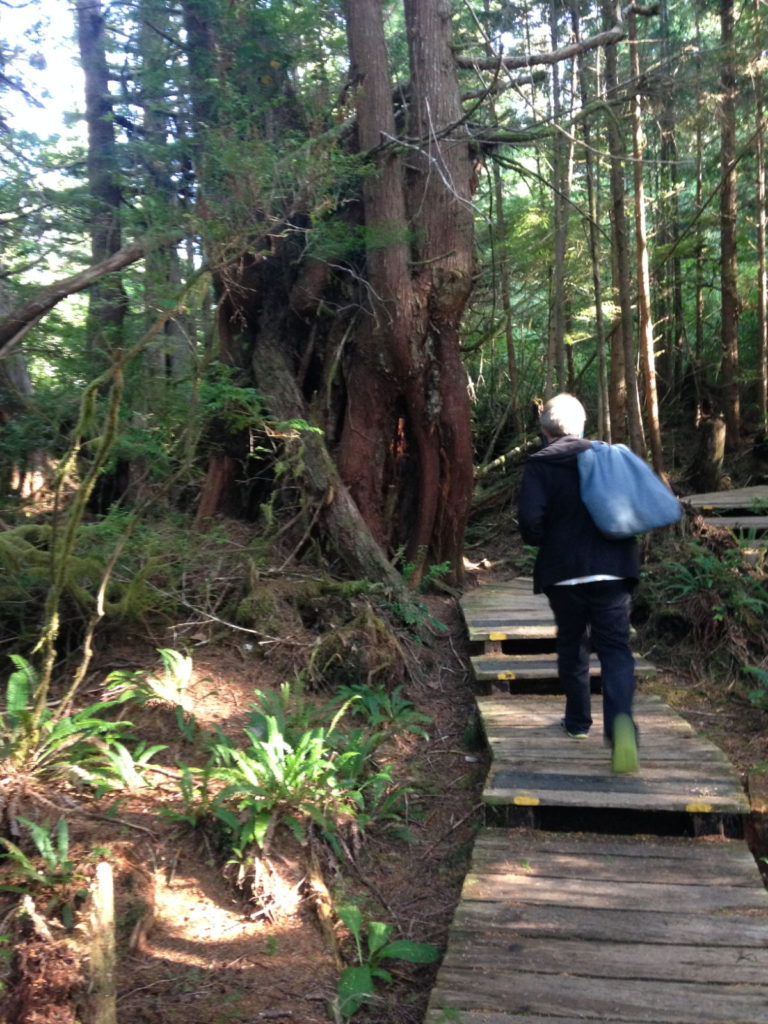
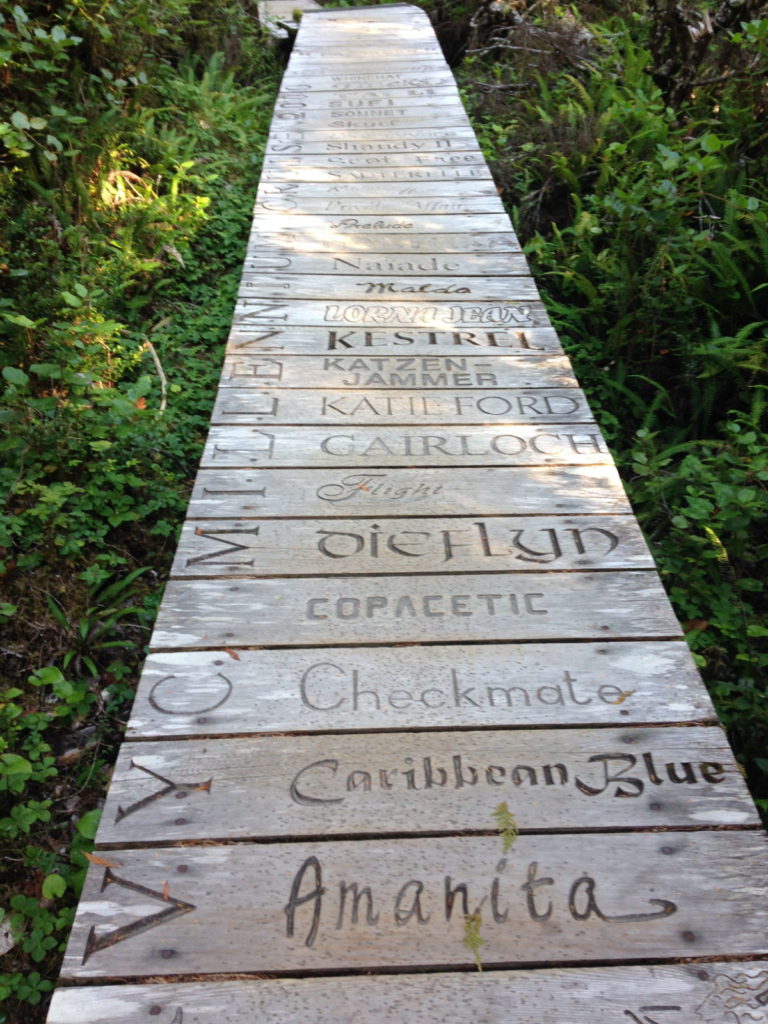
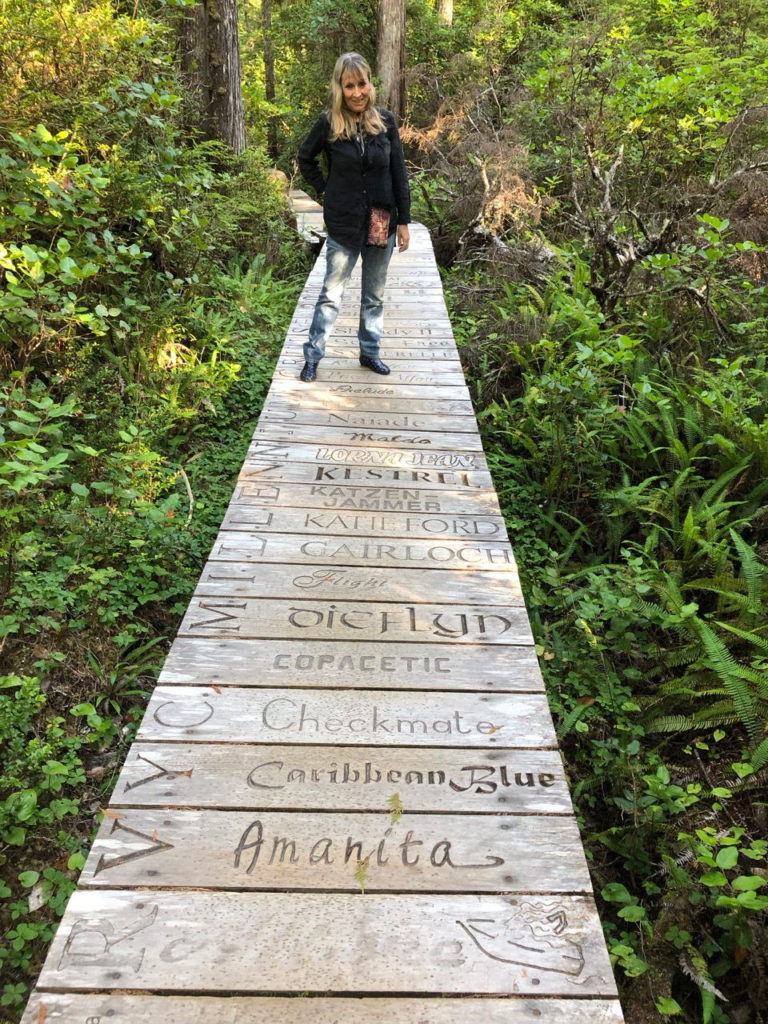
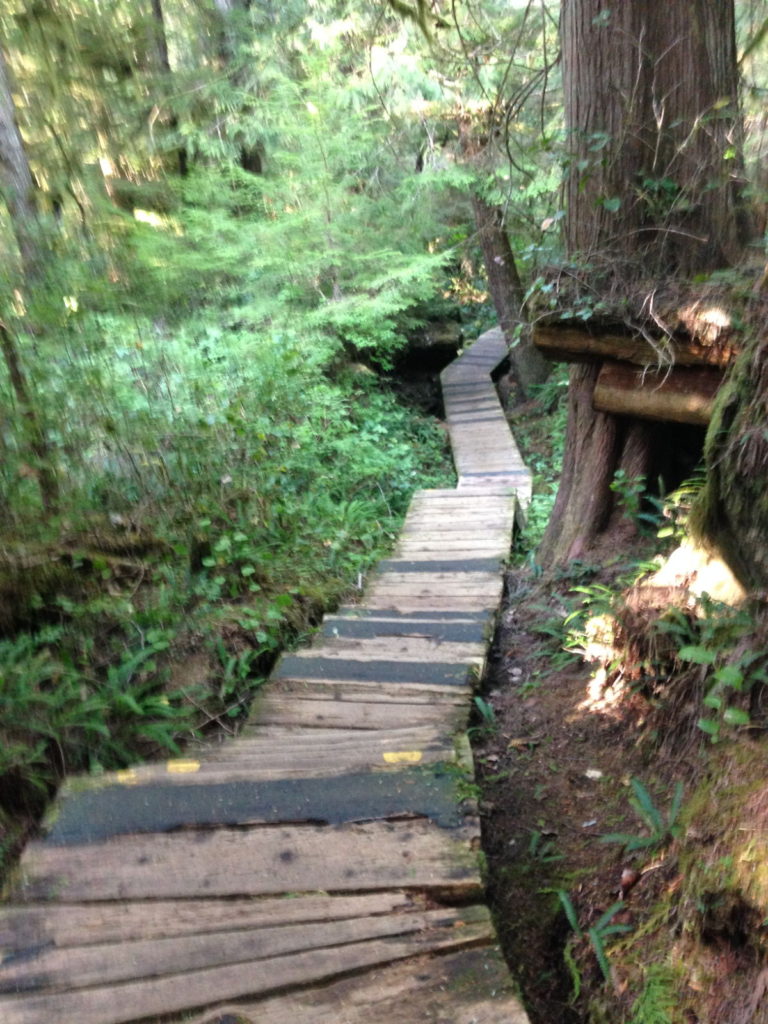
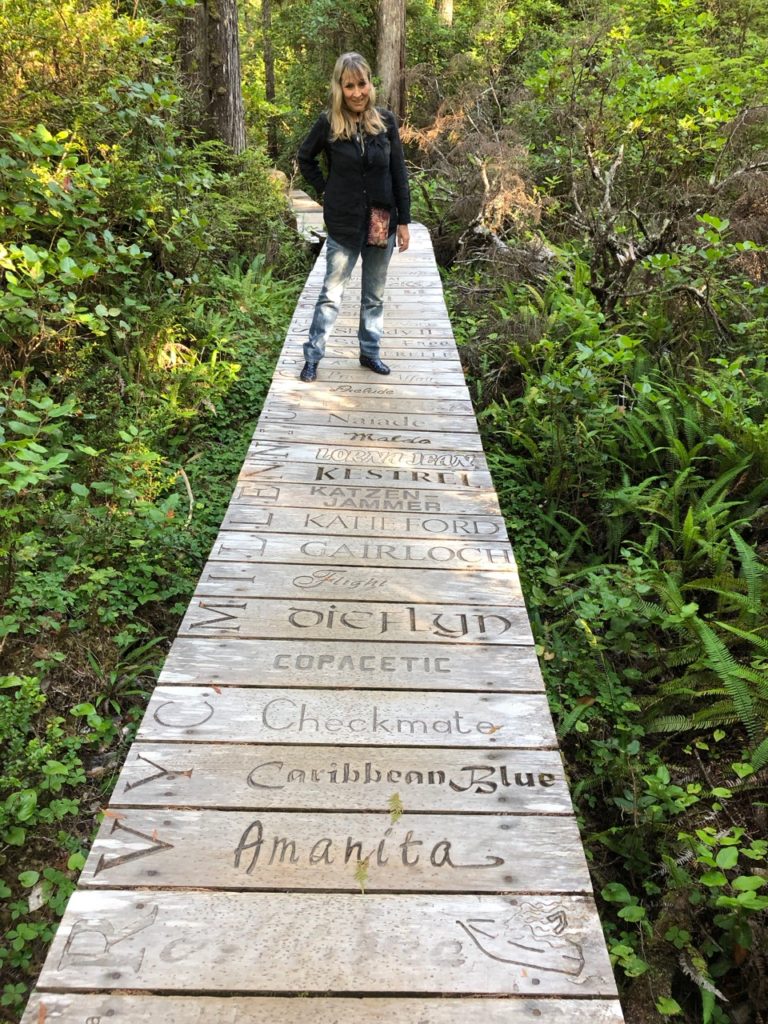
The boardwalk begins shortly after entering the forest. Waggoners provides the history of this useful and artistic path. Before its construction, the route to the springs was a muddy, difficult trek or accessible only by boat, so locals and visiting boaters began contributing individual planks to create a boardwalk, originally from sections of logs on-site. Inscribed on these were the names of boats along with dates and messages. In time the original pathway had to be replaced with brand new 2×6 wooden planks but the tradition of carving words remained. BC Parks allowed people to pre carve planks and leave them with park rangers for later installation and then sold bare planks for the same purpose. They make an impressive sight and it’s impossible to ignore the names and messages as you walk along. The boardwalk program is no longer in operation, however due to good old ubiquitous health and safety regulations.
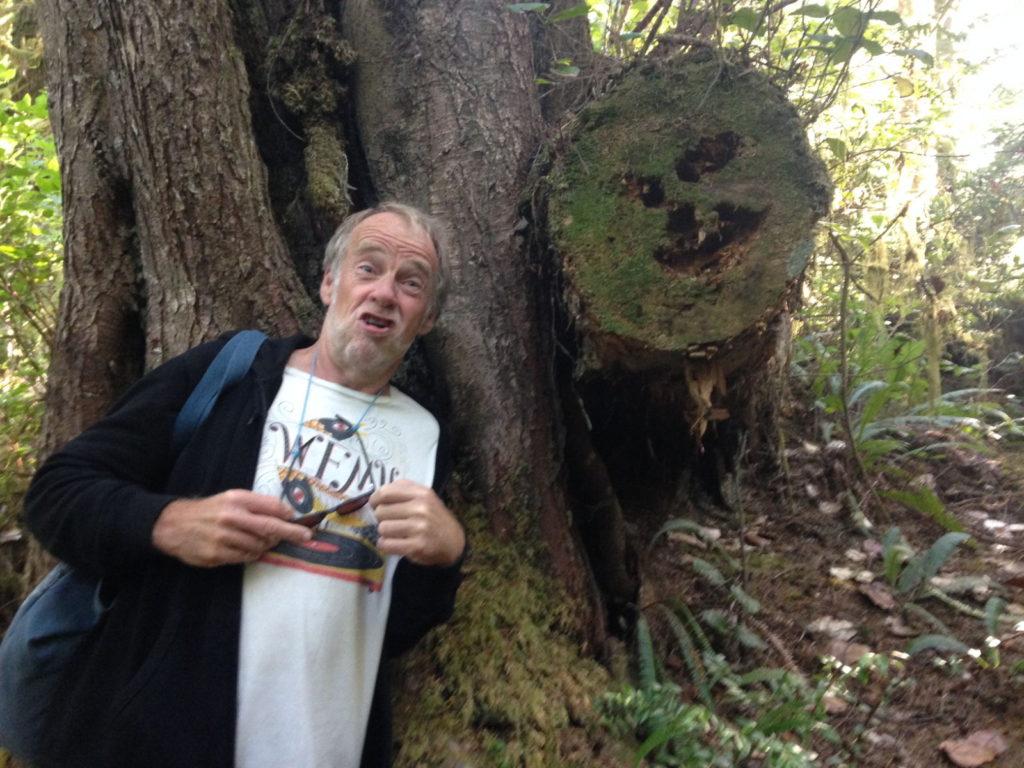
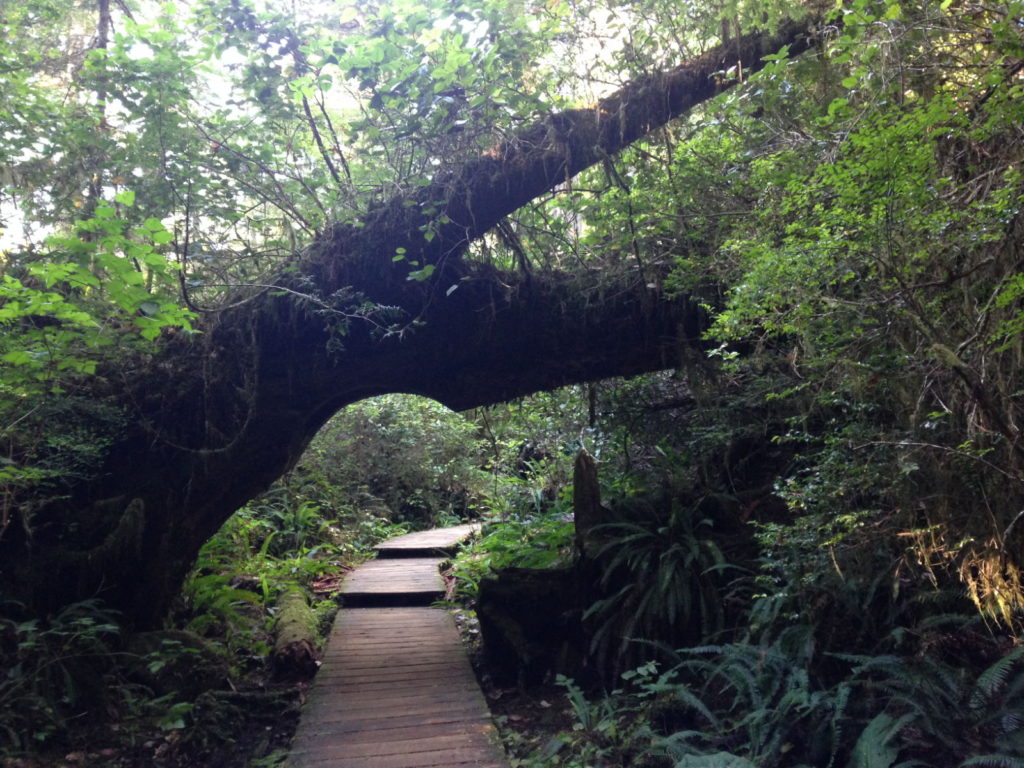
When not scrutinising the planks, the rainforest around us
provided its own attractions. The trees were spectacular, as you’d expect in
Canada. Their roots were the stuff of fairy tales, spreading out far from the
base of the huge trunks to form intriguing shapes and hollows. The branches at
the lower part of the trunk were as big as some of the smaller trees, and they
too formed irregular and bendy shapes. In the early evening light it was truly
a magical setting, especially with the heavy covering of leaves only letting
chinks of light through above us – and all the better for having it mostly to
ourselves. Pics below.
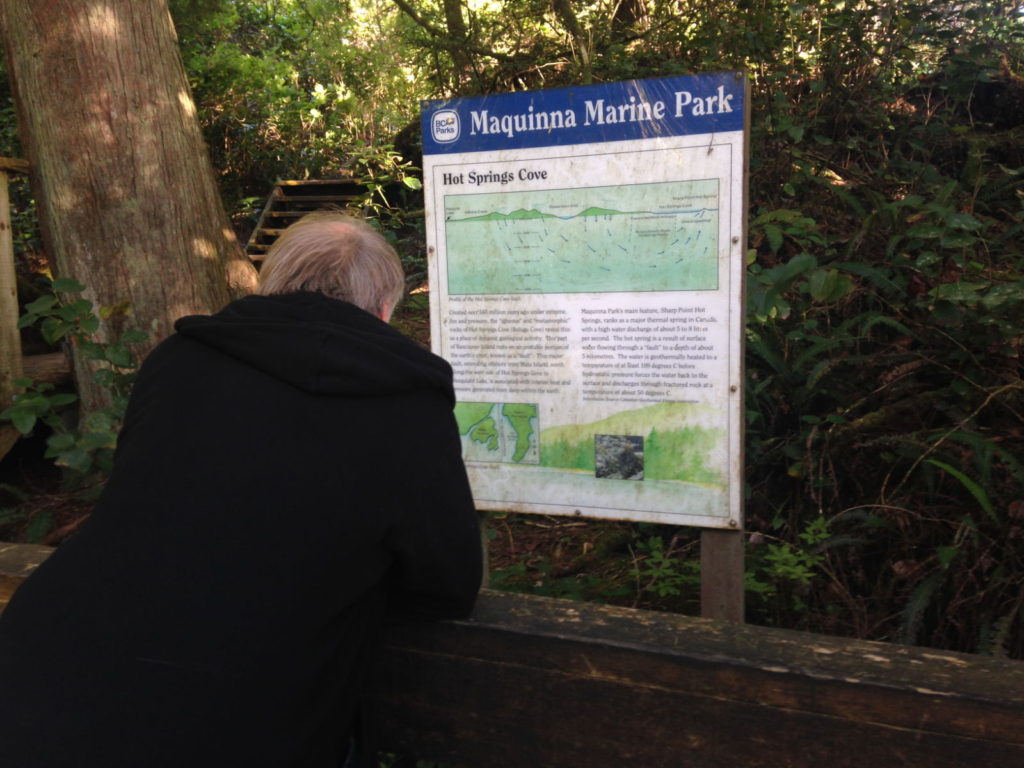
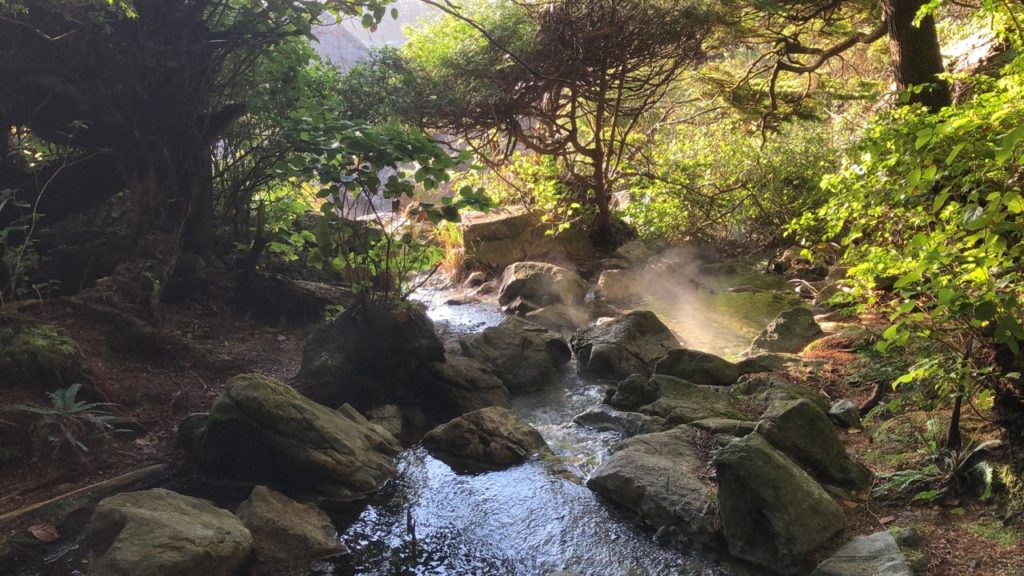
We knew we were near the springs when the smell of sulphur began to permeate the air and wisps of steam were visible a little way ahead. A few more people were around now, beginning to make their return trip along the boardwalk back to the camp site or hurrying to make the departure of the last tourist boat. We stopped to read a sign near the springs that explained they originate from a fault deep down in the plates, which made Paul think immediately of earthquakes.
The way to the springs before the boardwalk was built
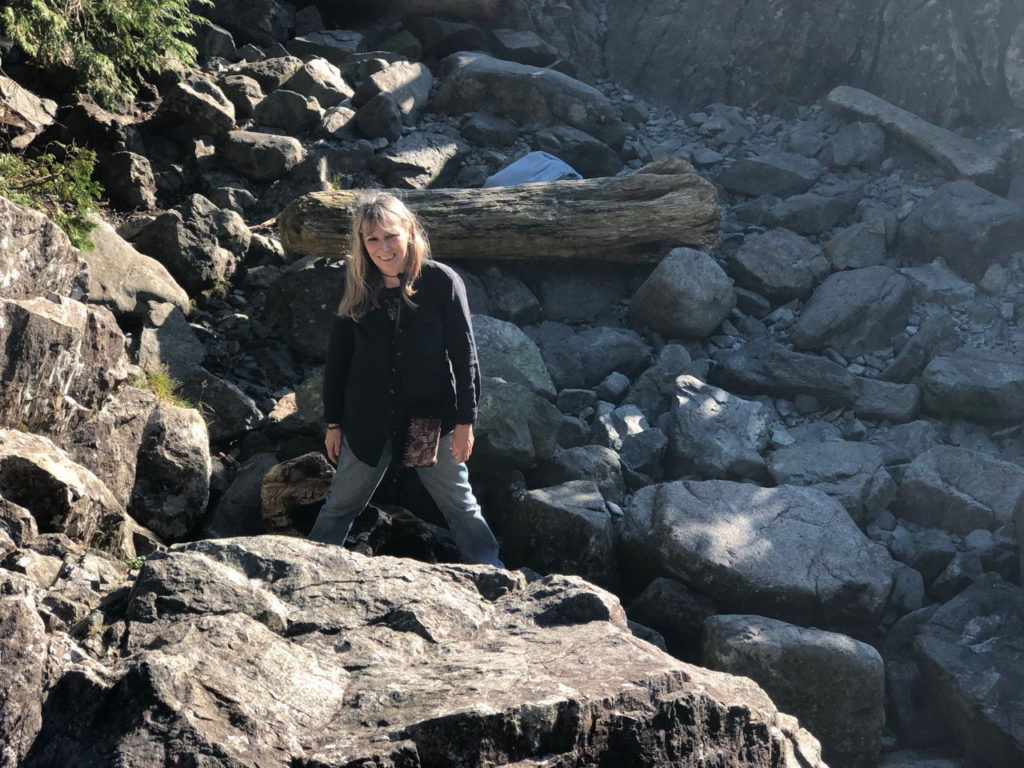
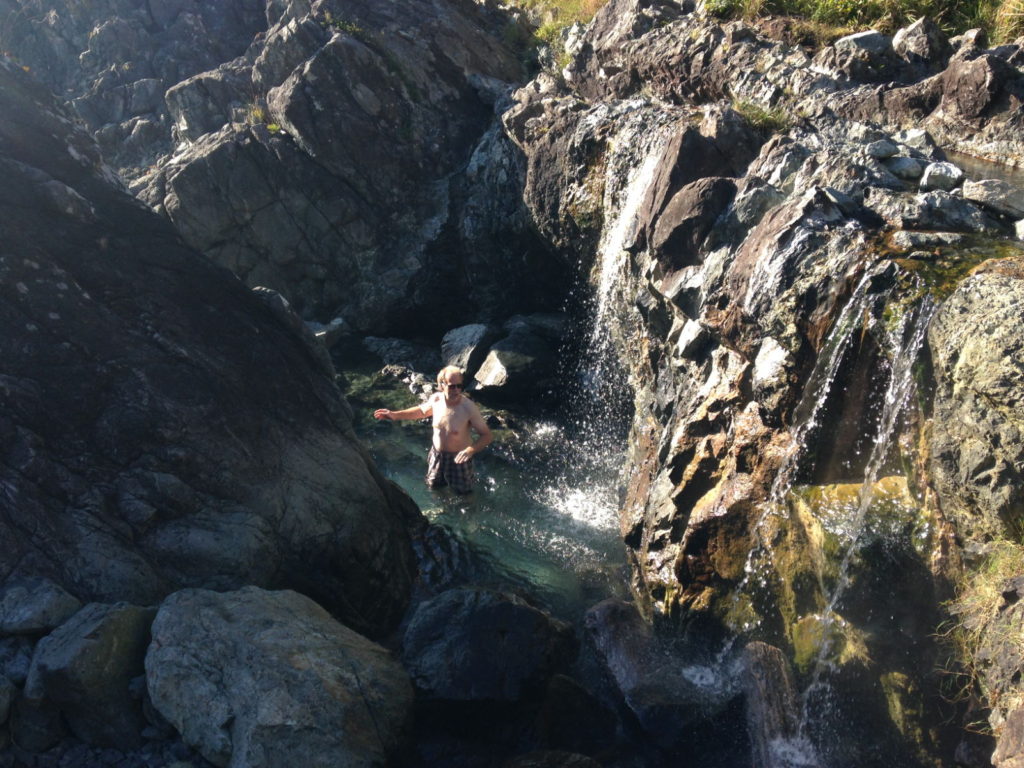
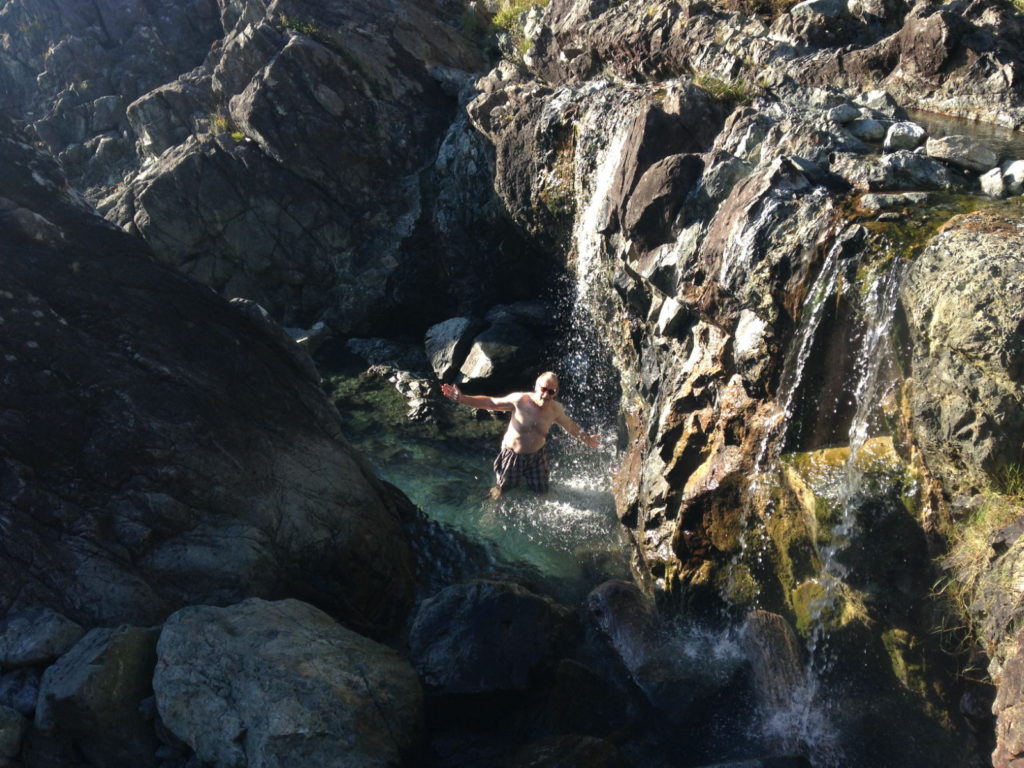
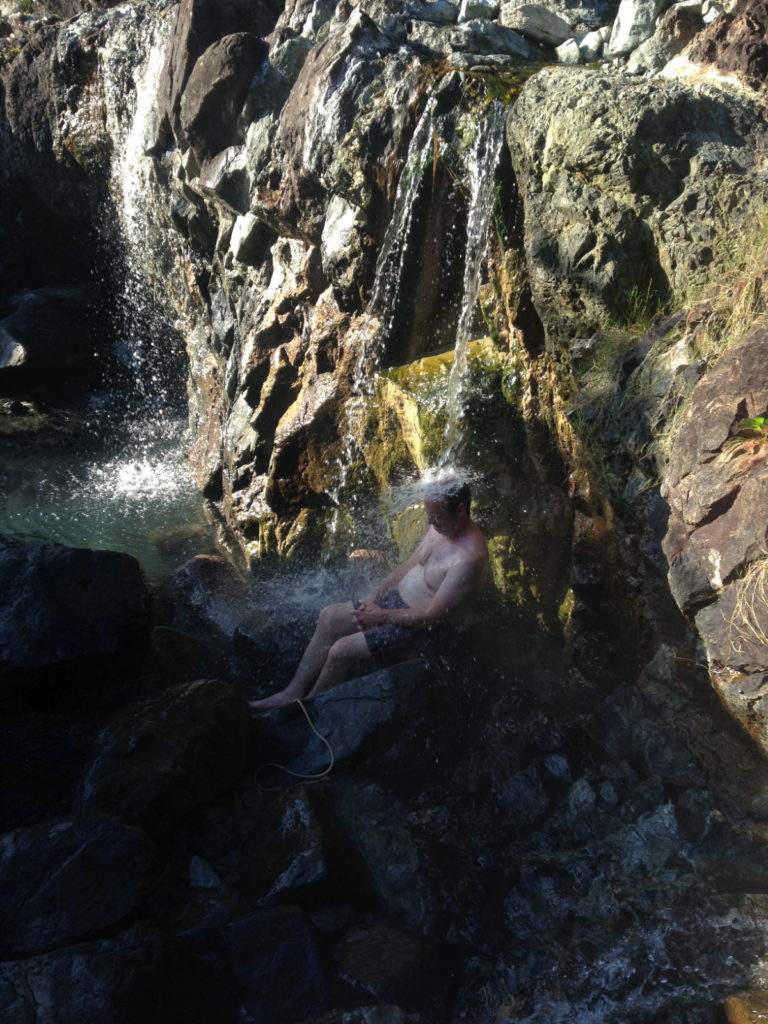
Undeterred by the prospect of earthquakes, however, he wasted no time in getting changed and stepping gingerly down into the hot, sulphurous steamy water. The pool itself is quite small, located amid a bed of jagged rocks, but at intervals waterfalls of hot water cascade down from the upper rocks to create a natural shower. Apparently people used to bathe nude in there and wash themselves with soap and shampoo but all this is now banned and swimming attire is required. Watching him sit there enjoying the force of the hot water on his head, back and shoulders so that it felt like a massage, I wished I’d mustered the courage to join him. Still, it was pleasant enough to sit in the evening sunlight and watch pretty blue birds with distinctive black mohican crests flying around, which I’ve since found out are called Stellar’s Jay. Try as I might though I could not get a good picture of them. Instead, here are some of Paul enjoying the springs.
Rest stop on the way back
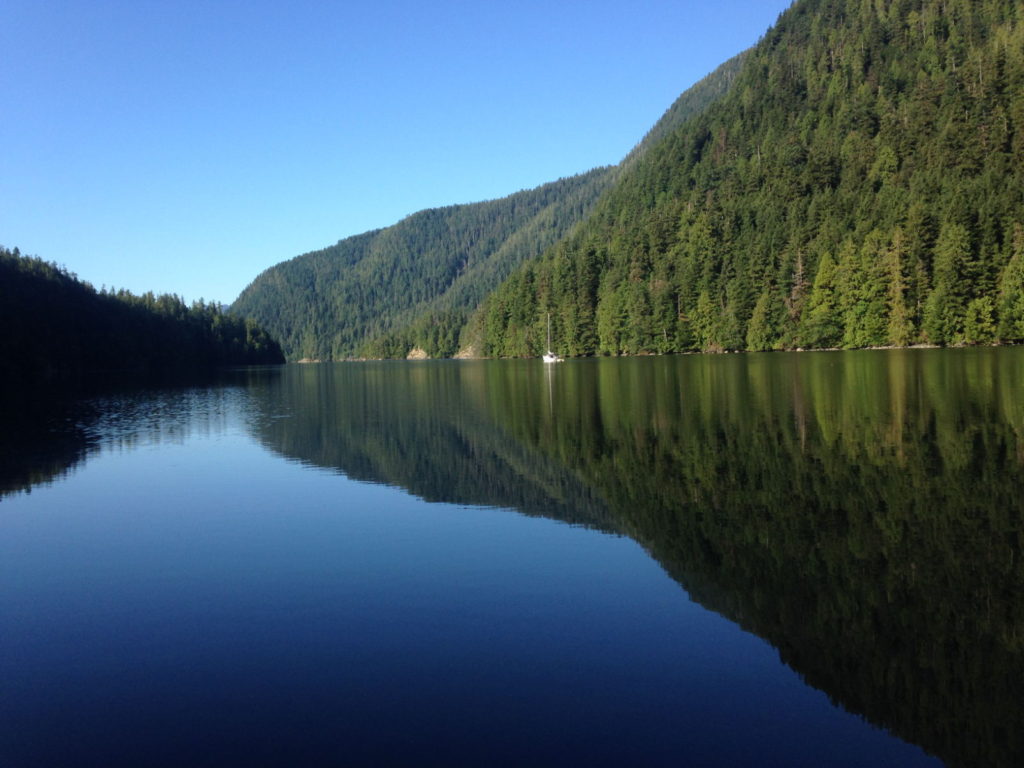
There was no need for an early departure the following day. We hadn’t settled on anywhere to definitely head for next so popped over to For Good to discuss destinations. Bacchante Bay was the place we decided on, and little did I know it would prove to be one of the most stunningly beautiful location I had seen so far. The three hour passage began at midday, and the weather remained clear, bright and sunny. By 1 o’clock Paul had all three sails up and we sailed peacefully through beautiful steep forested hills, where the trees displayed every shade of green you could imagine. Even though we made slow progress when the wind dropped, it hardly mattered when we could drink in those exhilarating views. Added to this was the exciting prospect that at any moment we might spot a bear.
Beautiful Bacchante BayThere’s bears in them there woods!
For Good was sitting at anchor when we arrived at 3 30. Their dinghy was missing from behind the boat and we spotted it on the log-strewn beach opposite. Behind the beach was a grassy meadow, leading into lush forest – unmistakeable bear territory: Robert had clearly wasted little time in going ashore to explore the area. Looking around, once we’d secured the anchor it was easy to see why. In this secluded haven we were surrounded by thickly forested cliffs, the highest we’d seen yet. It was extremely quiet and still, with only the odd ‘plop’ of fish jumping to break the silence. A snow-capped mountain in the distance completed the breathtaking scenes. I was content to sit and stare, but for a closer view of the rocky inlets at the bottom of the cliffs, Paul got in the kayak and spent ages paddling round the shores.
Says it all, really
The four of us finished the day sitting in our cabin drinking and chatting and swapping the results of our homemade (or boatmade) baking sessions. Vanessa brought some delicious cookies and I gave them a loaf of another successful batch of freshly-baked bread.
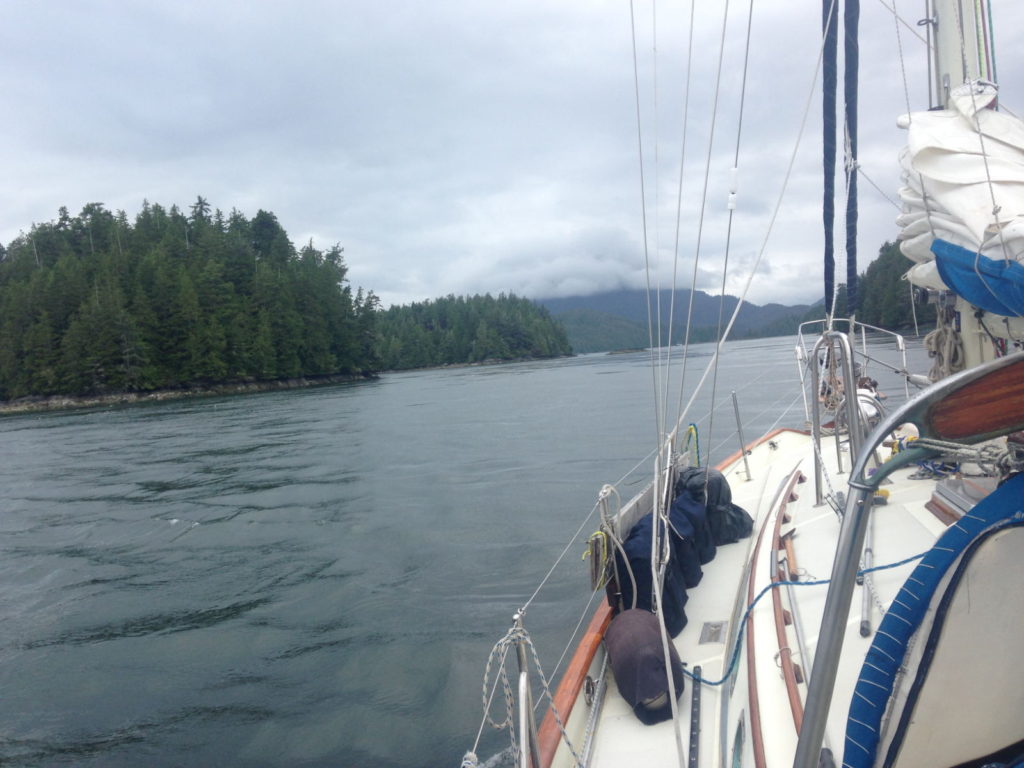
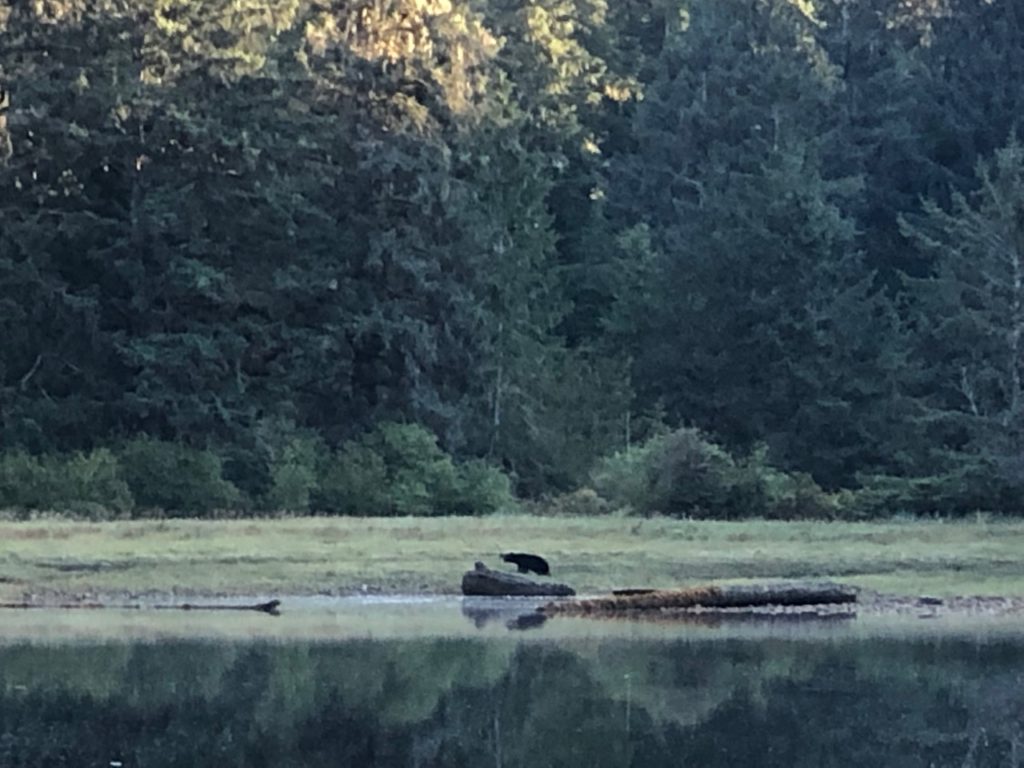
Monday 26th August, a bank holiday in the UK, began for us with the delightful sight of a black bear ambling along the beach in the early morning sunlight. In such an enchanting location, with sights like that I think all of us were tempted to stay longer. We were all in need of replenishing various items for our store cupboards though so we stuck to our plan of leaving at 9 30 for Tofino so that we could hit the shops. Not long after departing, Paul took us on a short cut around an island that turned out to have some alarming shallow patches and rocks that looked a bit too close for comfort (‘we will be fine’, he said). It was worth it though because it turned out to be very pretty. Luckily we saw it before the fog descended around midday. I positioned myself at the bow to keep a lookout for buoys and boats.
Going through the short cut
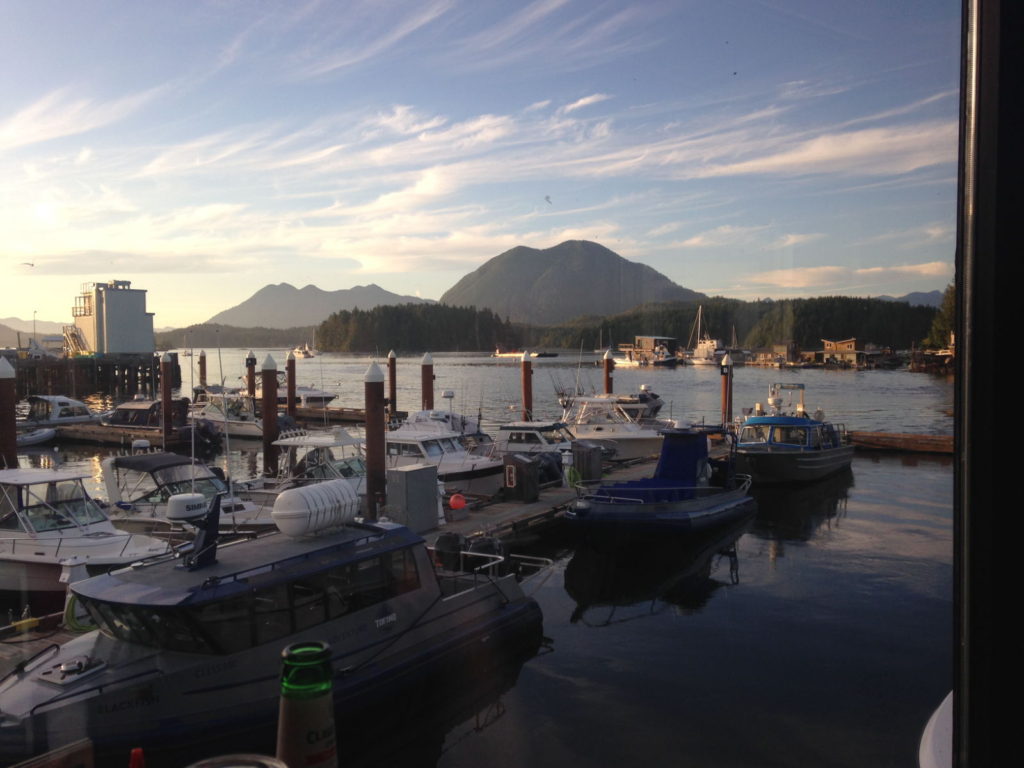
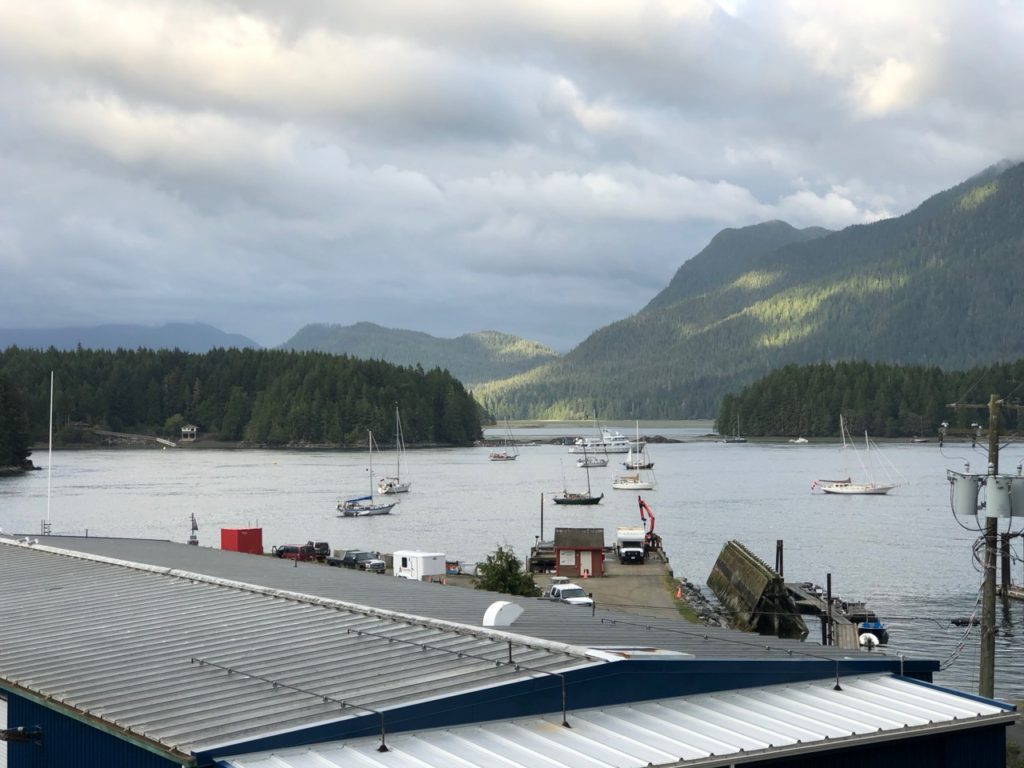
We knew it would be shallow water on the approach to Tofino so we all stuck rigidly to the route mapped out on the chart. Buoys near the marina were emblazoned with the word ‘shallow’ on a bright pink surface – perhaps for those who hadn’t researched the area. For Good had called ahead and booked us a place in the marina where would be rafting together on a pontoon fairly close to that pink buoy. We would go in first to tie up so that we’d be on hand to assist Robert and Vanessa with their first rafting. Despite the three of us (not Paul, naturally) being anxious about the decreasing depth the nearer we got to the pontoon, we rafted the boats together with no hassles. After checking in, we met at a bar in Tofino’s main street for some well-earned refreshment. The town wasn’t what I had expected at all. We’d heard it was a tourist town, prone to crowds and noise. Waggoners warn of experiencing culture shock from its commerce, loud engines, traffic and tourists. Maybe I was imagining somewhere like our busy UK seaside resorts, some of which can be garish, noisy and shabby – especially in high season. Tofino is none of these – it’s elegant, charming and picturesque, surrounded as it is by wild natural scenery and beaches; while its lakes, inlets and the ocean make it popular with surfers, kayakers and sea-life enthusiasts. Tasteful gift shops, shops selling sporting essentials and inviting cafes and bars line the main street along with art galleries and museums. It was busy and vibrant, yet even after the tranquillity we’d come from it was pleasant and definitely not loud and rowdy as I’d been dreading. I felt sure I was going to enjoy our few days in Tofino.
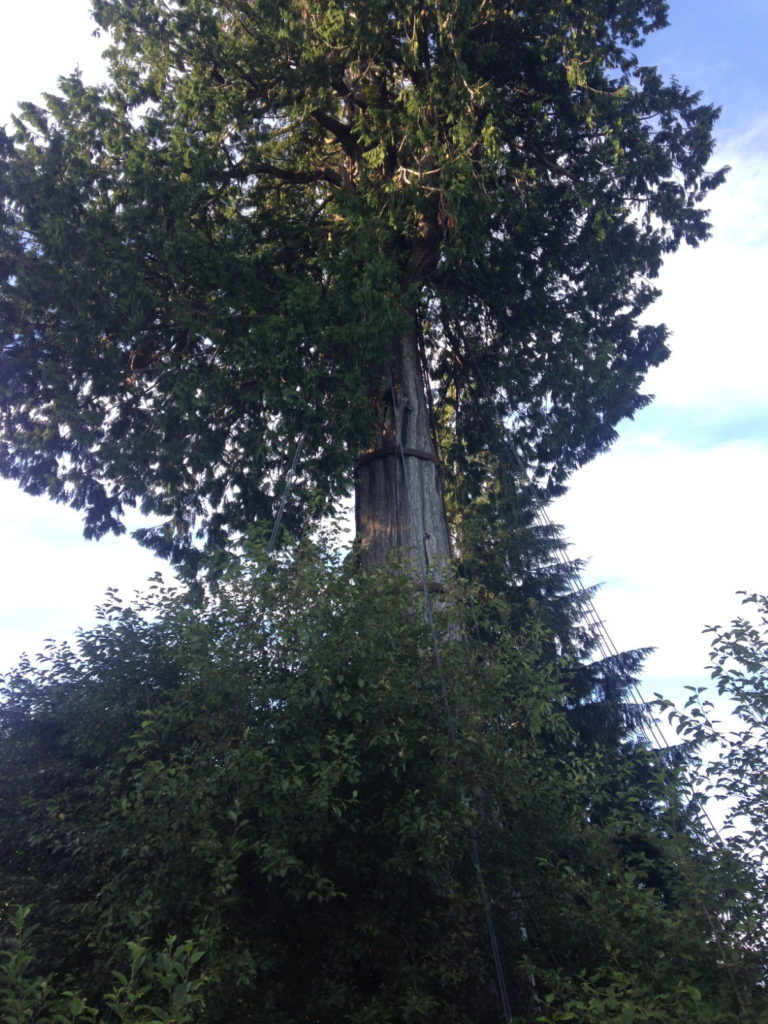
TofinoAn 800-year old tree in Tofino
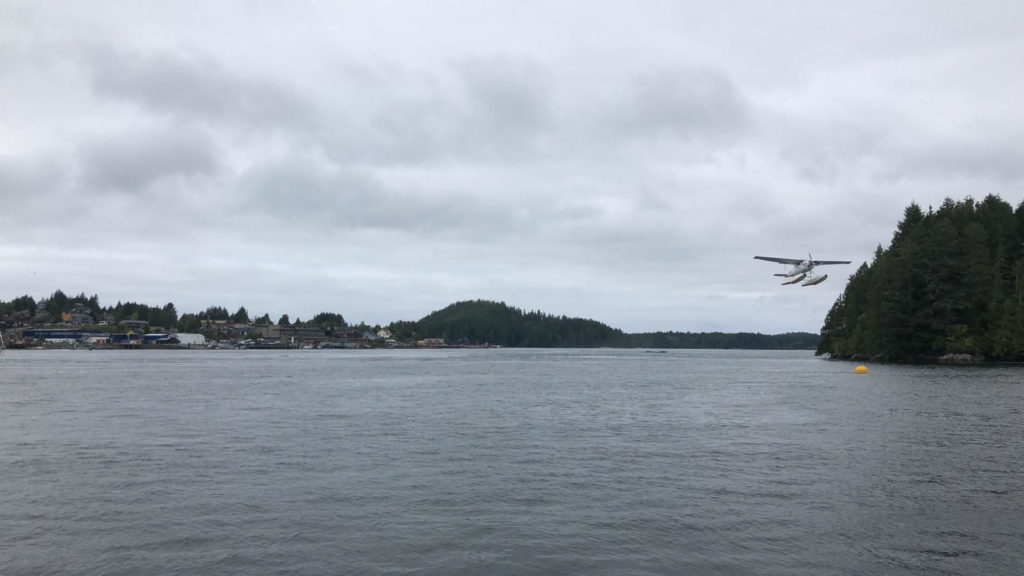
We spent three days on the pontoon making the most of marina facilities, going for walks, replenishing provisions and trying out the restaurants. On the 29th we decided to move out into the anchoring area at Duffin Passage until conditions were favourable enough to move further along the coast. The current was very strong and it took us two attempts to set the anchor. The water all around us was choppy but it was just about cope-able, and even though noisy float planes regularly took off and flew closely overhead, I was content to stay put rather than go out in that current again. Robert and Vanessa bravely chose to weigh anchor and seek a more calm location to ensure a peaceful night.
Our anchorage in Tofino
For Good ended up in a place called God’s Pocket and we met them there a couple of days later. The current was not as strong as when we anchored but we had a bit of a shock not long after we’d left the anchorage when a fisherman coming from the opposite direction warned us that there was a submerged rock to watch out for. Paul quickly located it on the chart and said we would have missed it anyway. The water was shallow and we were surrounded by whirlpools and eddies which made it impossible for the autohelm to steer so Paul had to take the helm while I kept an eye on the depth and looked out for crab pots for the hour long journey. The current got so strong at one point, that we were effectively not moving forward and Paul had to increase the revs to push us on. It was a relief to be in God’s Pocket (that’s a phrase I never though I would say) and spot For Good sitting on calm, still water in a pretty location. We spent an enjoyable last evening of August on their boat chatting for hours, since sadly they won’t be joining us on our trip down the west coast and we’d be heading off in different directions the next day. We will be keeping in touch, though and hopefully will meet up on future journeys. This turned out to be a lot sooner than we expected…
Thursday 15th August Walters Cove, Vancouver Is, West Coast
I hate seeing sights like thisAnd thisThe postman arrives
We went to the Cafe, ‘Java the Hut’ for some dinner early in Walters Cove, the reason being that the cafe closes early on a Thursday as the supply ship the Uchuck III arrives. The Uchuck is a converted minesweeper built in 1942 and is made from fir planking.
The Uchuck III (Actually the 4th Uchuck)
She now brings supplies and passengers to several of the remote coves and settlements along the west coast of the island. Passengers on board have to find accommodation ashore at each of its night stops and a few dozen people disembarked and were divided up amongst various locals who housed them for the night. Later they would all head to the ‘Java the Hut’ for their dinner, hence we had to be out early. It was fascinating watching the kayakers being ‘Wet Launched’ from the ship as I caught in the videos below.
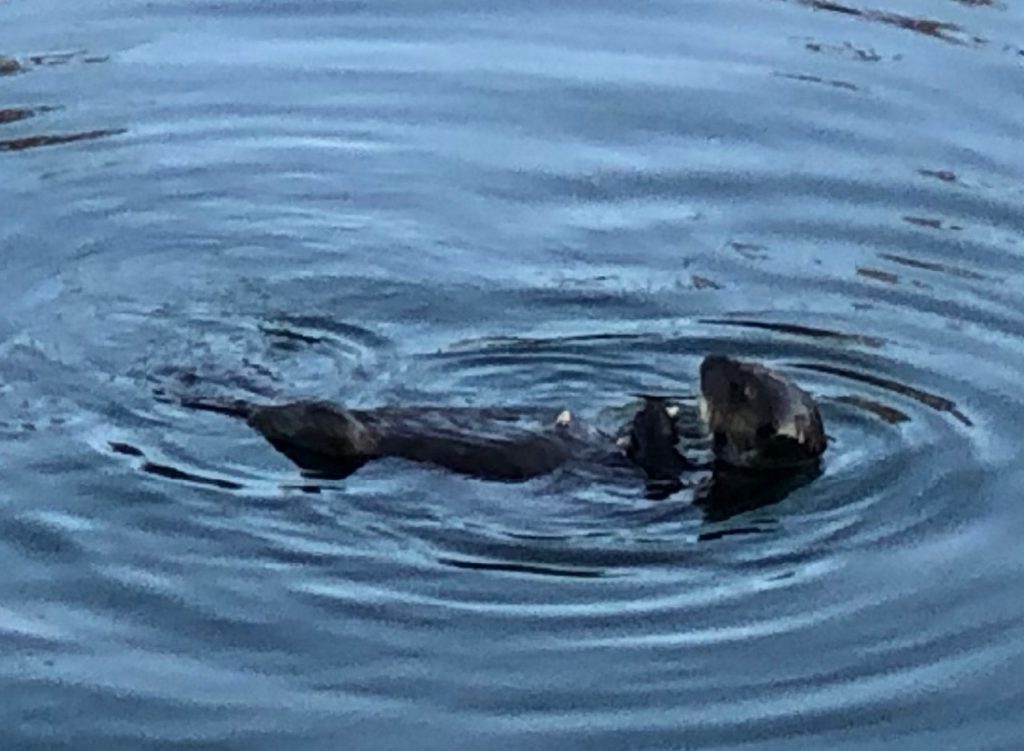
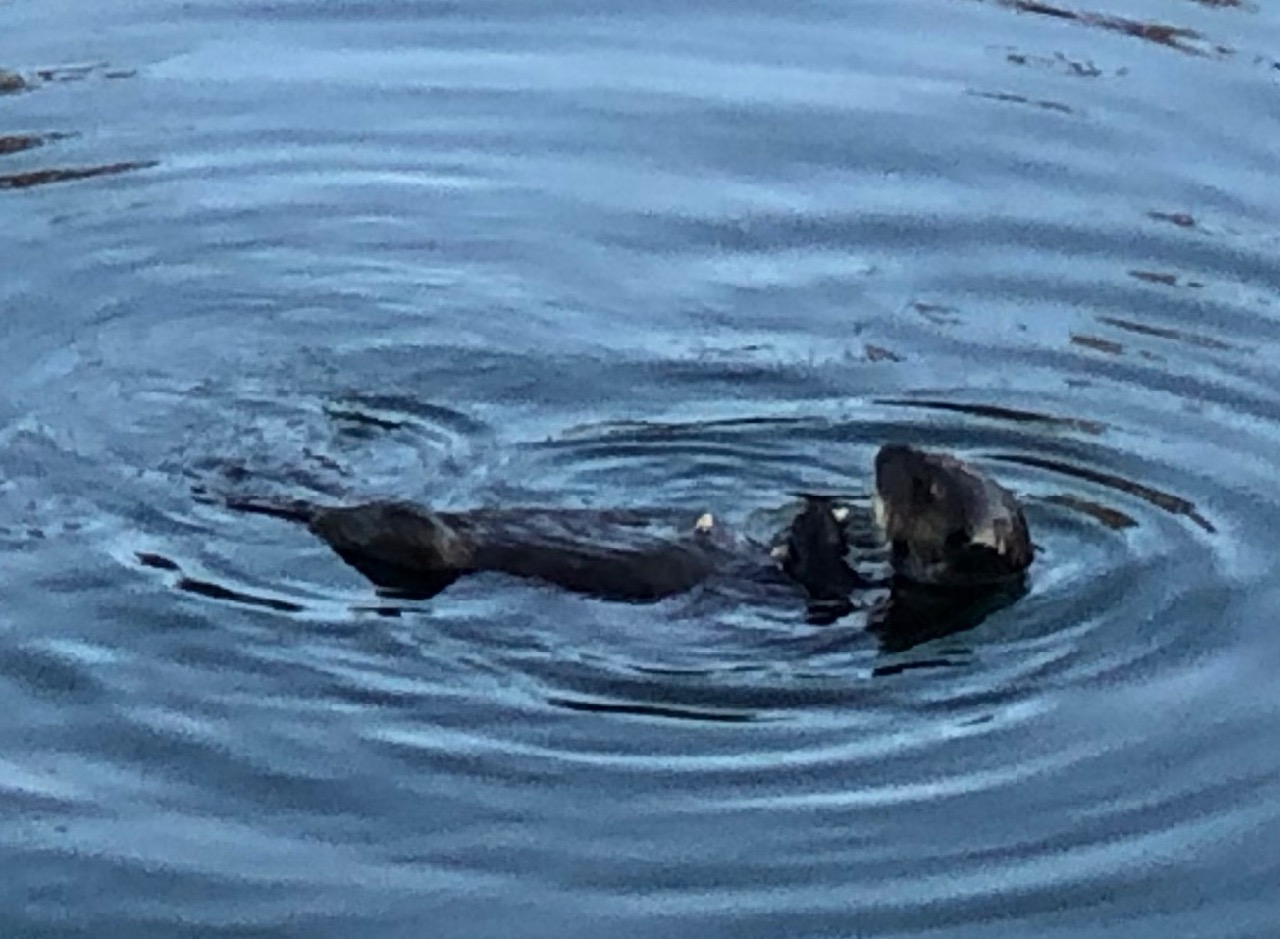
We also had great fun watching a couple of sea otters, one looked like he was getting ready for a night on the pull!
One has to look one’s best
Friday 16th August
After watching the postman arrive we departed Walters Cove for Dixie Cove, it was fun navigating the many rocks on the way out, I tried to use the GPS to keep our position in between the rocks, but it wasn’t updating fast enough and I got quite confused. Once through we went to a cove within a cove, it was very quiet and peaceful, except for the distant sound of machinery coming from the logging operation on the other side of the hill. Just as soon as we had the hook dug in, a fast motor boat approached us to explain that they were blasting over the ridge, but that we were quite safe there, just not to be alarmed by the blast. About an hour later, poor Kathy nearly jumped out of her skin when the blast happened, it was huge! fortunately there was only one, they were blasting through rock for a new logging road.
Sat 17th August We headed over to Rugged Point beach, had a very nice walk, saw bear prints and possibly cougar prints, it was great walking along with Robert & Vanessa as they could point out what the various footprints were. I was reminded of how much grief I gave my father as a 7 year old when buying shoes. I wouldn’t have anything that didn’t have a compass in the sole, or made animal prints, I never imagined I would one day be walking along a beach seeing these impressions for real. Later we found a sand dollar and saw a real black bear.
Thanks to Vanessa for this great video shot from their boatA Sand Dollar
On Sunday 18th we headed over to Nulchitz, an abandoned First Nations village. There was little left of the village. Sailing into the various remote parts of the west coast has made me appreciate just how much of the coast was settled by the first nations and what a bad deal they got from the British invaders.
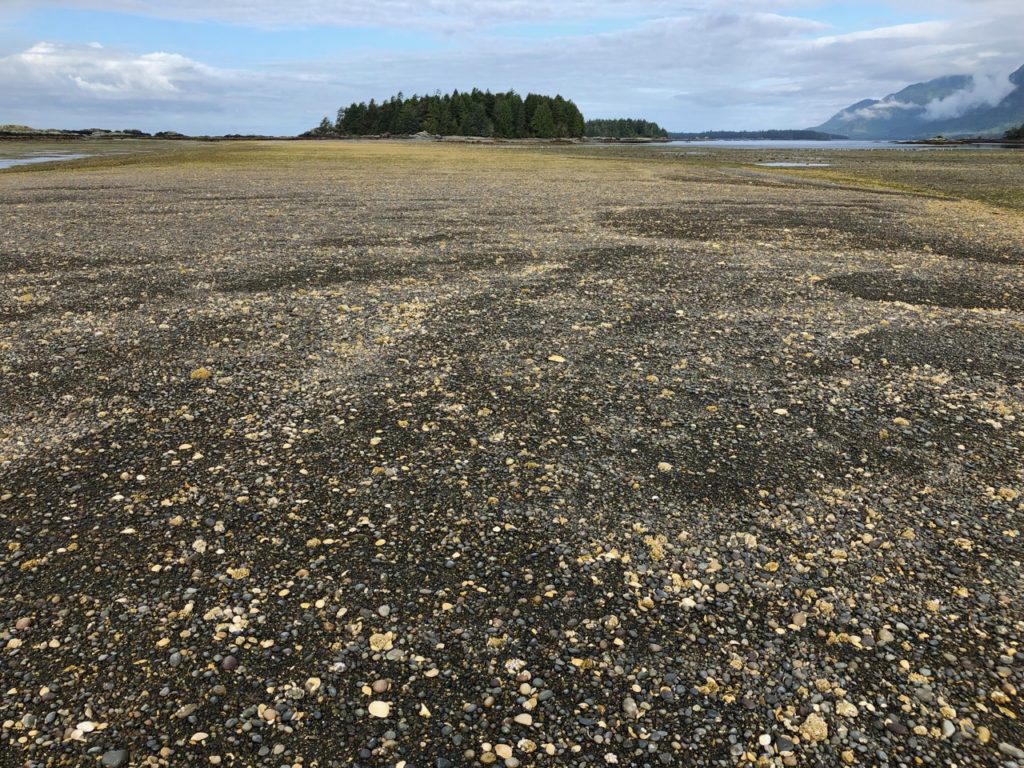
Later I walked across a shingle spit which connected to an island only accessible at low water.
The walk back to the dinghy
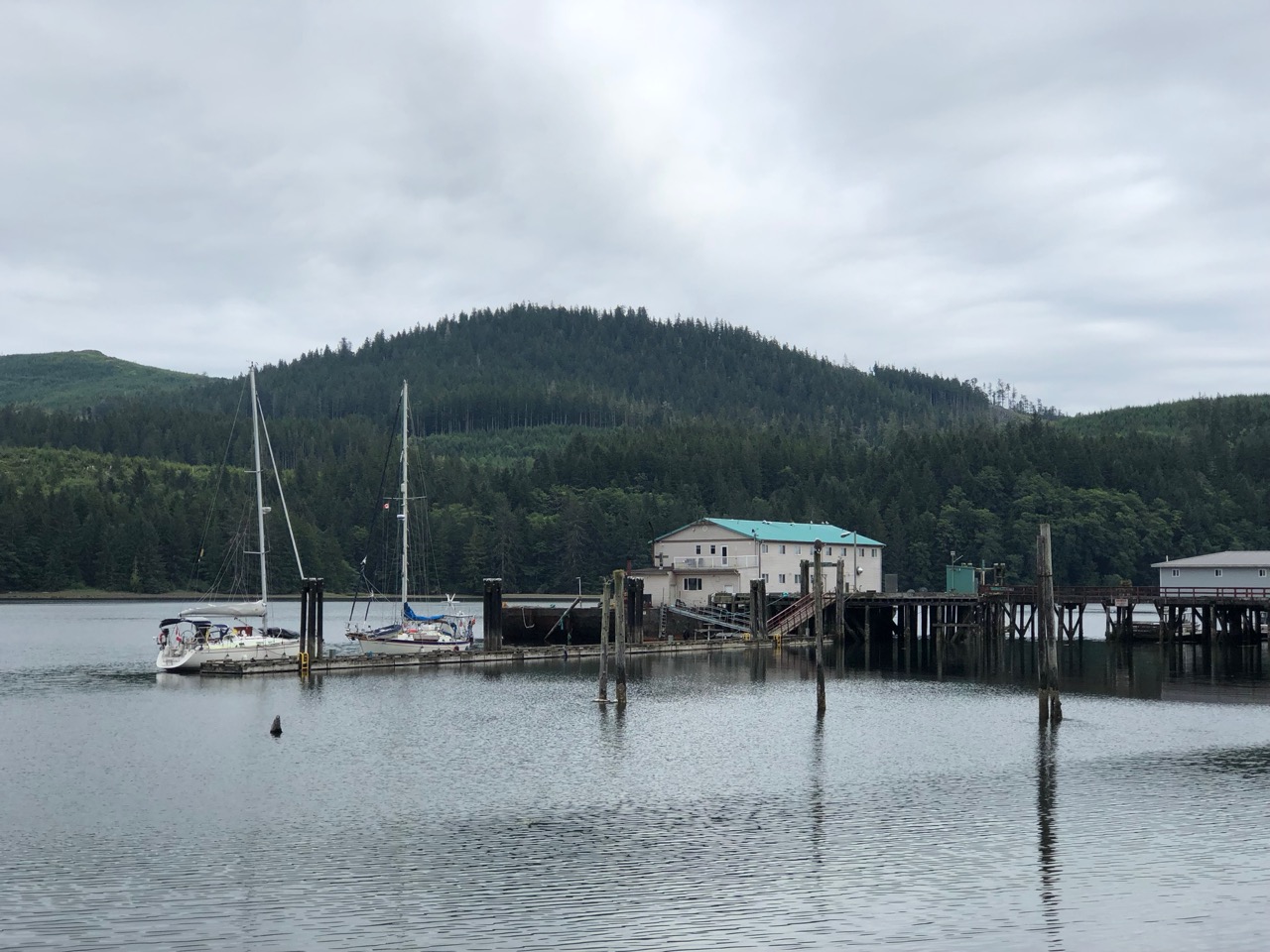
Mon 19th We motored to Tashis except for last hour where we managed to make 5 knots with the headsail out as we headed up the long inlet that leads to the old wood mill town of Tahsis. Once a thriving settlement with two big sawmills and a decent population, it is now rather sad with the mills closed down. The Westview marina has taken over as the centre of activity there. Waggoners guidebook to the area stated we would find a well stocked supermarket, a wine store, a bank/ATM, a cafe, cell phone service and internet. In reality there was poor wifi and no cellphone coverage. All the other delights were to be found in the one store. When I asked in the store for ‘No Alcohol beer’, the shop owner looked aghast and asked me to explain what I meant, when I did, he asked ‘why would anyone want that?’. The Marina mostly caters for Sports fishing and was rammed with little speedy fishing motorboats.
Back at the dock we enjoyed a nice dinner in the cafe, and I had a O’Douls non alcohol beer with it! (Obviously not sourced locally)
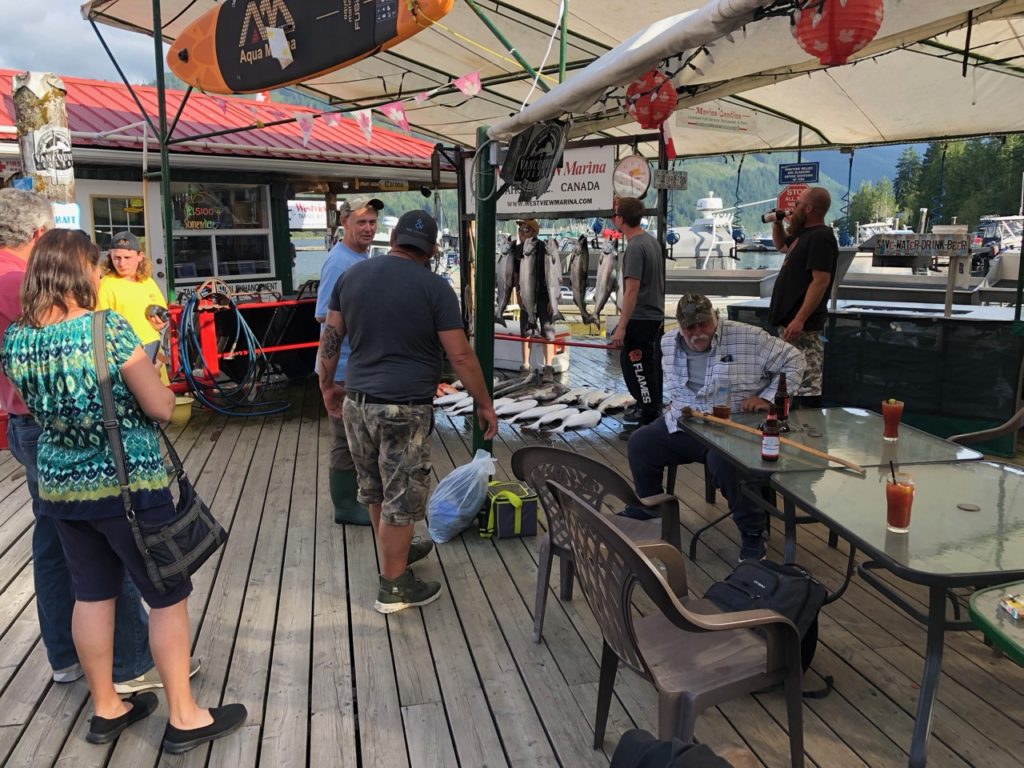
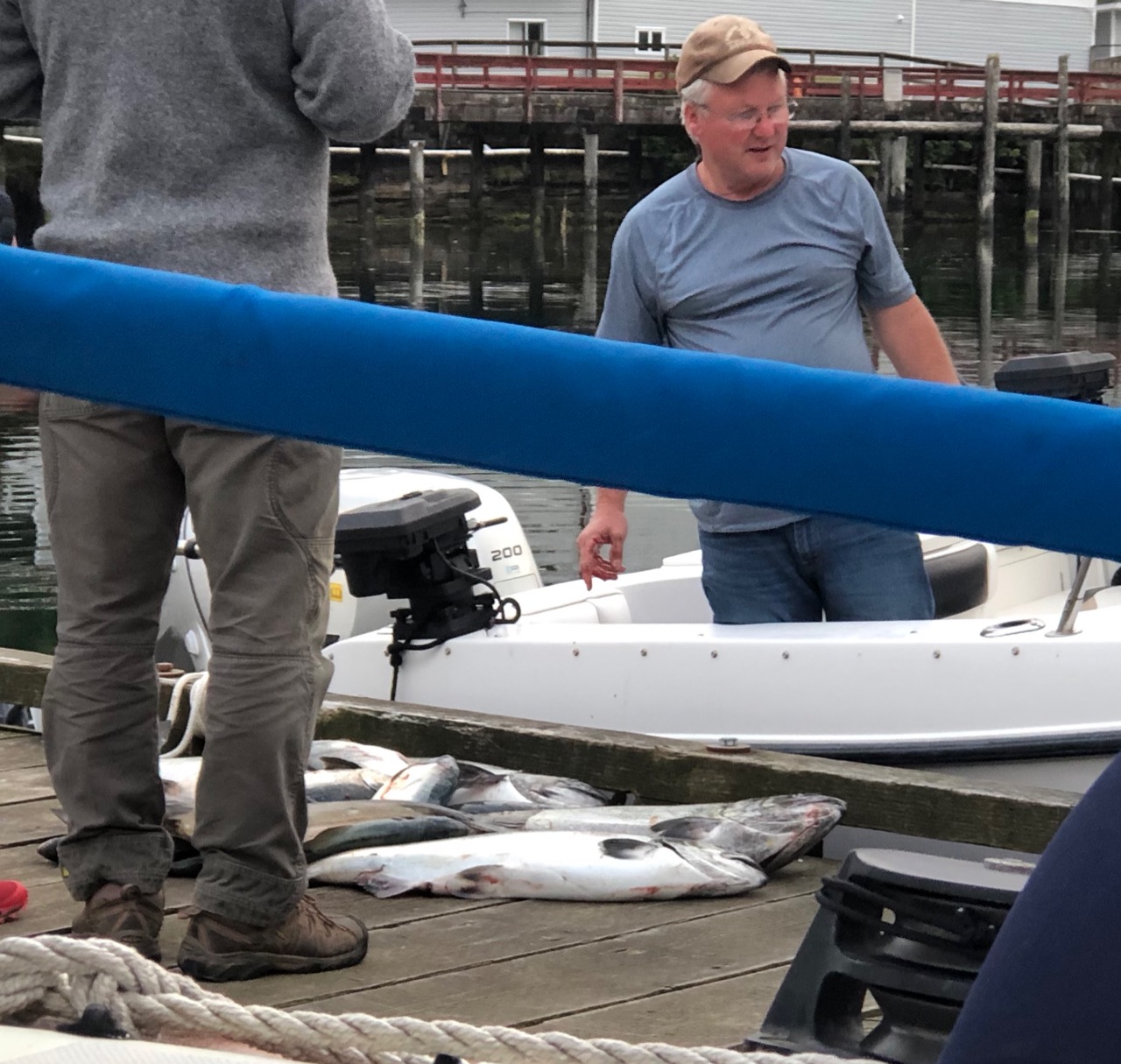
We watched them cleaning freshly caught fish at the gutting tables at the end of the cafe, and all the tourist fishermen stood proudly in front of their prize catches to be photographed.
Fishermen proudly pose in front of their catches hung up behind them.
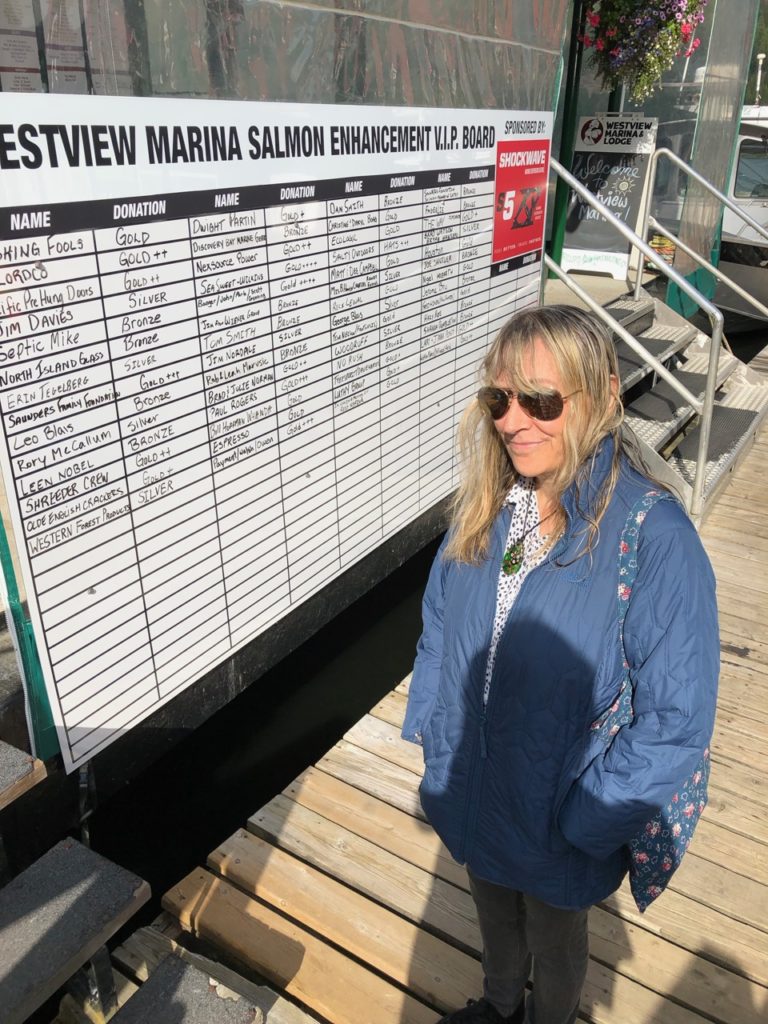
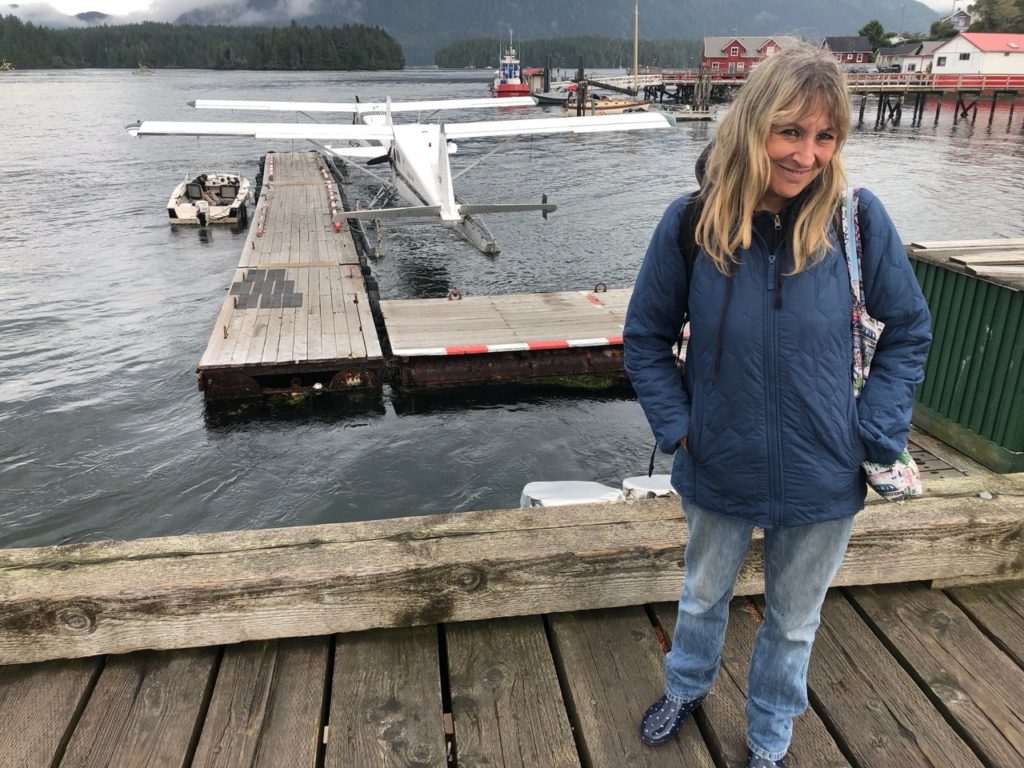
Earlier Kathy had jumped into the sea to get some of the fish heads and guts floating around. It would have been better if she had left her handbag ashore but it seemed to be an impromptu event she hadn’t thought through fully. We all rushed to her aid and pulled her out back onto the dock. There’s a slim chance her mobile phone may have survived as her handbag seemed quite waterproof.
The gap behind Kathy under the sign is where she nearly met a watery fishy end
Tue 20th Bligh Island Ewin inlet
Left for Bligh Island in a building wind, eventually we saw up to 30 knots of wind, we also spotted a bear on the passage.
Spent the evening on Sister Midnight chatting with Rob & Vanessa. They were a bit surprised how big the seas had been crossing over to the island, I was surprised at how many rocks we had to navigate around to get into the inlet, I was reminded of cycling around cones as we did in our cycling proficiency test at school.
This is the area where captain cook re-masted his ship Resolution and just around the corner in Friendly Cove, Captain Vancouver tried to negotiate the ownership of Vancouver Island with the Spanish, failing at first, and almost bringing Britain and Spain into a war with each other. In the end, Britain gained total control.
Wed 21st August
Meet up with Kevin & Karla on Gargoyle, they have a Benateu Oceanis 50, very nice and are heading down to the sea of Cortez like ourselves.
Later meet up with another nice chappie on his Bristol Channel cutter, a classy looking sailboat, a bit like a baba but with a flat transom, but more traditional looking. He had tried to leave for Hot Spring Cove but his engine was playing up, so he sailed back and anchored near us under sail.
Thur 22nd
We depart for Hot Spring Cove, seas build as we pass out of the inlet and towards Estevan point, at one point the swell & waves are around 2 metres with the odd big wave of 3 meters or more roaring in, as we turn to head south towards our destination we are taking the waves on our beam/quarter. We have been travelling with Robert & Vanessa for a few days now and hopefully they will join us for the trip down to Mexico.
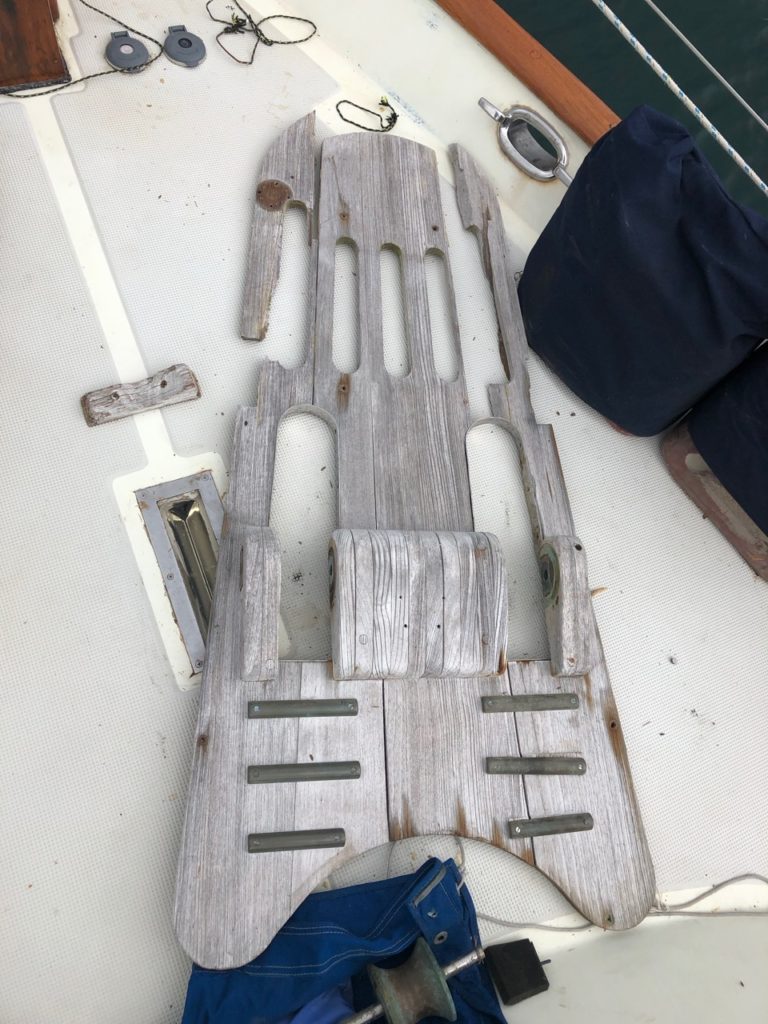
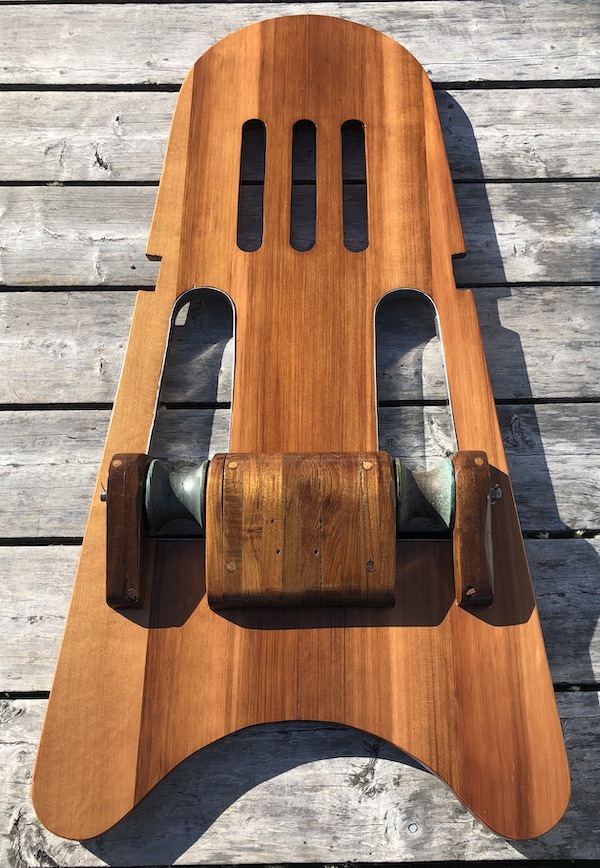
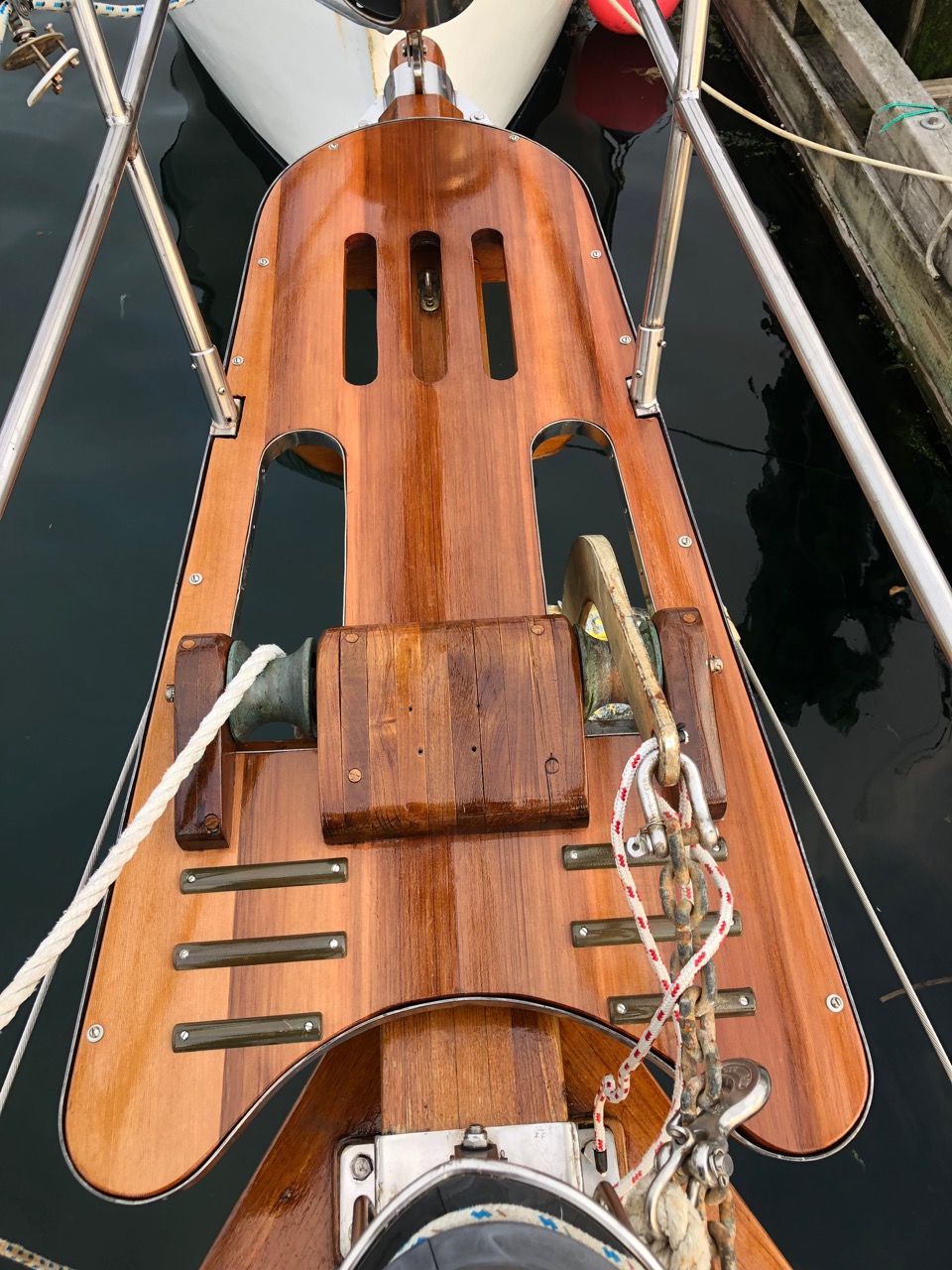
Sadly on ‘For Good’ they are having trouble with their sails and decide to motor sail the rest of the way, another 4 hours or so. Robert calls me on the VHF to say he has engine problems, he isn’t getting any sea water flowing through the engine to cool it. He wants to head for shore but I suggest he just sails the remainder of the route and if needed later I will tow him into the anchorage. Poor Robert and Vanessa are getting thrown around a bit in their boat and their speed is down to about 4 knots as they are having trouble keeping the sail full with all the wave motion. This is by far the worst conditions they have experienced to date. The wind is only about 10-15 knots, from behind, but they struggle with the main blocking the headsail and without safety lines to go forward on the boat they stay in the cockpit. I turn Sister Midnight around and head back to them as they have dropped back by 1/4 mile now. We are going head into the wind and waves, our bow is crashing down onto the waves. I’m pleased to see the new cedar bow platform is taking the waves fine. We reach them in about 15 minutes and I turn and follow them closely for a while. The wind backs slightly and I can see they change course slightly to keep the mainsail filled, however they won’t make the entrance to the cove on that course and will need to gybe both sails before we get there. I suggest we round up into the wind a bit and reach into Hesquiat Bay, which is well protected given the NW light winds, and has a bar (shallow sandbank at the entrance) that keeps the swell out. This bay is massive and around 9m deep throughout so they can drop the hook anywhere without risk. As we approach the entrance the wind moves closer to our bow so we haul in the sails, Robert hasn’t adjusted his sails so they flap a lot and he drops to 3-4 knots, I roll up 50% of my headsail so I don’t get too far ahead. Within an hour we are over the bar and drop the hook in a very settled area.
I had checked that Robert was ok to anchor under sail on the VHF radio, and he was happy. It was then that I realised I had never anchored this boat under sail alone, and as it was calm, in a big empty bay, I decided I would do the same too. I rolled up the headsail and asked Kathy to steer into the wind, she thought this was so I could drop the mainsail and was a bit freaked out to hear the anchor chain running out. I was also a bit freaked out as a small squall came through just as I let out 30 mtrs of chain, the bow blew down, the main filled and we took off at some speed. I legged it back to the cockpit, let out the main a bit, ran to the mast and dropped the mainsail rather quickly, then back to the bow to continue with the anchoring.
Fri 23rd
Robert gets engine going, but it’s too late to leave, they are still resting after their rough ride here. I dinghy into Rae Basin, an even safer spot at the head of the bay, a river flows into here and some impressive trees lie there. I hadn’t realised but it’s a very short walk to the huge Hesquiat lake that lies at the head of the river.
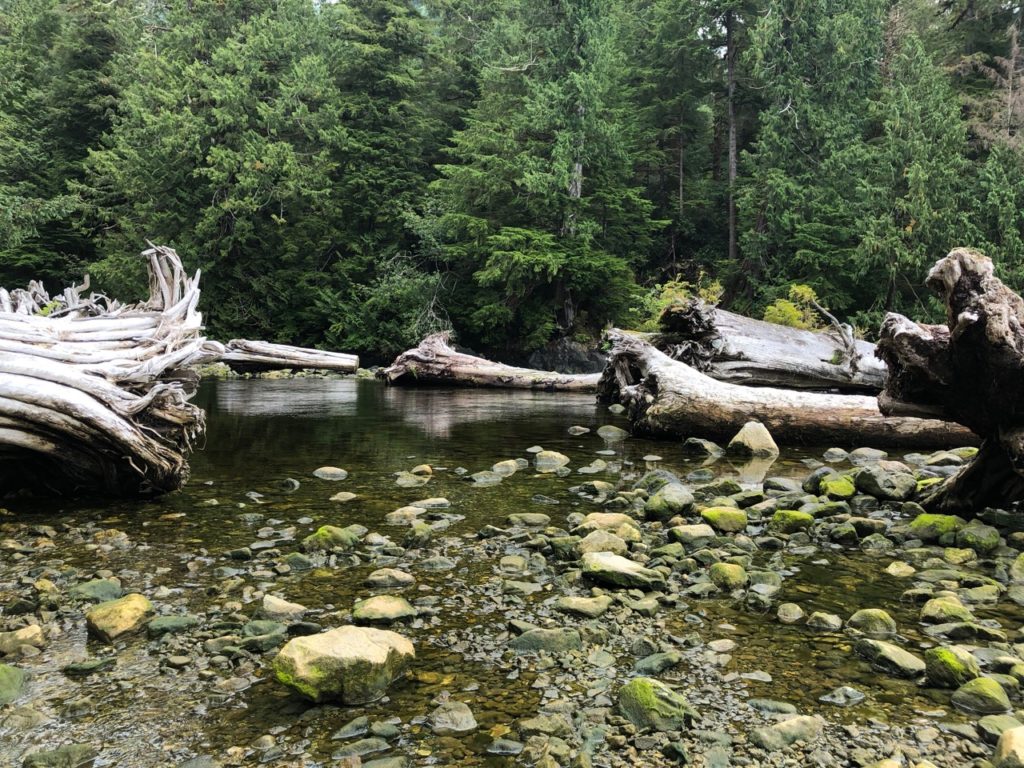
Huge logs lying at the mouth of the river
Sat 24th Depart Hesquiat Bay for Hot springs Cove.
Lots of crab pots to watch out for here.
Nice motor, no wind, swell building
Forecast has swell dropping from 2-3m to 2m by Sunday but wind rising to NW 30, so now seems best
It takes just 3 hours before we are happily anchored in Hot Spring Cove
We head off to the springs, the custodians of the springs have built a wonderful walkway through the forest, it runs for 2km and there had been a tradition for visitors, mostly yachties to leave a plank with their boat name carved into it.
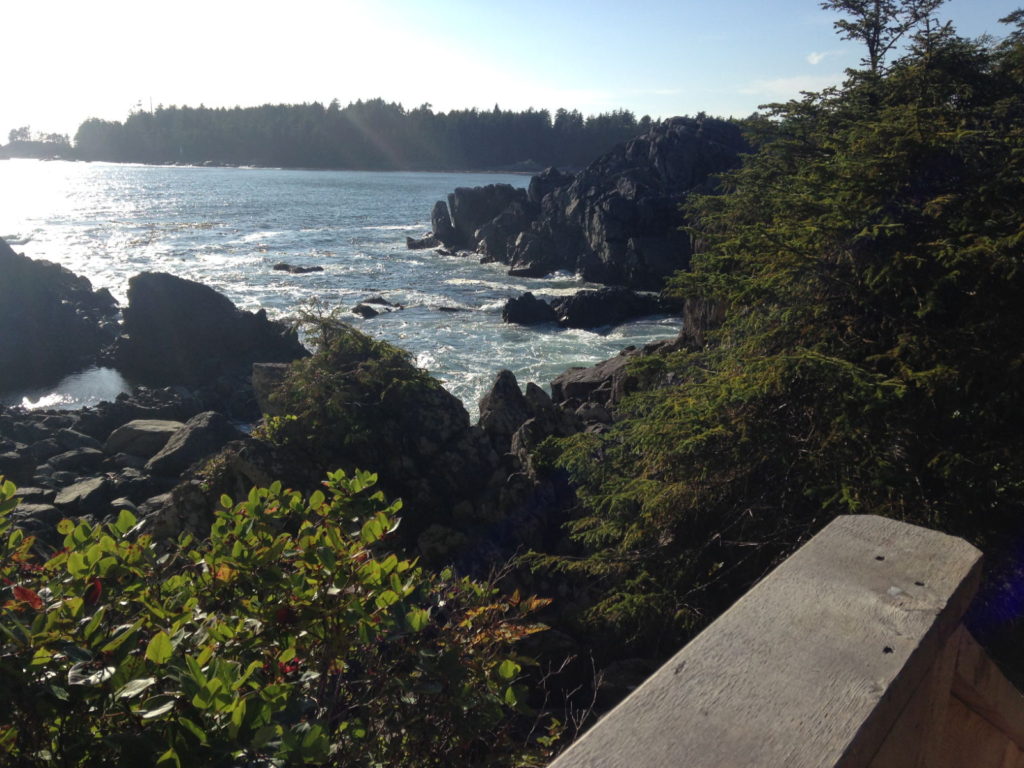
Once at the springs I spent a long time sitting in the hot water which gushed down the hillside then out into the Pacific Ocean. It was so relaxing sitting under a hot waterfall being pummelled by the water falling, just like a jacuzzi. However it might have saved a bit of time if I hadn’t gone in with my fancy sunglasses on, I became very intimate with all the various pools between me and the ocean before I found them. Kathy reviewed the pictures she had taken of me to determine when I had lost them and on searching that pool they turned up, Phew.
At some point Kathy baked a couple of top notch loaves.
From the Hot springs we took the inside route around Flores island and stopped in a lovely spot at the head of the Bacchante inlet. Here we spotted another big black bear prowling along the beach.
Bacchante was beautiful and we could easily have stopped there for several days, but Kathy was worried about not having had any wifi/cellular connections for a while, and we were running low on chocolate, so we headed off to the fleshpots of Tofino. Vanessa had called ahead and found there was room for two boats to raft at the hammerhead of the end pontoon. They rafted to us, a first for them, of course rafting, or ‘parking alongside’ is easy to do when the weather is fine and currents aren’t an issue, however when you have never done this before, I can remember, it’s quite a scary thing. As it turned out, Robert brought his boat alongside us perfectly and we were soon all sitting in the cockpit having a good natter.
After 2 days paying to be bounced around at the end of the pontoon by the constant stream of day tripper and whale watching boats we headed out to anchor. Currents run fast here, and a healthy sprinkling of rocks and shallows causes quite a few rapids and whirlpools. After a few hours, Robert & Vanessa decided to head off to God’s Pocket, a quiet cove just an hour or so to the north. We left them to it as the whirlpools, and planes taking off over us didn’t bother us much, we also had a lot of internet stuff to catch up with.
These guys arrived at night then dragged during the night.
Tofino is a lovely holiday resort town, it has a long beach famous with surfers, and it’s a bit of a young surfer kind of place, however I enjoyed the art galleries there and Kathy was made up to have a modern well stocked supermarket.
A project boat if ever I saw one.
After a few days we headed up to meet Robert and Vanessa in God’s pocket. another peaceful spot, we dinghied over to them and watched footage of movies Robert has made in the past and picked up videos and photos they had taken of us.
‘For Good’ heading off, hopefully not for good as far as we are concerned.
Sunday 1st September. We said our farewells, Robert & Vanessa had decided that they were going to postpone their trip to the Sea of Cortez, and would hopefully try to make it in 2020. We really hope we can meet up with them next year. They headed off to Ucluelet and we waited a few hours before we went back to Tofino to get a few supplies before we left for the USA. Our plan had always been to leave at the end of August, and the weather was now good, also Monday is Labor Day, a Public holiday in Canada and the USA, so being at sea all day suited us, we would arrive in Astoria on Monday. The plan was to leave Tofino at 22:00 in the dark in order to arrive at the Columbia river entrance around midday on Tuesday when the tide would be flooding and we could safely cross the bar. A bar is a big sandbank at the entrance to a river that can create dangerous conditions if the currents flow a certain way and the ocean swell opposes it. Until 22:00 we had a few hours to kill so we wandered around town, after picking up some supplies in the co-op.
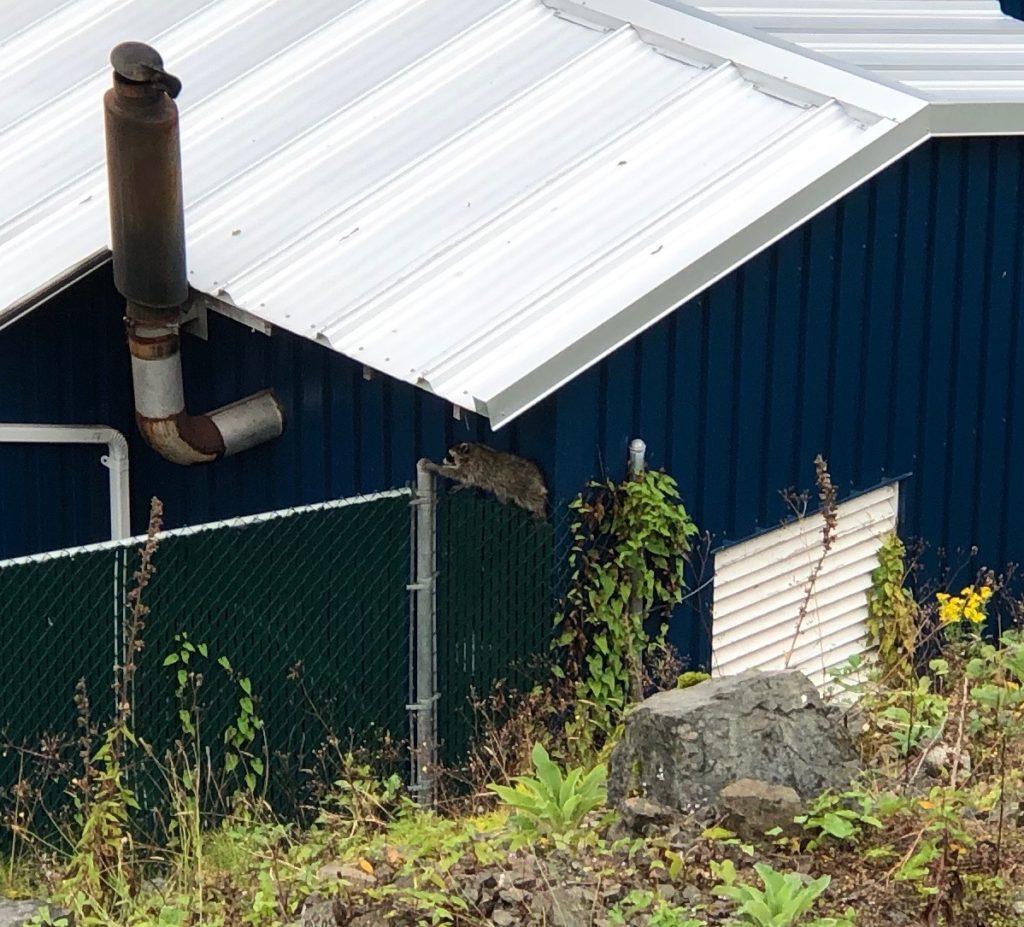
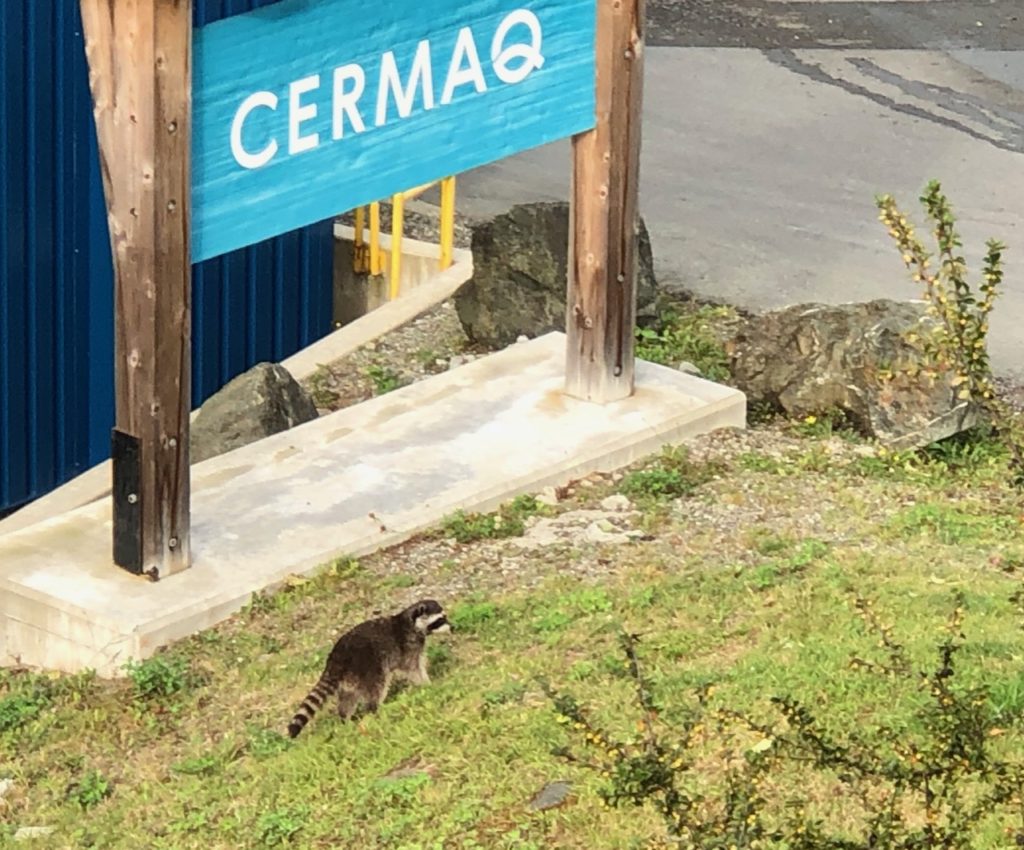
We had some fun watching three racoons stage a break in at a fish processing plant, they seemed to be working as a well co-ordinated team, with one keeping a lookout while the others climbed in through a hole they had found in the wall. I presume the building had a lot of salmon in it.
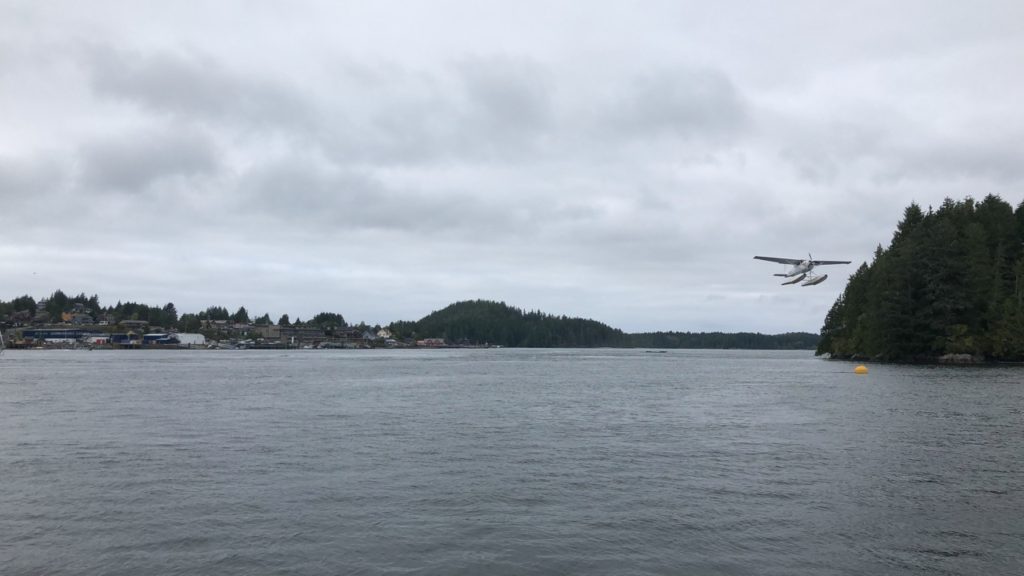
This guy left the building, presumably well fed and was heading home.Watch out KathyPlanes taking off over our mastTofino Air’s operation
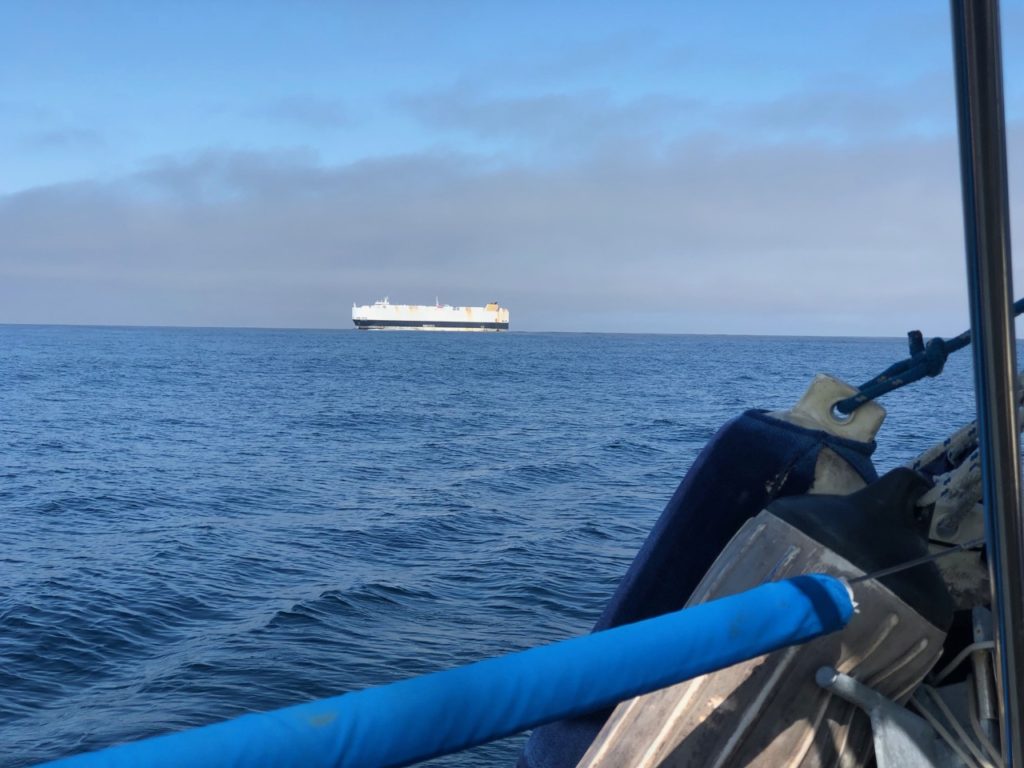
At 10PM we set off into the rapidly fading light, no sooner had we weighed anchor than the fog descended. We navigated our way out, I had already taken bearings on the only pot marker in the harbour in our way and we slipped past that into a grey foggy night. Soon we were bouncing up and down as we left Tofino and hit the Pacific swell. The fog stayed with us for about 20 hours, so Kathy and I kept a close eye on the AIS and Radar. The AIS gives us details on any big ships out there and how close we will get to them. Of course there were quite a few fishing boats without AIS we had to watch for on the Radar. Monday morning and the fog lifted, we could now see the ships out there.
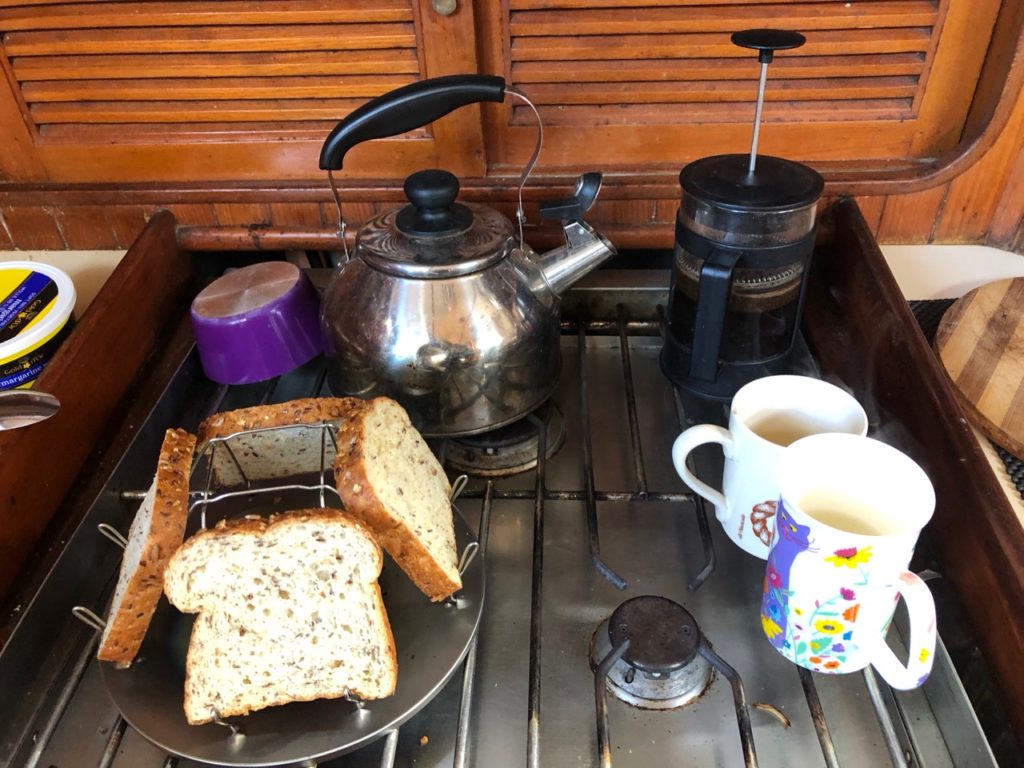
We were able to make coffee and with the new camping device I bought in the co-op hardware store, we could make toast on the stove.
Kathy in her ‘Off watch’ position
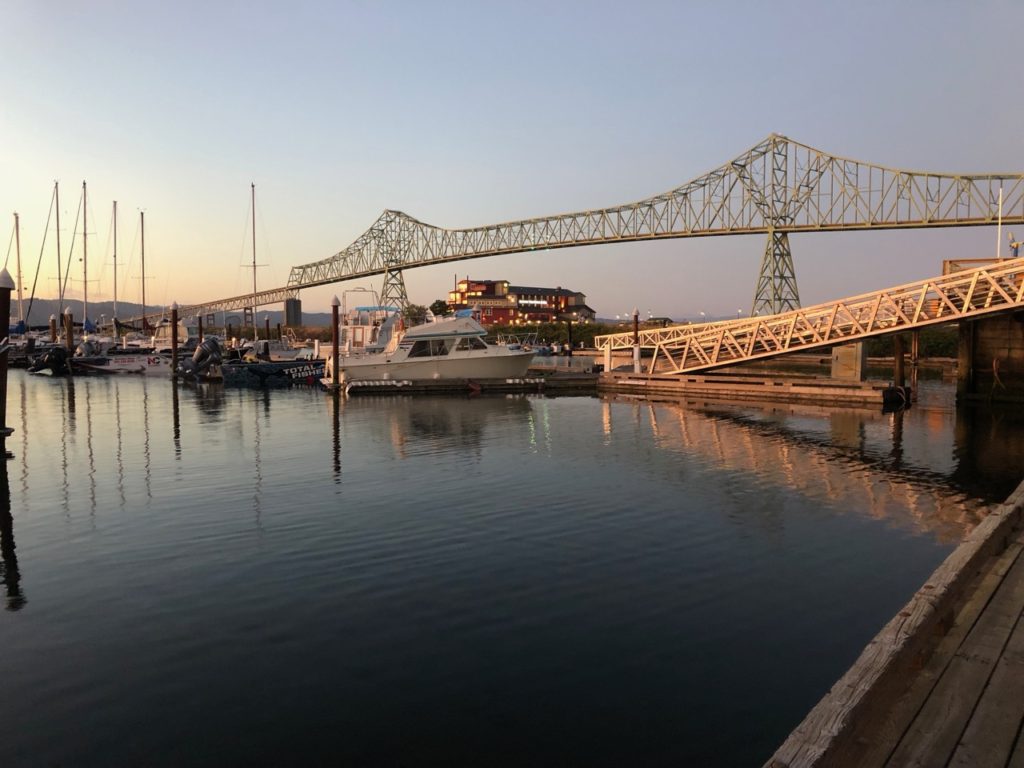
We rolled out the Yankee sail and turned off the engine. We were making 5 – 5.5 knots, which was just perfect for our planned arrival time. The weather forecast was good for a bar crossing and soon we were heading up the river Columbia using the rhyme ‘Red Right Returning’ to remember to keep the red buoys to starboard on our way in. This is the opposite to the European way of doing things. The bar is considered one of the worst in the world, it has a nickname of ‘The Graveyard of the Pacific’ with over two thousand shipwrecks to its name. Looking at the rollers crashing over the banks either side of the entrance one could understand why. As it was we were soon over the bar and fighting to avoid hundreds of sport fishing boats that seemed to be everywhere. Finally we could see the bridge that signalled the location of the marina.
A quick call to the marina got us a space on the fuel dock where we could register and check in with the USA authorities, primarily the CBP (Customs Border Patrol). The CBP have had a lot of bad press recently, but I was very impressed with the reception I received by the officer here, he was quick, helpful and sorted everything out in just 15 minutes. We now have a 1 year cruising permit and 1 year stamps in our passport. I recommend Astoria for clearing in, this is actually why we came.
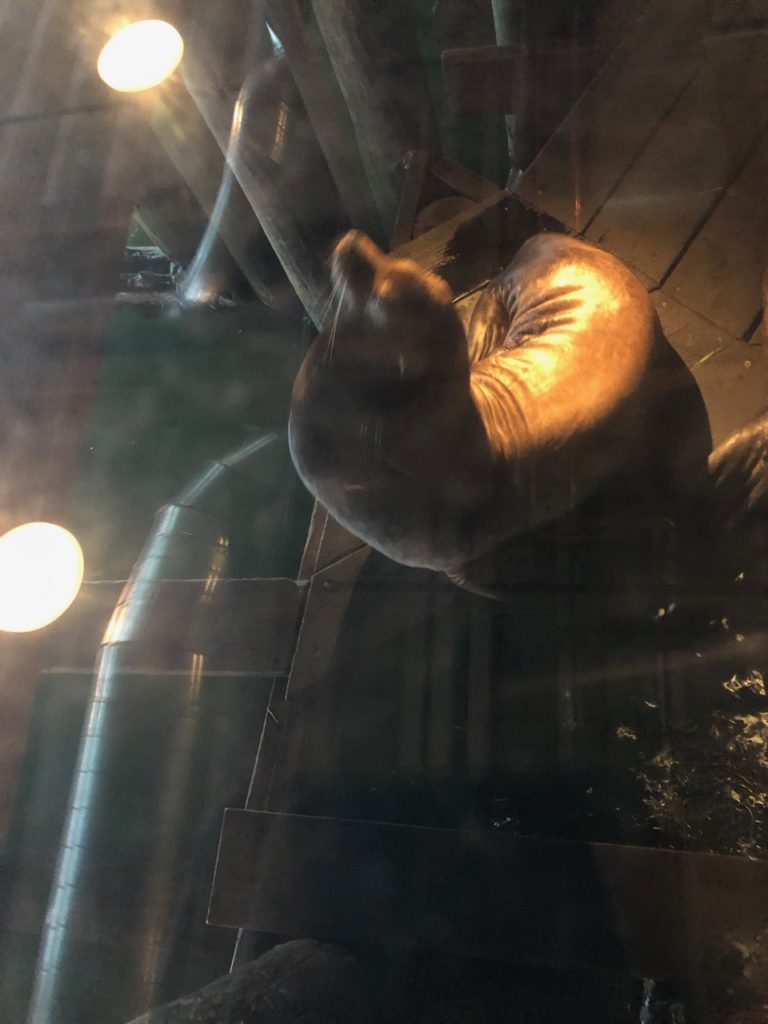
Tuesday evening and we headed out to find a restaurant, Buoys brewery hit the spot, it’s a micro brewery / restaurant on the waterfront. they have a section of the floor made of glass and you can look down to the piles supporting the building and see the resident sea lions chilling there.
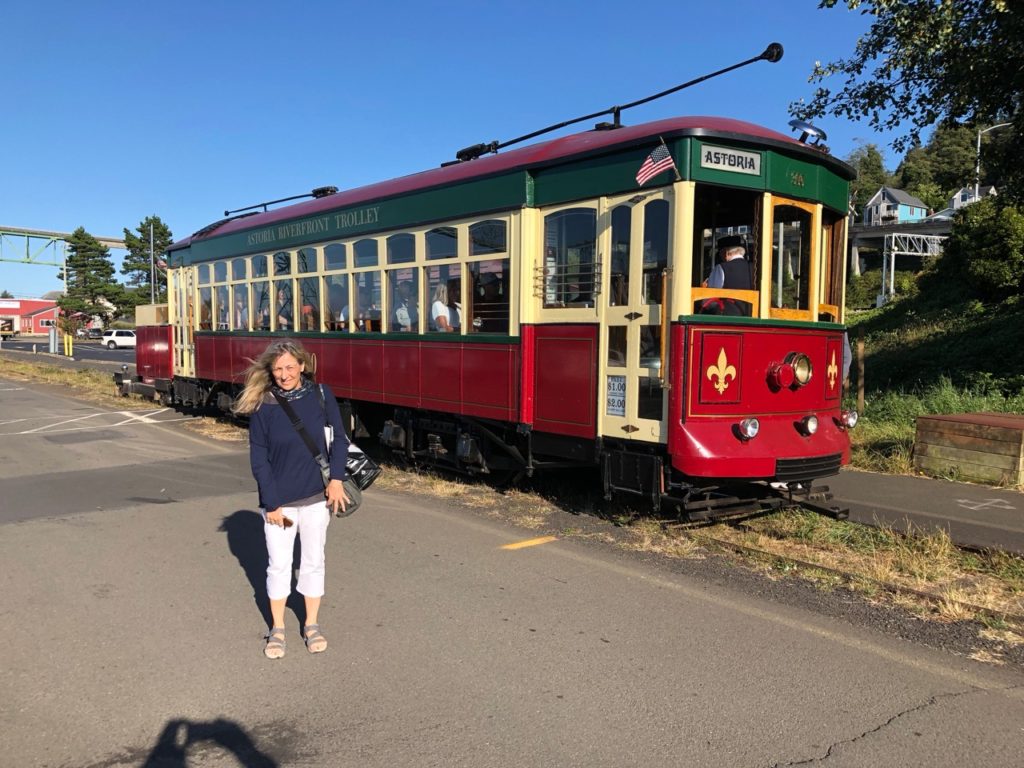
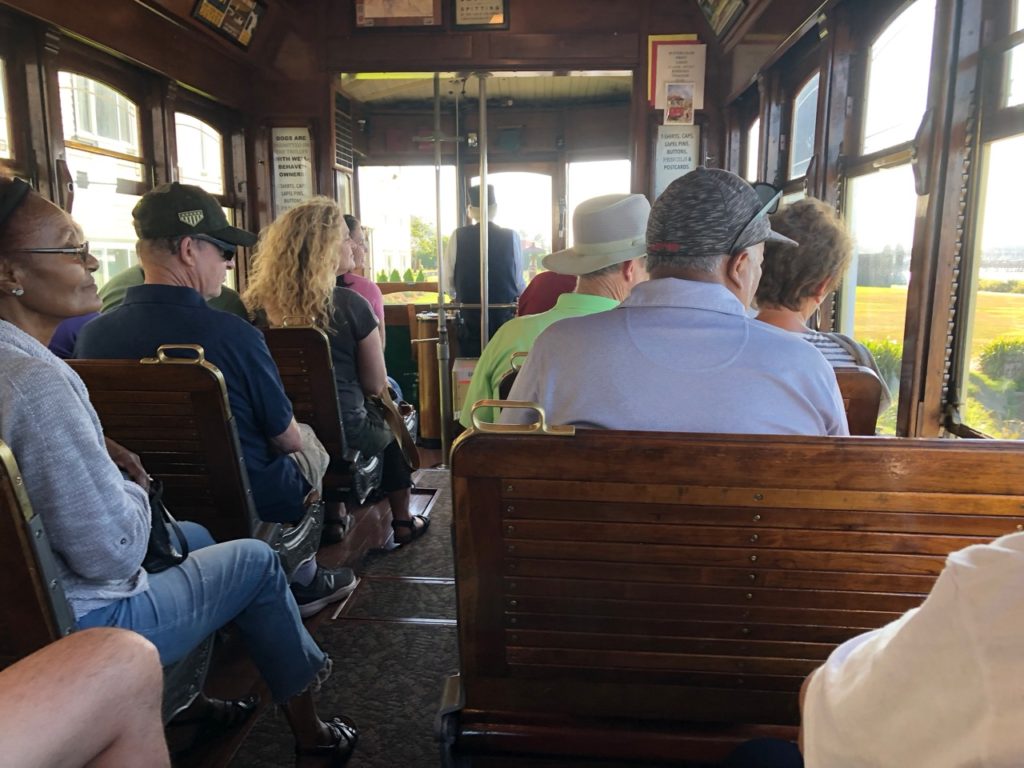
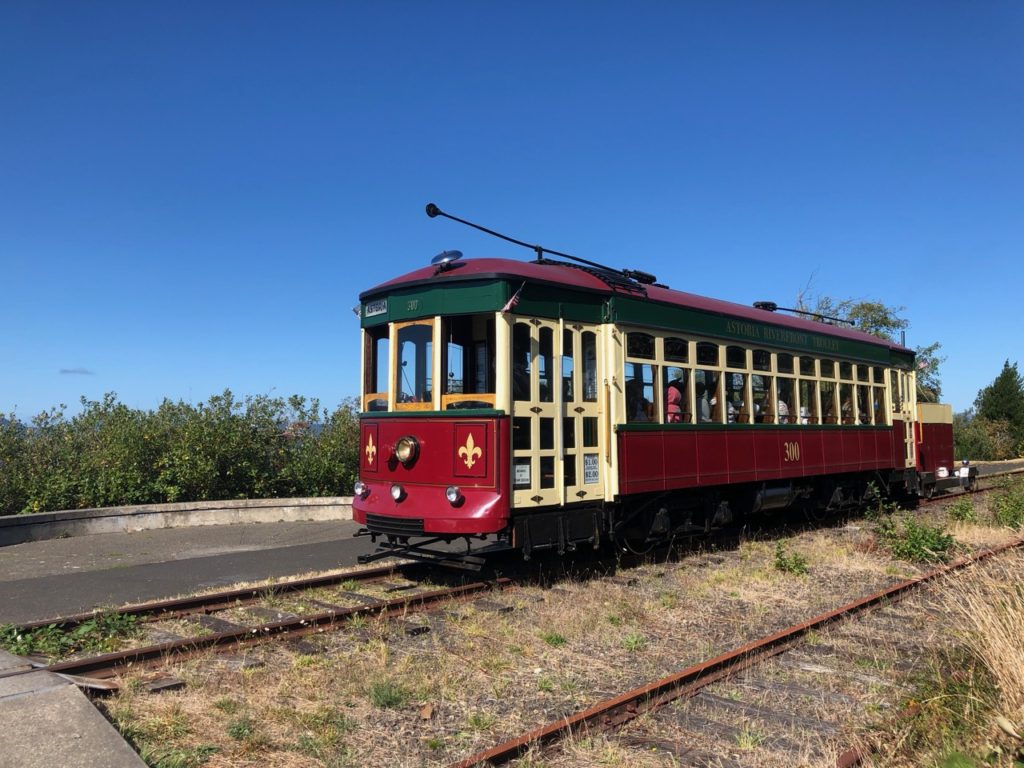
Wednesday 4th September. We took the trolley car to Safeway to get some fresh fruit and veg as customs forbid us bringing any in from Canada. I had eaten a lot of fruit on the passage down!
The trolly car is old, I expect Kathy will write more about it, but it’s a museum piece, literally, and plies the old railway track along the waterfront. It’s a wonderful ride, and only $1 each trip, or $2 for a day pass. It’s operated by volunteers who give a lively commentary along the route.
We will be in Astoria for a few more days before we probably head south to Newport.
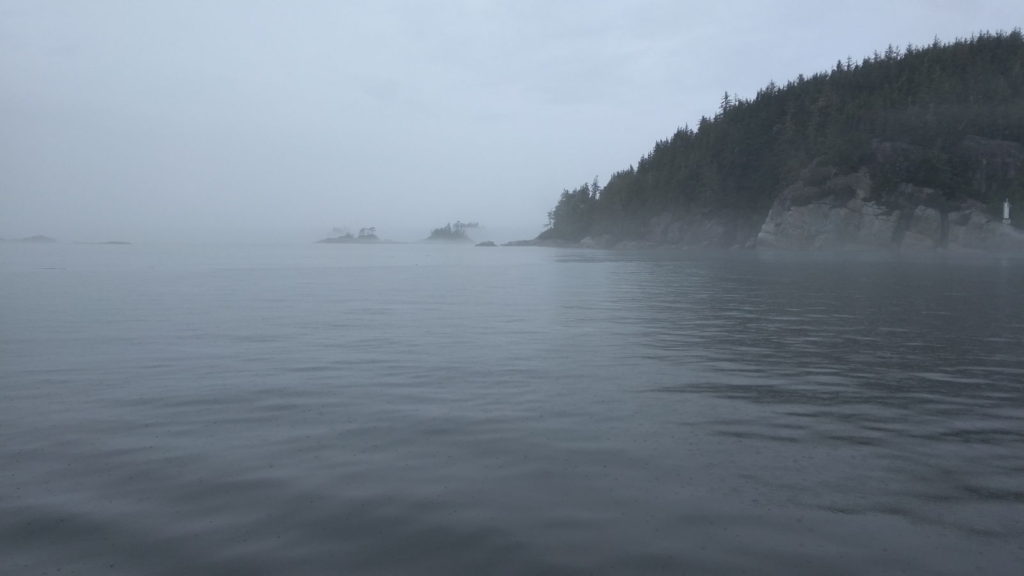
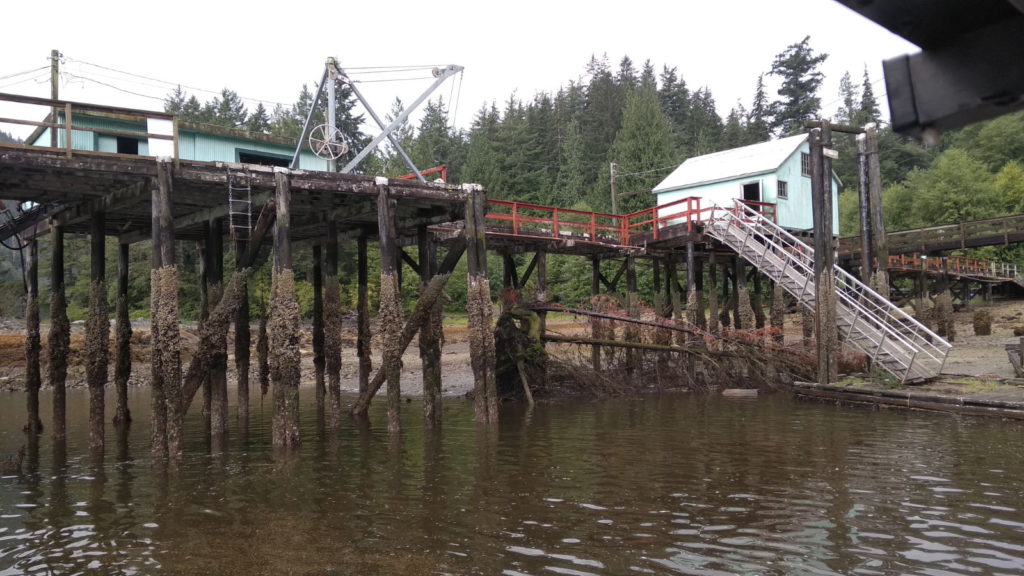
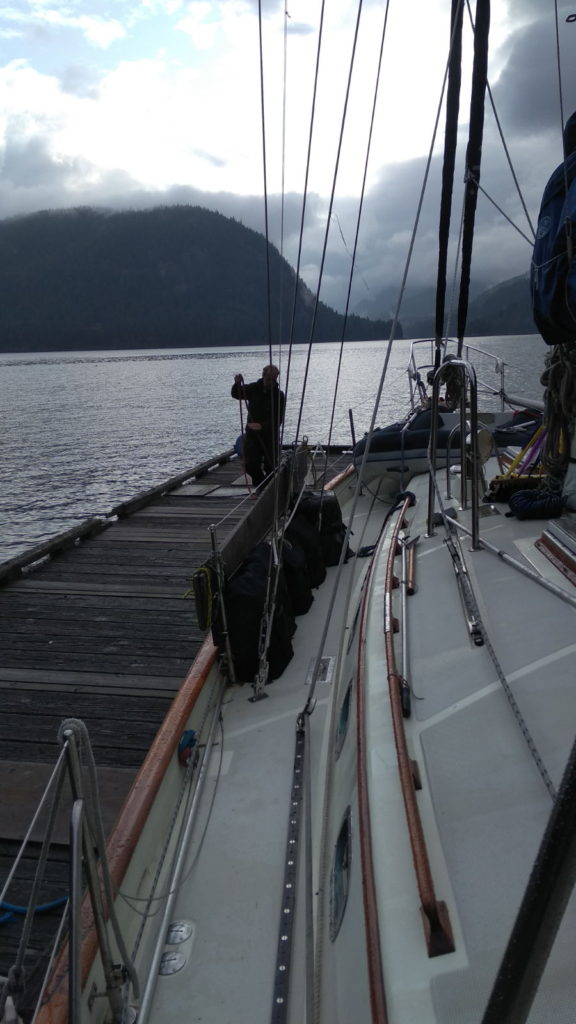
Fogust is the term used by Canadians for this time of year when fog is guaranteed most days. As if to prove this, the air around us was milky white when we got up on the first morning of August. It had rained heavily through the night and the temperature had dropped. After a short discussion about whether to set off or not, we came to the conclusion that we would only be hanging around the harbour on a damp, chilly day, and might just as well be going somewhere. There was every chance the fog could clear as the day went on anyway. We left Sointula at 9 30 for the 5 or 6 hour passage to Minstrel Island, a place where Grizzlies had been spotted lots of times according to reports in our nautical guides.
Leaving Sointula
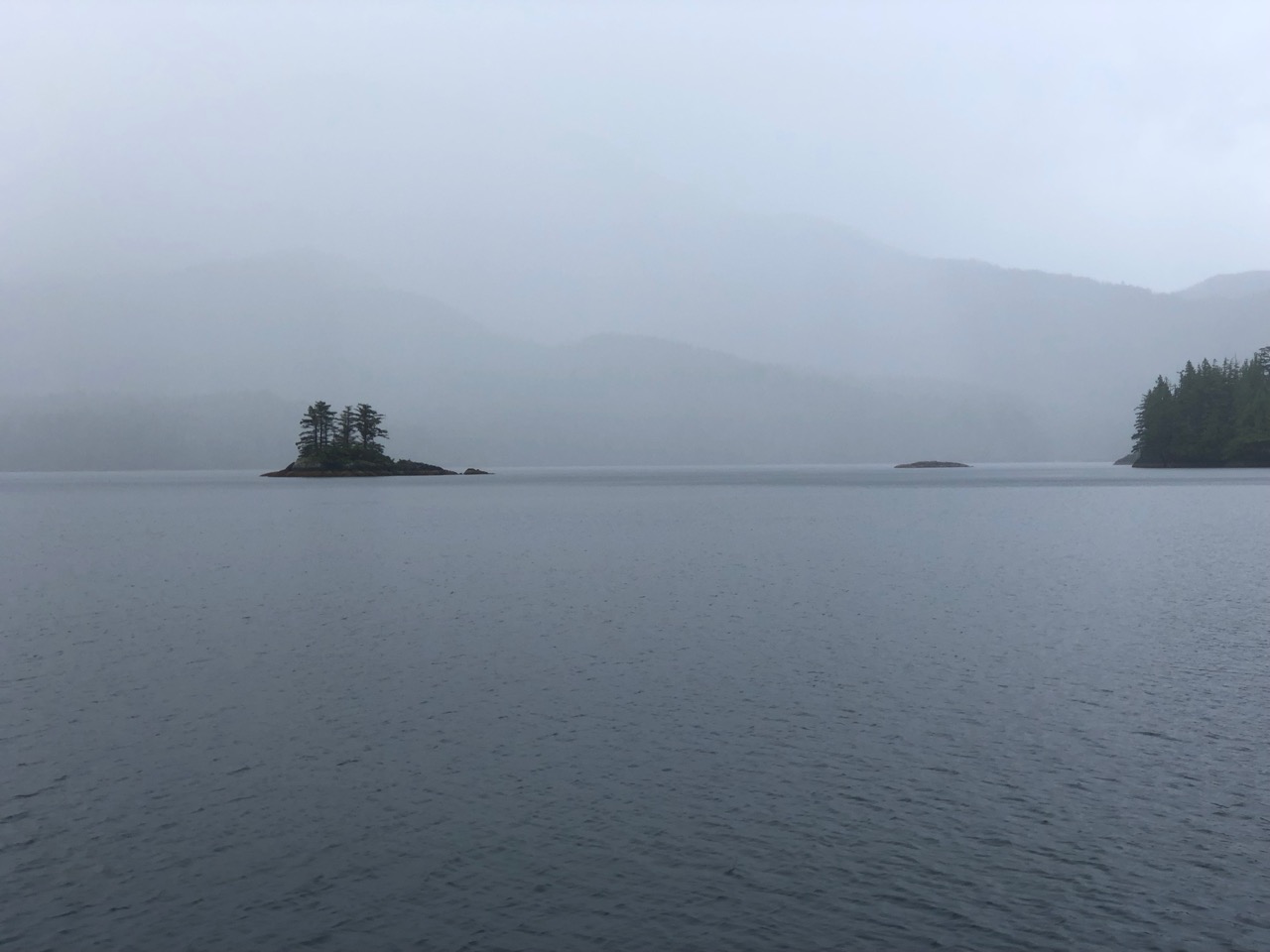
We hadn’t gone far when we discovered the autohelm wasn’t working. I knew Paul could fix it but he wasn’t going to be able to do that during this passage. The fog was fairly thick around us and it got steadily colder and wetter as drizzly rain began to fall as we progressed further out. We would need both pairs of hands and eyes in these conditions, faced as we were with hours of hand steering. This brought home to me how much I have come to take the autohelm for granted. Invariably we untie from marinas, weigh anchor or slip a mooring buoy, motor out for 5 or 10 minutes, and then switch over to autohelm and relax (most of the time). It frees us up to get on with other things. I remembered a night not long after Paul had acquired Lady Stardust in 2005 on a night passage returning to Liverpool from The Isle of Mann. It was freezing cold, pitch dark, and the sea was rough enough to lurch us from side to side. We didn’t have autohelm then and took turns hand steering for four hours each throughout the night. I can still feel how chilled through I felt, and how cold my hands and feet got, despite being encased in layers of thermal gear, a full set of oilies, woollen hats and gloves etc. Staring out at the fog and rain this morning, I comforted myself with the fact that at least it wouldn’t be that bad. Such poor visibility does make you feel vulnerable, though: it was only possible to see a couple of feet ahead. This wasn’t quite how I imagined my first day back at sea would be after nine months away from the boat.
Fogust!
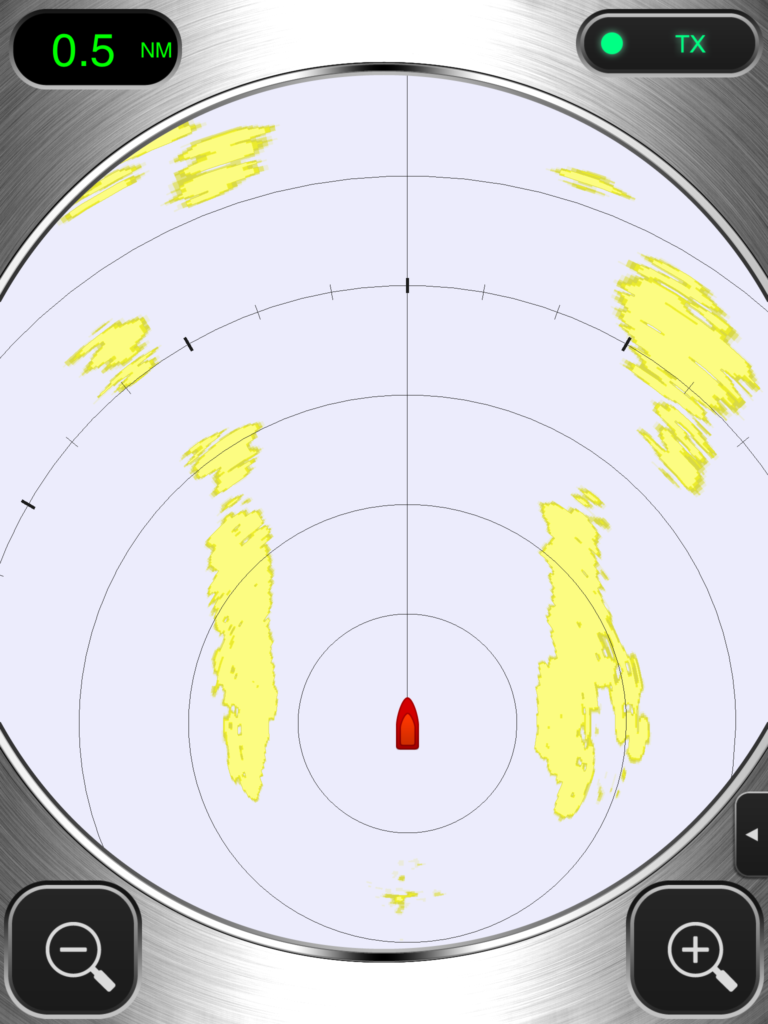
It did at least provide us with an opportunity to test out
the new radar, and for me to re-familiarise myself with the AIS. I positioned
myself at the chart table and studied both screens until I got the hang of how
the information on the radar was displayed. Paul told me to watch for
consistent shapes as opposed to ones that faded off after a couple of
appearances, since that was the difference between a vessel and large pieces of
debris or logs that the radar picks up. We
did 90 minute alternate stints on the steering but the cold got through to me
after only half an hour and I realised I’d been hasty in thinking I didn’t need
to clad myself in full weatherproof gear. Being so constantly occupied and
vigilant made the 5 hour journey go very fast, however, and the fog had lifted
a bit by the time we approached our destination. We tied up to a pontoon that
had once been part of a thriving marina but which was now abandoned. It was an
eerie looking place, with only a couple of other boats taking advantage of the
free berthing. Nature has already begun to claim back part of the
constructions, and Paul had heard that the place was scheduled for complete
demolition sometime soon. For now, though it was a welcome break from the fog
and cold. We wasted no time in putting the heater on and shutting the hatches
against the wind. The rain got heavier an hour or so later.
It rained heavily all night again, and a couple of times when I woke during the night I could see flashes of lightning through the V-berth’s hatch, but we slept well despite this. It was dark and peaceful and most importantly, warm in the morning. The air didn’t feel quite as icy when I stepped out into the cockpit, and the rain had stopped. I was particularly pleased by the lack of fog. Only a few wispy strands clung to the tree tops when we motored off at 9am.
Leaving the anchorage
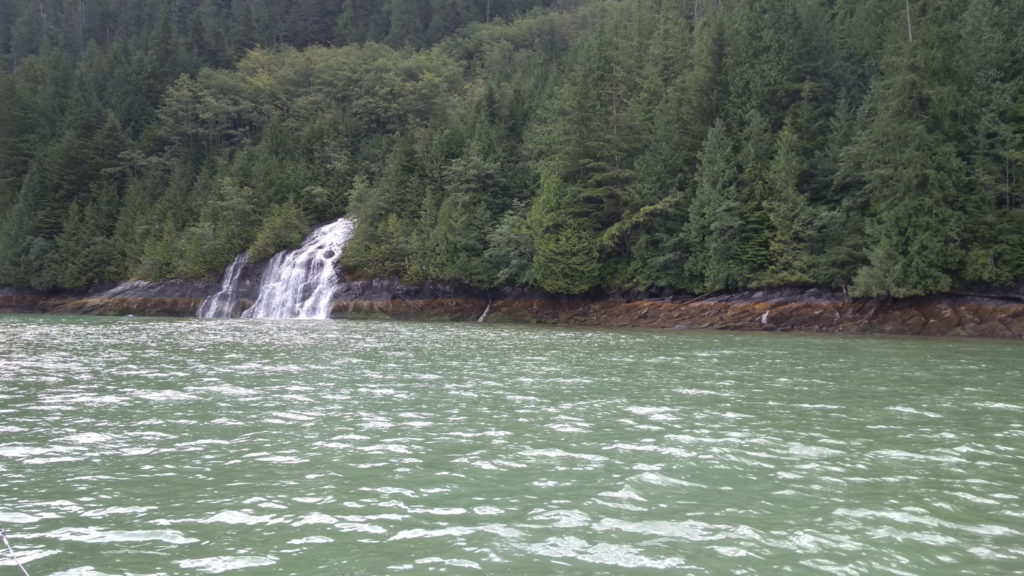
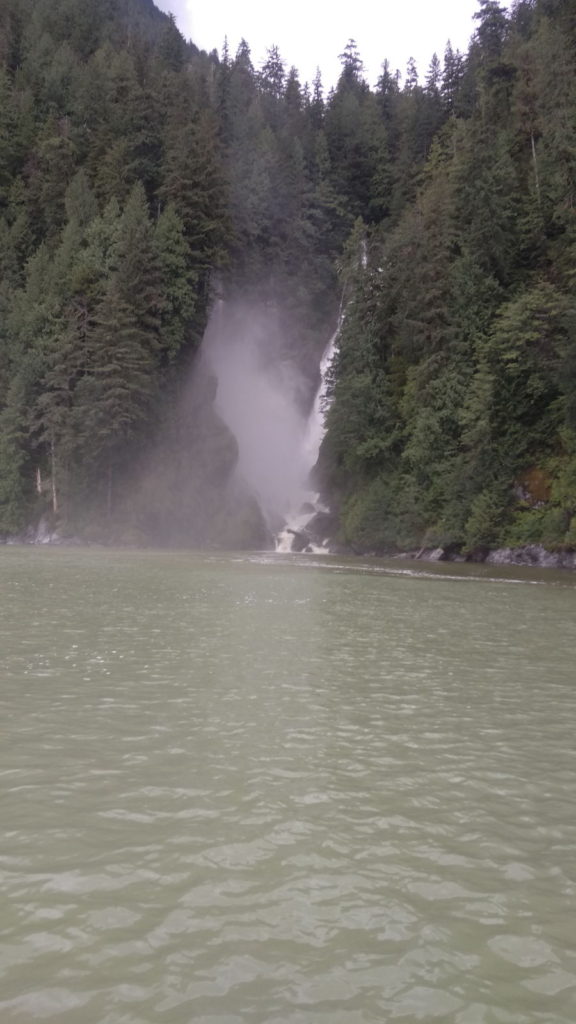
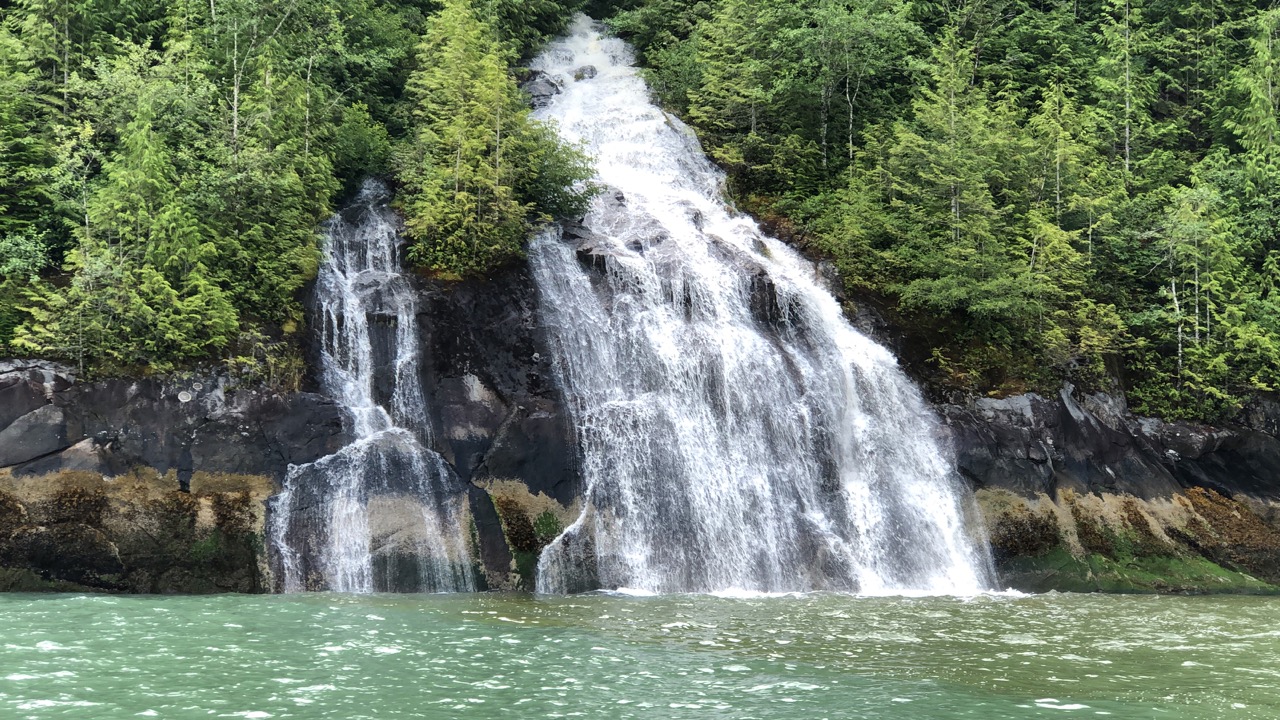
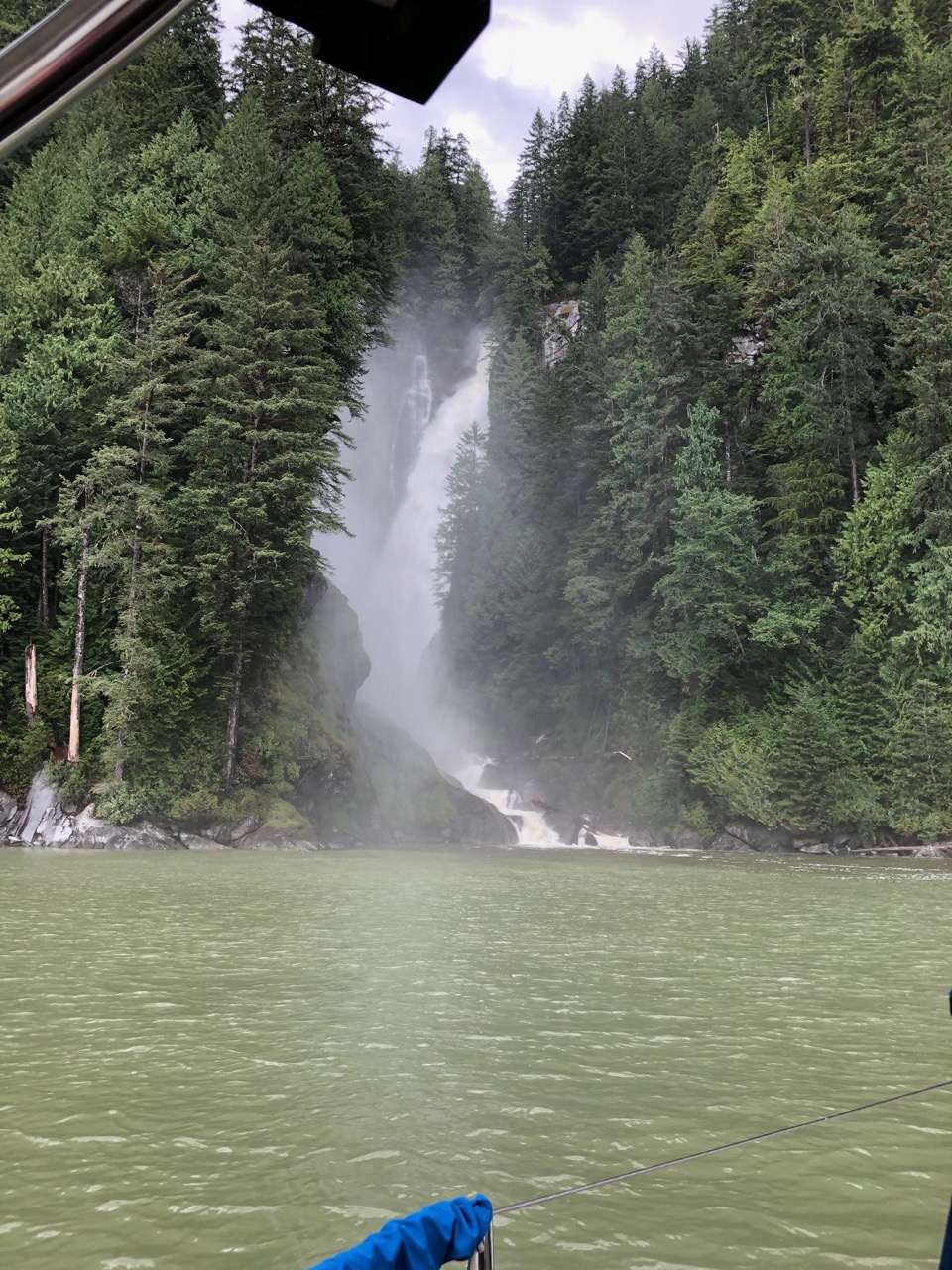
A couple of hours later it was clear, calm and dry enough for Paul to get on with the task of fixing the autohelm. Once that was working it was pleasantly mild enough to stand on deck and scour the shore for signs of life. Very few other boats were around and by 2pm we’d made such good progress Paul decided we’d motor on past our intended stop at Glendale Cove and carry on further into British Columbia’s longest fjord (70 miles long and two miles wide). This was in order to see the waterfalls that had been recommended to us. They were indeed a sight worth seeing, cascading down into the sea from mountain heights of up to 6,000 feet; a truly mesmerising sight and sound. The environment on either side of us looked ideal for bear-sightings but all we saw were hawks and eagles soaring above the water ready to pounce on their prey – a magnificent sight in itself, but I desperately wanted to see a bear.
We doubled back and returned to the anchorage at Glendale. There is a lodge and accommodation on shore specifically for Grizzly bear tours so we were definitely in the right place: our nautical guide, Waggoners, the authority for cruisers in this area, claims it has the highest concentration of Grizzly bears on BC’s west coast. After anchoring we continued to scour the shore until evening fell but it remained disappointingly empty of life.
Glendale
On Saturday 3rd August we were up early to check
on the depth as there had been a concern about our position in the shallow
part. Boats and kayaks from the lodge were out and we tuned into their radio
frequency, knowing they would probably communicate sightings and locations
amongst each other. One passing kayaker told Paul he’d seen three bears the
previous day, and if we waited long enough we were sure to spot one. Meanwhile,
there was plenty around to keep us entertained as sea birds descended for the
morsels to be found in the mud from the receded tide. Gulls, herons and lots of
other birds that we didn’t know the names of, flew down pecking on the beach and
getting aggressive with those who tried to get too close to them. They all
seemed to fear the mighty eagle, though – flying off en masse whenever it
swooped near them.
Once the tide had risen again, it was time for us to be
moving on. Several of the lodge boats were gathered near the shore of a beach
as we began to motor out into the bay. It became clear they were watching
something, so still and focused were the passengers. Paul was the first to spot
that it was a bear. Grabbing the other binoculars, I could hardly contain my
excitement when I saw it too. A Grizzly bear, foraging only feet from us, and
not at all fazed by so many pairs of eyes staring at it. I’m not ashamed to say
it brought tears to my eyes. I’ve always loved bears, and have long lamented
the rough deal some of them get at the hands of humans. This one was living as
it should be, going about its business undisturbed, and with cameras, not guns,
aiming at it. We watched for half an hour before I could tear my eyes away.
Paul got a fairly good video clip of it but mine didn’t come out as well as I’d
hoped. Still, there would be more to see (hopefully).
There’s a bear in the distance!
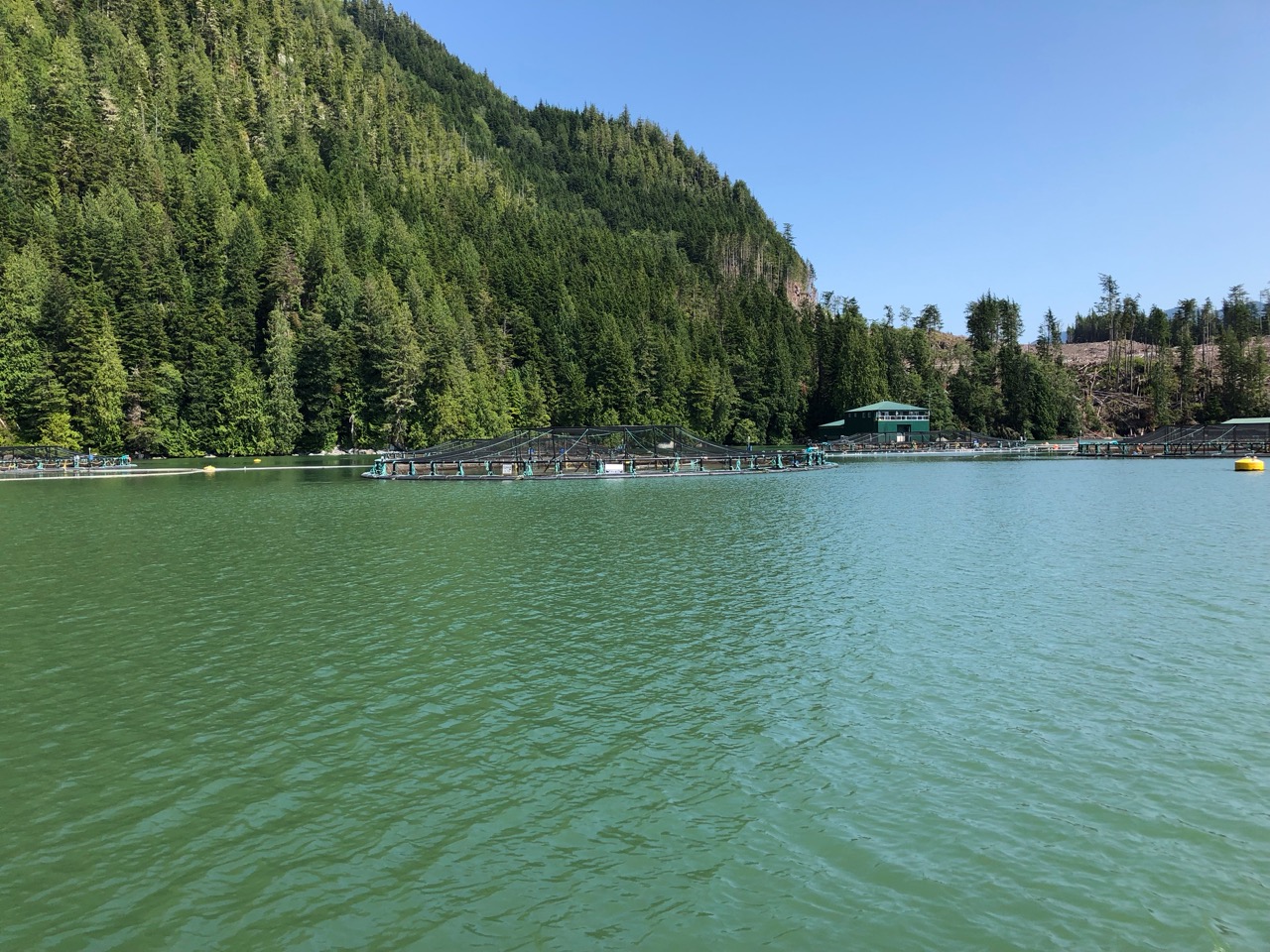
We journeyed on through steep, thickly-forested hills on calm blue water as the day grew warmer. The whole area is uninhabited by humans. We saw a solitary fish farm with two workers busy tending the huge operation, and maybe a couple of other boats but we were largely on our own for the entire passage to Kwatsi Bay. Paul had gallantly chosen this place in preference to the other option, Echo Bay, which he’d discovered holds a pig roast every Saturday evening. He thought correctly that I’d want to give that event a miss. We arrived at 5 30 and anchored in a beautiful location.
There was only one other boat nearby, but best of all there was a black bear on the beach opposite. We sat in the cockpit with binoculars practically glued to our eyes – another amazing sight to marvel at. We heard splashing close by as we watched; dolphins were diving near the bow as if to catch our attention and pull our stare towards them instead of the bear. Every time we looked back at the bear, the splashing would start up again. It was such a peaceful place; we had eagles soaring above us and the calls and squawks of other birds coming from the forest while we sat taking it all in. I kept thinking that we were only feet away from a bear when every other time I’ve been that close to one has been in a wildlife park. It was a humbling thought and I felt privileged to witness it.
Black bear territory
Pig roast over in Echo Bay for another week, we set off for it on Sunday 4th. It had been misty earlier in the morning creating a picturesque image as it swirled around the trees. The skies were clear by 11, leaving us with a chilly wind but calm waters for the short hop to Echo Bay. We secured a berth there and were tied up in a charming little marina by 1 30. Keen not to miss the museum we’d come to see, we checked in at the office cum shop and asked for directions to it. Billy Proctor is a well-known character around these parts. Well into his 80s, he has filled the museum with artefacts from a lifetime in the islands. The 20 minute walk took us through a steep woodland trail which brought back memories of millipede-laden paths in Asia that had rendered me rigid with fear. No millipedes here. Instead, there were huge green slugs that looked like snakes! Despite this and the heat from the afternoon sun it was a nice walk to Billy’s dwelling.
Echo BayOn the way to Billy Proctor’s
The man himself was sitting on a bench outside chatting with two other guys when we got there. The exhibits were contained in a large shed-like building which Billy had built from lumber he’d milled himself. It seemed he had kept pretty much every item he’d grown fond of over the years from his childhood onwards. I spotted several things familiar to me from the 60s and 70s, such as egg cups, picture books and old kitchen appliances. There were hundreds of coca cola and other soft drink bottles and cans, fishing equipment, old sporting programmes, cameras, toys and far too many other miscellaneous items to mention. Billy ambled in to inform us that he’d collected a lot of stuff over the years. We nodded our agreement and praised his preservation and arrangement of so many things. He told us he’d built a log cabin out of just one whole tree, and to be sure to visit the small replica school house he’d built next to the museum which he’d filled with items from the original Echo bay schoolhouse that had closed in 2008. It was a fascinating place, a real out-of-the-way sanctuary overlooking a small dock where his and other boats were tied.
Billy Proctor
More thick fog greeted us early in the morning as we prepared to depart for the trip to Port Hardy. This would be a longer passage and we began it surrounded by swirling white mist – like being surrounded by steam in a hot bathroom, but more eerie. We had to set forth into it hoping we were not too near other vessels, rocks or logs. Once out of the marina it grew ever more disconcerting. I likened it to driving with a blindfold on and felt happier sitting at the chart table scrutinising the radar and AIS screens while Paul hand steered in the chilly cockpit.
As soon as we had cleared all the land masses the autohelm took over and I prepared some vegetables for soup that evening. The fog lingered until well after lunchtime, only clearing as we tied up in Port Hardy at 2pm. This was where we had begun our Canadian travels ten months earlier after our five week crossing from Japan. It felt good to be back in the familiar and friendly Fisherman’s Wharf. We rafted up to a boat that looked as if it had been there a while – space is always tight here – and took a walk into the centre to provision for the next week or more, as shops were likely to be scarce from now on.
Port Hardy
After spending a lazy day in Port Hardy catching up on
various tasks and internet stuff we untied from the boat we’d rafted on to
early on Wednesday 7th August. The fog had cleared by 10 o’clock and
it looked like a warm day ahead. Bull Harbour was our destination and we
arrived there at 12 30. Only First Nation people are permitted ashore here
unless you have special permission. There were two motor boats tied on to the
visitor pontoon but we chose to anchor further out in 5 metres of water. No
phone coverage or internet here, and it was too chilly to be outside so we
stayed in with the heating on listening to classical music while I made pastry
for vegetable pasties.
Bull Harbour
I hoped Sea Otter Cove, our next port of call would live up
to its name, unlike Bull Harbour where I didn’t even spot one bull. I saw a sea
otter as we drifted away next overcast morning – convinced it was the same one
who’d popped its head up when we arrived. The boat seems to startle them – they
stare at it momentarily before flipping over to display their seal-like body
and diving under the water. This passage would take us round Cape Scott.
Waggoners was full of dire warnings about it, devoting almost a full page to
its hazards and historical tales of disaster. It ends with this grave statement;
‘a careful skipper, fully aware that the safety of his vessel and crew truly
are at risk at Cape Scott, must judge conditions and make the right choices’.
Sister Midnight’s skipper insisted it would be ‘no big deal’. He did say we
would be exposed to the elements once we had cleared it as we’d be in The
Pacific with no shelter from islands. I set about stowing things safely, just
in case.
When we arrived in Canada just over a year ago, sea otters
were the first living things we’d seen for five weeks. They were in huge groups
off the coast of Port Hardy and we were only able to view them through
binoculars. The ones we’d spotted so far on this trip were lone, or in couples,
and much closer to the boat. I soon learned to discern between them and birds
or debris on the water. Their distinctive black flippers poking up are often
the first thing I see, and a huge fluffy head bobbing opposite their feet as
they lie in repose, looking for all the world like someone relaxing on an air
bed. I don’t think I will ever tire of looking at them. Once we were safely anchored in the cove I sat
with the binoculars staring out to my heart’s content. I told Paul I’d been
watching a sea otter and a seal playing together. He said they were more likely
to have been fighting over a fish – such is the difference in our perception of
things ;-). Later that evening, Rob and Vanessa came over in their dinghy from
‘For Good’ for a drink and a chat. They are on a worthwhile mission to spread
awareness about environmental and conservation issues while sailing and living
aboard their boat.
Sea Otter Cove
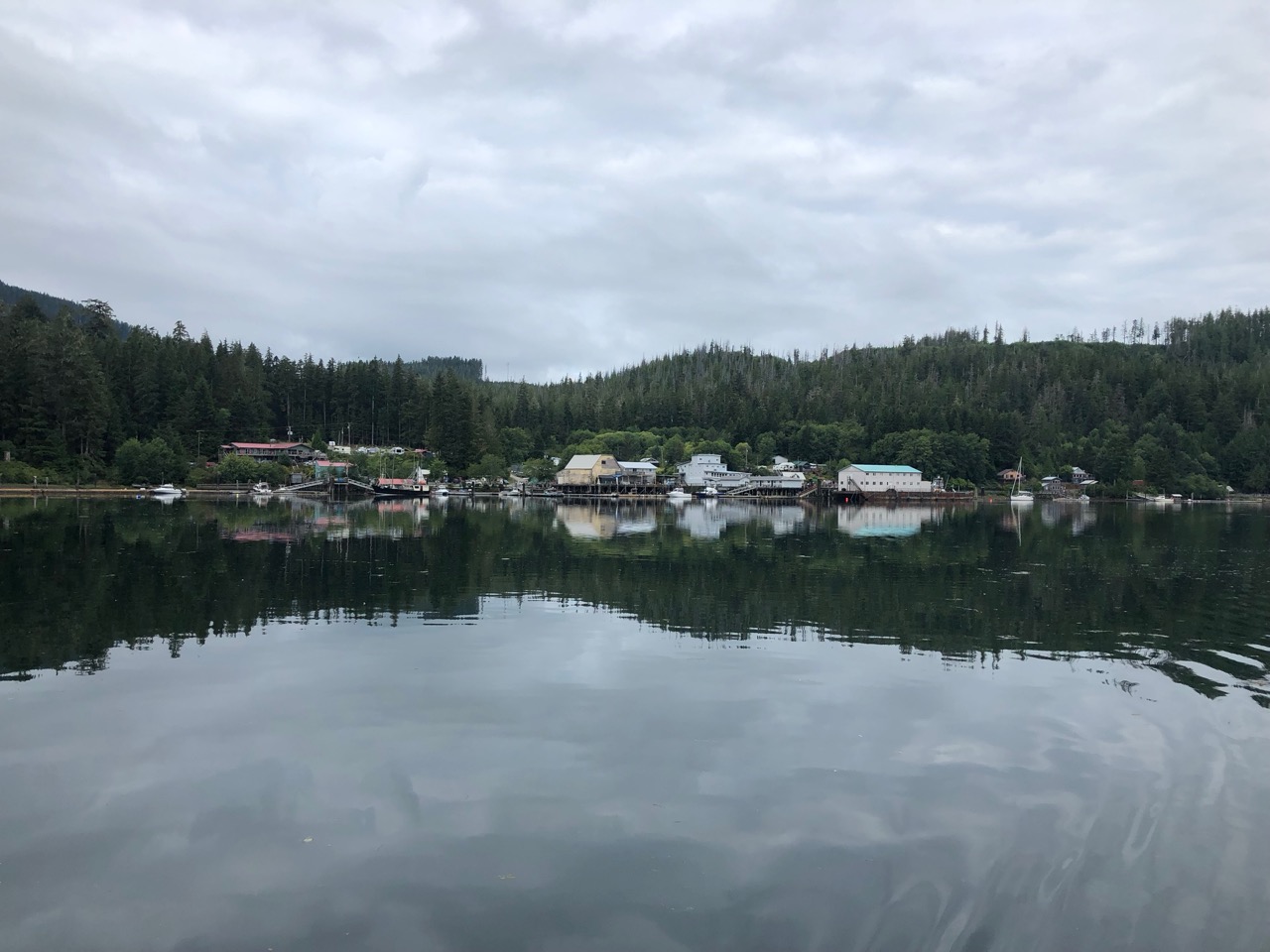
Winter Harbour, where we tied on to the public dock on Friday 9th August is a small, friendly place which was formerly a commercial fishing outpost. When that closed, the docks and fuel facility were taken over by the main general store, ‘The Outpost’ and that’s where we headed to replenish our supplies of soda water and bread.
Winter Harbour
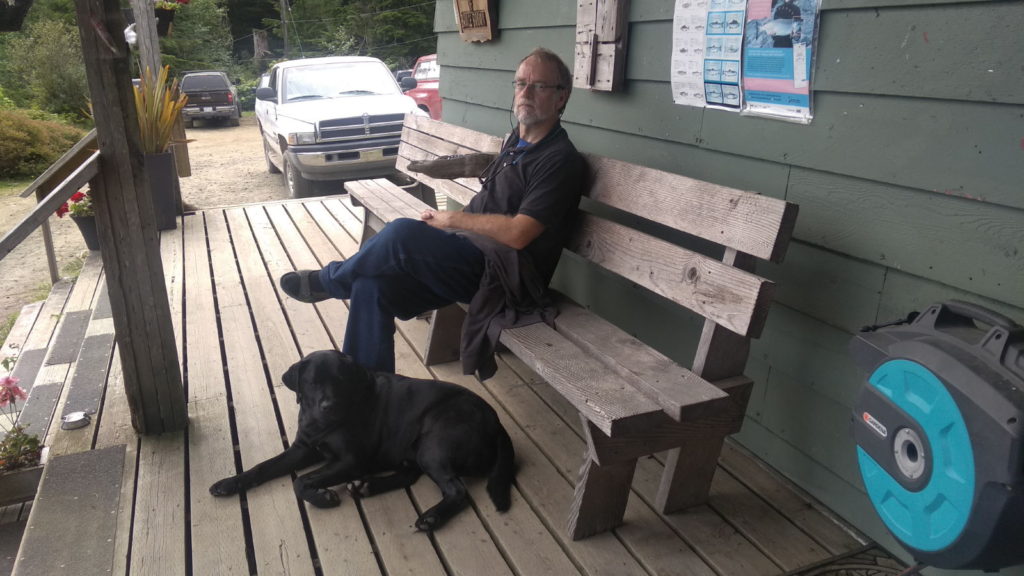
We also bought some internet, choosing the ‘48 hour for two devices’ option. Unfortunately, my phone greedily sucked up a good deal of the allowance by updating apps as soon as it connected until Paul found out how to turn it off. We sat outside the shop on the steps catching up on internet things enjoying the sun and making a fuss of the friendly black Labrador, Keeper (pictured below with Paul).
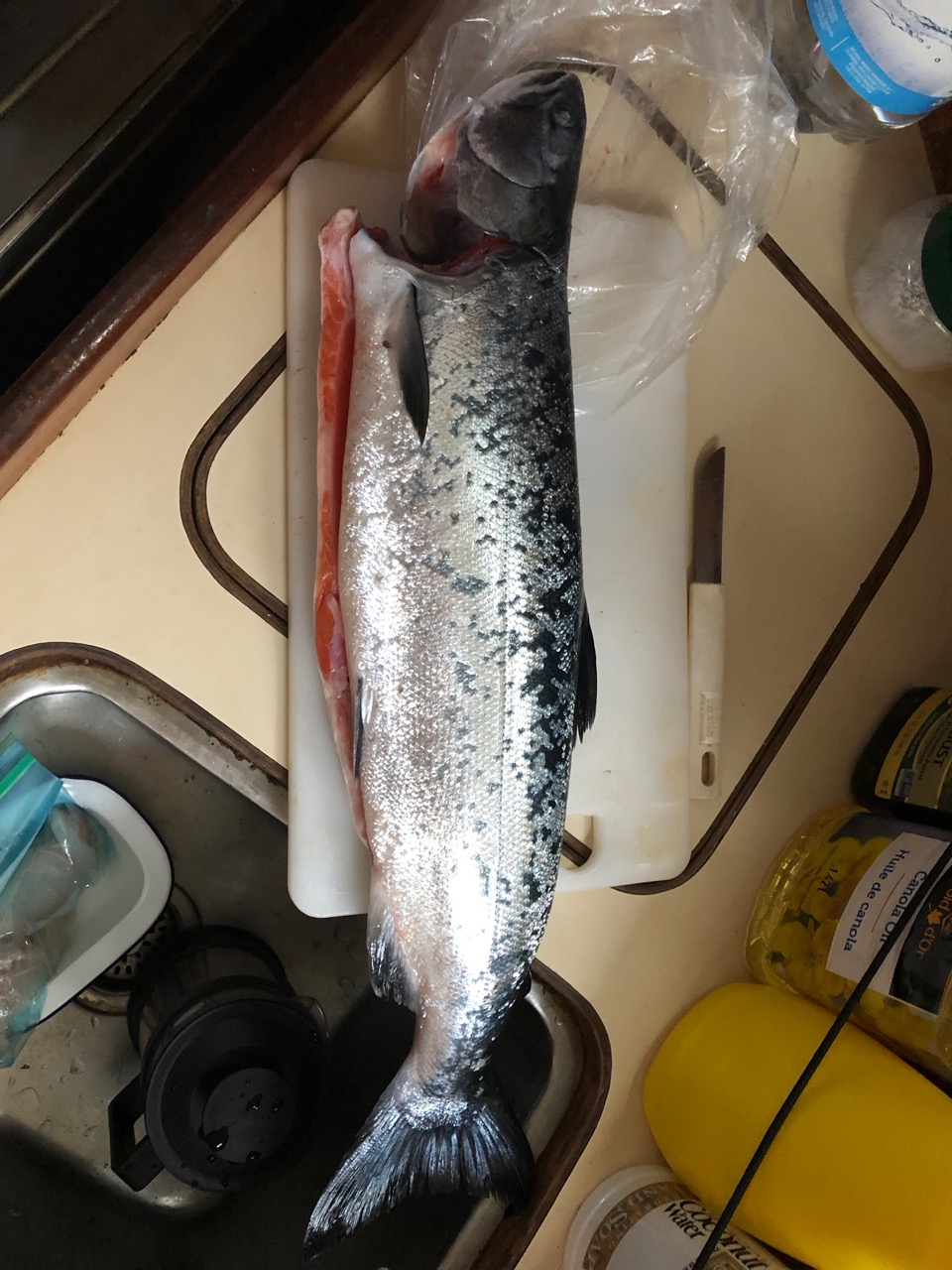
Back on the boat, we discovered that some huge mosquitoes had taken up residence in the cabin, so though I hate to kill anything, they had to be disposed of if we wanted to avoid irritating itchy bites. Out on the pontoon, Paul got chatting with two police officers who were interested in our plans and about where we had been. Learning that we would probably go to Hot Springs Cove later in the month, one of them recommended a restaurant run by his sister. Even more productive was his chat with two fishermen who had just returned from a successful afternoon’s fishing. Not only did they present him with a huge salmon that would provide him with five meals, they also gave him some fishing equipment and tips on how to catch them (watch this space ;-).
We spent another full day at Winter Harbour just taking it
easy, going for short walks and taking some pictures and planning future stops
along the coast. There were some great-looking dwellings on the outskirts of
the forest behind the harbour. They had the look of holiday caravans and
chalets but could possibly have been permanent. Just imagine spending the
winter away from it all in one of those…
Robert and Vanessa arrived and berthed behind us. Their
knowledge and tips about spotting wildlife is proving to be invaluable. Robert
spotted a black bear on the shore opposite to us and after a while looking
through the binoculars, Paul and I got in the dinghy and went over for a closer
look. To my excitement and delight, two cubs came into view along with what was
obviously the mother bear. I almost squealed but we let the dinghy drift closer
so as not to disturb them. I was waiting for the best opportunity to take a
picture but before that could happen, a fishing boat that must have spotted us
staring at the spot, motored over downwind of the bears and the mother caught
their scent immediately. She stood up straight, an amazing sight in itself, and
the trio rushed back into the foliage behind them. They didn’t reappear
unfortunately. Robert told us afterwards that the trick is to not make it too
obvious that you are looking at a certain spot as it’s likely to attract
attention from others.
Sea Otter!
The weather finally had finally begun to feel more
summer-like so early in the morning of Sunday 11th August, as I was
making coffee, I heard loud splashing near the boat and ventured out into the
cockpit to see what it was. A sea otter was just behind the stern crunching and
munching on shellfish. It sounded like somebody noisily eating a packet of
crisps. I tried to video it on my phone but it didn’t come out – hopefully
there will be other chances. By 9am we had untied and were on our way to
Klaskish in the sunshine and with fewer layers of clothing on. There was enough
breeze to put the mainsail up so for a short while we were able to enjoy the
silence without the drone of the engine. We were both thrilled further along to
see a baby sea otter on the tummy of its mum.
Klaskish Basin is reached, in the words of Waggoners,
‘through a knockout, must-see narrow gorge with vertical rock sides overhung
with dense forest’ and ‘you will be separated from the rest of the world’ once
you are through. It felt like a pretty
accurate description once we were safely anchored: very peaceful and unspoilt
with wild nature all around us. ‘For Good’ was anchored not too far from us and
although the weather had been a bit unsettled, we took the dinghies over to the
shore in the early evening sun and anchored them together to sit and share a
bottle of wine. They had spotted a bear in the area earlier in the day but
unfortunately none came out to show themselves. It was great to sit chatting
and drinking in such a stunning setting until rain and a chilly wind after an
hour or so forced us back into our respective cosy cabins.
View from anchorage
It rained throughout the night. I heard it battering the
roof at various times when I woke up and that continued until 8am. It was very
foggy too and we debated what to do, since we would have to navigate round the
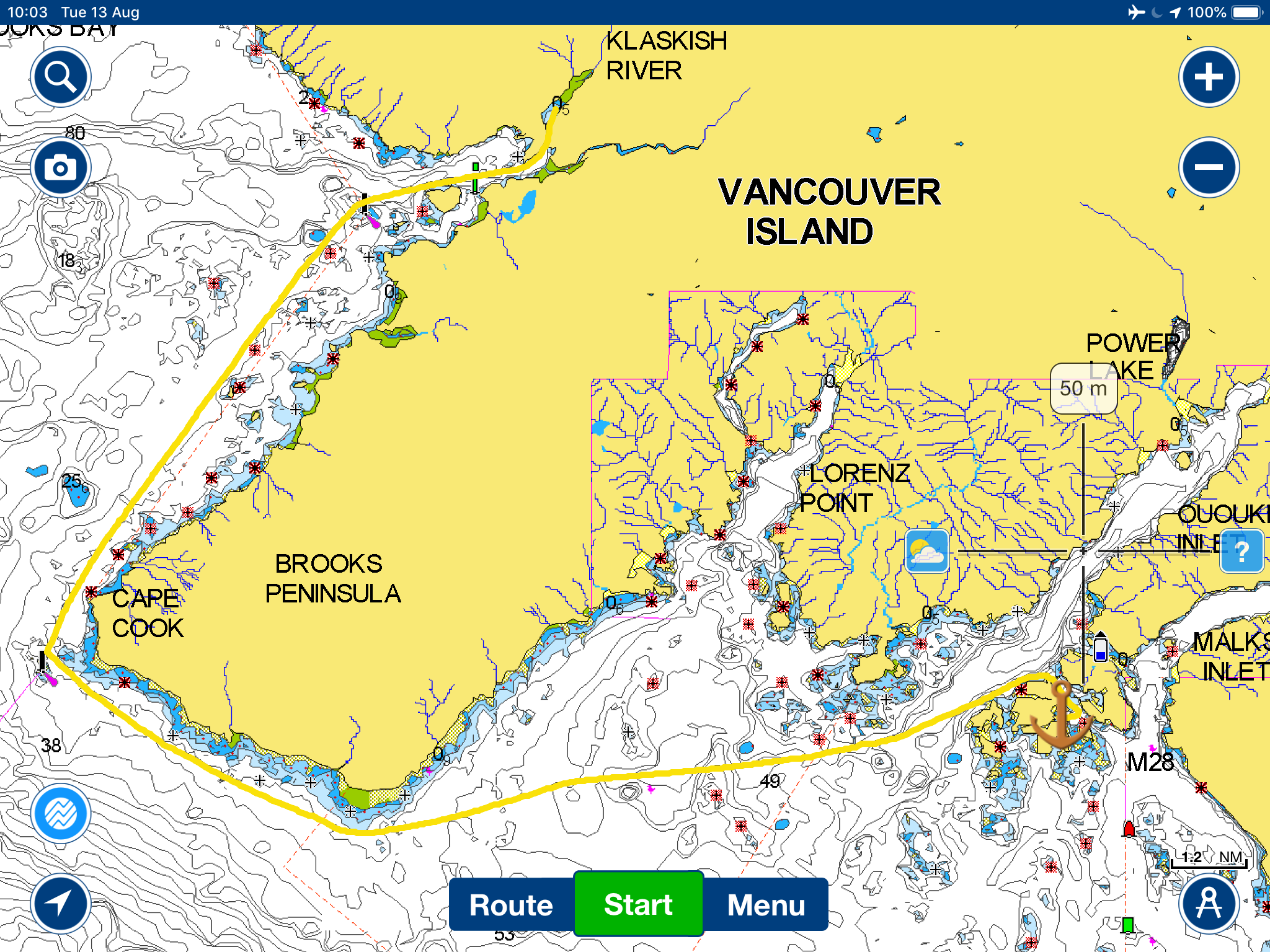
notorious Brooks Peninsula on the next leg. It was decided we would leave at 10
and stick together as boat buddies. Waggoners doesn’t mince words describing
Brooks Peninsula; it is, along with Cape Scott and the waters off Cape Cook,
the most hostile area on the west coast of Vancouver Island, and marks a
milestone in circumnavigation. Here is their take on it:
The peninsula itself is a mountainous, rectangular
promontory that extends 6 miles out from Vancouver Island, like a growth on the
side of an otherwise handsome face. Rocks and reefs guard much of the
shoreline. Tangles of driftwood make beaches impassable. Cliffs rise from the
beaches. At the tops of the cliffs is wilderness. (Waggoners, p. 366)
More alarmingly, its cape (Cape Cook) and the Solander
Island area have been known to sink boats when conflicting currents meet
accelerating wind and the cape ‘should be given the greatest respect’. Paul’s
response to such caution was to state that it would be no problem on a day like
today. So off we went. It looked fairly innocuous as we drew nearer to it. We
were keen to see the puffins and sea lions that are reported to inhabit the
rocks around the area but we only saw one as we were moving away from one of
the huge rocks. It was so camouflaged by the rock and so huge, that it was only
as it moved its massive head that I could tell it was a sea lion. The sea was
getting rougher now and with ‘For Good’ still behind we ploughed on through the
choppy waters for the next headland, Clerke Point. Waggoners reported that the
pyramid-shaped waves that had been battled at Solander disappeared at Clerke
Point. I hoped this would be the case as it was getting decidedly bouncy down
below and I did a quick check on the stowing. It didn’t exactly get calm as the
afternoon wore on but thankfully it got no worse than bouncy. Paul hand steered
for a bit and then put the sails up to give us more balance.
As we approached the anchorage, (having gone through the snigger-inducing ‘Gay Passage), more rocky islands and solitary rocks appeared and I watched the numbers displayed on the depth sounder carefully. Robert and Vanessa went off to anchor in a cove between two islands while we scouted around for a suitable spot some distance away in a larger bay. We should have followed them. With Paul joking about ‘any advance on 2 metres’ as my voice grew more panicked about the rapidly dropping depth, the awful noise of ‘keel scraping bottom’ reached our ears and indeed jolted us sideways. It was so loud I was convinced it had broken through and we would see water flooding the floor. I don’t think I will ever hear that sound and think all will be well. It was of course. We tried to get off the rock by using the bow thruster and even putting our joint weight on the other side of the boat by leaning over but we ended up having to wait an hour or so for the tide to float us off. Then we anchored properly and all was well 🙂
Where we went aground!
We were in The Bunsby islands, or more specifically, West
Nook. It had been grey and drizzly when we arrived and the following morning dawned
with a promise of much the same. We planned to stay for another day before
moving on and were faced with a whole day to kill; the heavy showers
threatening to curtail any exploring. Paul decided not to let the rain put him
off and set out for a row in the dinghy. He was soon joined by Robert and while
they were chatting the weather changed into a warm and sunny early afternoon,
bringing out the true beauty of the place.
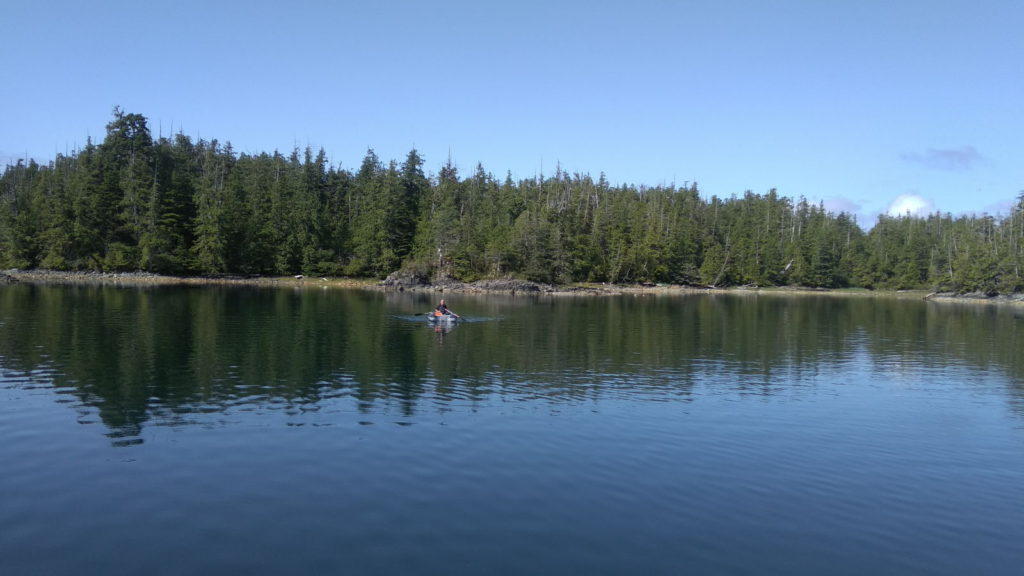
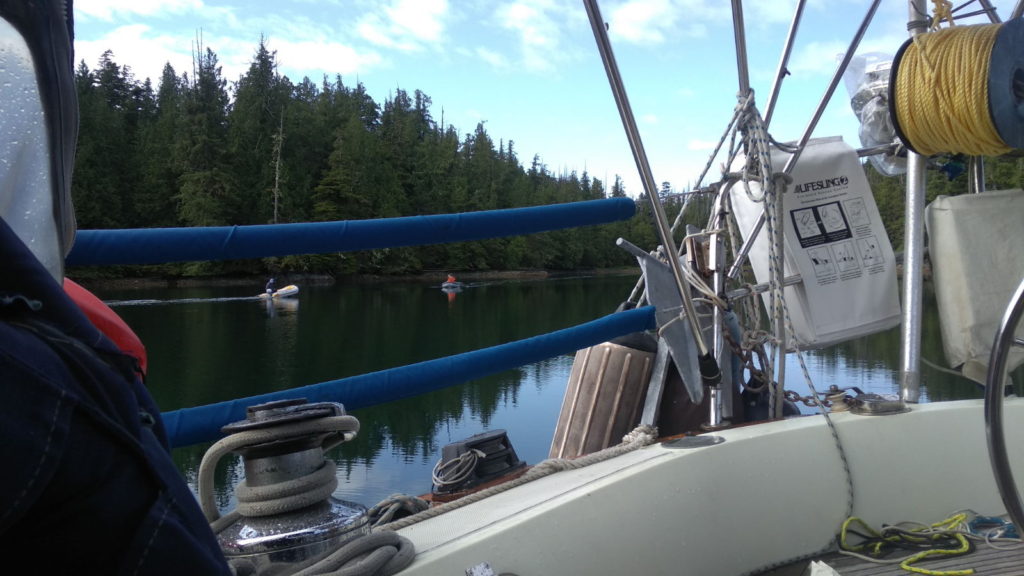
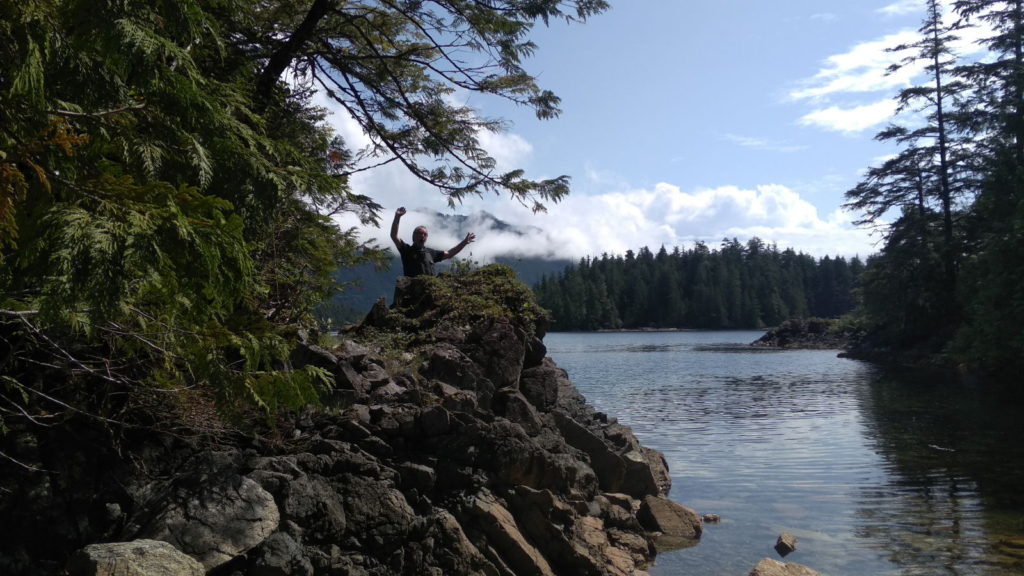
The pictures below show this, taken when Paul and I went for a dinghy
ride that lasted for two hours. We parked the dinghy a few times to beachcomb
and to go for short exploratory walks inland. It’s my favourite part of anchoring,
doing this when the weather allows.
Late in the afternoon we dinghied over to see Robert and
Vanessa at their anchorage and while we were chatting a sailing couple from
Austria came over from their boat to chat and swap journey experiences. Turns
out they are making their way to Mexico too so we will see quite a few familiar
faces once we get there I hope.
Wednesday 14th August. This morning I watched the
sun come up behind the mountains after a peaceful and rain-free night. We would
be setting off for Walters Cove today, a place that might have some welcome
wifi for us but no chance of replenishing wine supplies because it is a ‘dry’
town. The Kyuquot Native community voted for it to be so and even the hotel and
resort complexes do not sell liquor. It was only a short distance away from
West Nook which was just as well because the autohelm failed again. There were
lots of shallow areas and rocks to watch out for so we would have probably hand
steered the whole way anyway. This time, we saw several black fins gliding
slowly through the water. I’m guessing they were sharks from the speed they
were going but I know some fish resemble them. The weather continued to be
gorgeous; warm and clear, enhancing the stunning rugged scenes around us. We
followed ‘For Good’ all the way and tied up behind them on the free pontoons.
We had an hour to wait until the shop opened so followed the 10 minute woodland
path to ‘Java the Hut’ restaurant for a drink and some internet catch-ups on a
balcony overlooking the bay.
Walters CoveWalking to Java the HutMore sea otters
Walters Cove is a picturesque little village and the people we met were welcoming and friendly. It also has sea otters and we finally got to observe them up close. They tend to gather shellfish from the bottom of the sea around the pontoons and then surface to smash them open and eat the contents. Paul got some great video footage of them doing this, and later in the day they have grooming sessions. We watched them meticulously combing and cleaning their fur, diving down and coming up for another wash and brush up time after time – so close I could almost have touched them.
Wed 7th Aug 2019 Sitting at anchor in Bull Harbour, a very safe little bay on the southern side of Hope Island.
It’s quite weedy out here
The Tlatalsikwala band a First Nation group own this island and we can’t go ashore without first getting permission. It’s a pretty place, but we are only here as it’s a convenient place to wait for the tides and weather to get round the top of Vancouver Island, in particular, Cape Scott. Tomorrow we leave at 09:30 am in order to reach cape Scott at slack water, around 13:30, The forecast so far is for decent weather, so I’m not the least concerned, despite lots of doom and gloom mentioned in the pilot book. Talk of the infamous Cape Scott and lives lost, ships wrecked or sunk, strong currents and steep waves. I sometimes think they over emphasise these things, they are certainly terrifying to those just setting out on a life of cruising. I have found you can usually get a good feel for if the weather is going to get bad from the forecasts, experience and local knowledge, also as soon as the weather starts to deteriorate, you can generally find somewhere safe to wait it out. The other thing is, you should be able to handle extremely bad weather anyway, as it can happen at anytime, and the boat should be up to it. The main thing is to get away from dangerous shorelines and reefs as quickly as possible if the weather looks like it’s going to get bad, and you can’t get into a safe place.
Brooks Peninsula
Once we round Cape Scott we will head into a little cove called Sea Otter Cove, which should be well protected while we wait for the next opportunity to carry on down the coast. This is the Pacific side of Vancouver Island and we are exposed to the waves and sea swell coming across over a few thousand miles of open ocean. Things will need to be stowed properly.
The new radar worked well in the fog
Technical Update: I used the trip to Knight Inlet to test out the boats systems, often referred to as a shakedown cruise. As soon as we left Sointula it became apparent that the Autopilot didn’t work. I expected the fault to be in the wiring or rudder angle sensor, which is buried deep in the aft locker and as it was pouring with rain I decided not to empty the locker contents out, instead we hand steered and the next day I fixed the coupling to the rudder angle sensor. It works now, but I’m not impressed with its ability to steer a straight line, it’s path steered is closer to how I used to walk home from the pub, when I was a big brandy drinker.
Looking at the Forward looking Sonar sensor that lies on the deck on the end of a long pole I hang over the side of the boat, I noticed it was smashed and hanging off the bracket. I epoxied it all back together in a somewhat creative way and it seems to be working fine.
Not so lucky when I got the new iPad out to fire up the Navionics prog. This is the iPad with the faulty screen that was replaced in Japan. I had just paid £80 in Birkenhead to get a new screen (Screen number 2) and looking at it I couldn’t believe there was a crack running diagonally across the display. I have no idea how that happened, it’s been sitting on the cabin table minding its own business, then suddenly it’s cracked. I give up. At least it still works, but probably not for long. I bought a recon iPad before I left so we have a backup. Currently I use one iPad at the wheel and can flick between chart plotter and radar on it, and down below we have the MacBook running OpenCPN on the chart table with the radar running on the iPad next to it, so one o us can study the radar in detail from below.
We have a little iCom handheld VHF which is great for monitoring Ch16 in the cockpit, however it’s a bit rough, chipped and the antenna is falling apart, I’d love to buy a shiny new one, but that’s a few hundred pounds, so when it jumped out of my hand and disassembled itself on the cockpit sole, with plastic shards heading in every direction, I wondered if this would be my chance, sadly my miserly side took control and I have managed to tape it all back together, it works fine, in fact better than before now the antenna is taped up. It looks a state. I will have to keep an eye out for Black Friday type offers at West Marine.
The 65lb CQR now sits on the bow platform alongside the Spade anchor.
The USB charger outlet I installed at the wheel pedestal doesn’t have enough woomph to keep the iPad charged, but I can get about 20 hours I think, I can bring it below for a full charge if needed. On long passages we would steer using the Garmin chart plotter anyway.
The windlass thing that grips the chain, it’s not called a gypsy is it? should freewheel when the clutch is loosened, I took the whole thing apart in Malaysia and cleaned/greased it and it worked great, however it seems seized now, so I took it all apart, gave it another clean, but when I reassembled it the chain gypsy clutch was binding near the area where the key goes, so that was not going to solve the problem. I suspect something has changed shape in the last couple of years, very odd. I had to file a few thou off the inside surface of the clutch and it went back together well, in fact I was able to let the chain roll out at exactly the speed Kathy was reversing today, and we set the anchor in record time.
Altogether I’m delighted with the boat and its systems. I’d love to replace all the electronics with the latest Multifunction displays, but we get by with the mishmash we have. The main worry now is how to get a new spray dodger for the cockpit, the current one will depart the boat with the next strong wind. I tried to order one in Canada at Cambell River, however they didn’t seem keen to have my business. Possible in Mexico I can find someone to knit me a new one, or maybe San Diego.
Thursday 8th We left Bull Harbour around 9AM in order to round Cape Scott at slack/low water at 13:30. The sea was calm, light winds, but as we entered the Goletas channel, a good 15 knots popped up from the south, I unfurled the headsail to see if it would drive us along, and we were making 5 knots without any mainsail. I couldn’t be bothered to furl up the headsail, turn into the wind and raise the mainsail, so we chugged along with the engine off until we had crossed the channel. Then the wind dropped and we motored the rest of the way to Sea Otter Cove. Passing around the dreaded Cape Scott at slack water. Cape Scott was calm, but as we rounded it a southerly wind of 10-15 knots appeared and slowed us down a little. Soon we motored into our destination to see our new friends Robert & Vanessa anchored in the cove. Robert & Vanessa have a boat called ‘For Good’ as they are on a mission to help raise environmental awareness. They are filmmakers and have given up life on land to sail away and make films about the changing world. You can found out more about them at www.sailingforgood.tv or on facebook as facebook.com/sailingforgood They bought their sailboat, a Cal 34, sold up their home and moved aboard before they had even learnt to sail, much braver than anything I have ever done. However they are finding the rapid learning curve a challenge, and when they arrived in the cove, they had gone aground trying to reach a mooring buoy. We tried to reassure them that it was no big deal, they had re-floated and anchored closer to us and where fine. We explained that it’s all about learning by mistakes, and they would be masters soon enough. Having rounded the ‘treacherous Cape Scott’ without incident gave them a boost I think. They are hoping to sail down the coast, as we are, to the Sea of Cortez, but are rather nervous about the passage. We are hoping to bump into them along the way again.
Sea Otter cove has provided a couple of Sea Otters for our entertainment, but no bears yet. Still we are waiting for low water
Friday 9th Left sea otter cove for winter harbour. This was a shortish hop along the west coast of the Island. Not long after we arrived Robert & Vanessa arrived and tied up behind us on the public wharf. I have found a new easier way to catch fish, basically I walk along the dock until I see a fisherman who has a load of fish, then I hang around complimenting him on his skills until he realises the best way to get rid of me is to offer me some fish. Today my neighbour, two elderly gents from further south down the island offered me a small Coho Salmon, When I say small, After I had sliced it into a load of steaks, I had 6 meals stowed away in my freezer and a large fillet for my dinner that night. They were lovely gents, and went on to explain what I needed to do to be sure of catching my own salmon, and one of the gents disappeared below and returned with a load of spinners, hooks and spoon things, which he gave to me. This would ensure I would catch fish. We will see.
Winter Harbour is a lovely quiet resort. While sitting in the boat, two policemen came to visit me, RCMP guys, and asked me a few questions, once satisfied we had a god natter about boating on the west coast. They have a rib they trailer to various location and are responsible for enforcing the law on the water here.
A good days catch for some sports fishermen.
Saturday 10th Had a second day in Winter Harbour, just lazing around. It’s an interesting place with plots of land being sold off for around £20k which were big enough to house a large caravan and have a small garden area. Later that day we scooted over to the far side of the harbour to get close to a black bear and her two cubs that were walking along the beach.
IMG_20190730_173708
Sunday 11th Left winter harbour for the 4 hour trip to Klaskish Basin, approached through a very narrow opening in the hills, about 50m wide at the narrow part, it was fun navigating through the gap. Robert and Vanessa on ‘For Good’ where there and later we all headed to the beach at the end of the basin in our dinghy, dropped our little dinghy anchor and sat drinking wine and chatting in a glorious surrounding. We had hoped to see bears but we didn’t, Robert spotted some earlier on his way in to the basin, but he’s an expert at that, we are getting better. Soon the rain returned, then fog descended and we retired to our respective boats for the night.
Monday 12th We left around 10AM to pass around the famously dangerous Brooks peninsula, another doom and gloom voyage according to the pilot book we had. The forecast was for 20knt winds from the south on exposed headlands, but I didn’t mention this to Robert as I didn’t want to put them off, and I was confident we wouldn’t have any issues, as we approached Solander Island, just of cape cook at the NW end of the peninsula I could see some waves just starting to break, but nothing too serious so we pushed on. Passing between the headland and the Island, in order to see the seal colonies, we turned into 15 knot headwinds and seas of about 2-3ft. The boat was slamming into the waves occasionally, and I wondered how Robert and Vanessa were fareing, being a smaller and lighter boat they had it a bit worse but they coped well. We slowed down a little not to get too far ahead of them. We saw just one seal on the rocks, but boy was it huge, and really well camouflaged. Once we rounded the SW corner of the peninsula we had the waves on the beam (Side on) this causes an uncomfortable roll on the boat, and I think the others struggled a bit with that, we hoisted our staysail and that steadied the boat a little. After about 7 hours total of lumpy sailing we were in the Bunsby Islands, and nestled in-between the islands are a few little coves which are very pretty and well protected from the pacific waves and wind.
Heading into West Nook, we were motoring around looking for a spot to anchor away from the centre, partly to leave room for ‘For Good’ to fit, but also to get as far away from the entrance as possible in case the wind shifted when we had that horrible experience of hearing the keel bounce along some rock and the boat rapidly come to a halt. All the reversing, turning, pushing and pulling that ensued wouldn’t budge us, however we had gone aground 15 minutes before low water. It had been a relatively soft grounding, and I just went below and got on with other things, confident that in the next hour we would float off. I called Robert on CH16 to let him know, he had chosen to anchor in another cove, and I explained we had gone aground, he offered to dinghy over to help, but I explained we were fine. Really I shouldn’t have been chatting on CH16, but I didn’t expect anyone to hear our low power signals, unfortunately the coastguard was on quickly calling,”Vessel that has gone aground, this is Prince Rupert Coastguard” . What followed then was a bit of discussion about how I didn’t need to be rescued, everything was fine but he would still notify the search and rescue team. I was happy an hour later to call him back and let him now we re-floated and where at anchor now without any issues. I expect there’s a bit more gel coating to repair on the bottom of the keel again. Looking at the chart, the rock we hit is marked but not where it is, the avionics chart is wrong.
Rock on the left at 0.9m is where I have put the pin, also our spot on the said rock. Anchor Sign is our end destination, and House is where Sue and Andy recommended we anchor!.Moonrise in Bunsby Islands
Tuesday We spent the day dinghying around the islands exploring the many little coves and beaches, I was looking for debris washed up from the Atlantic, and there were certainly lots of floats and buoys around, but I wanted to find a Japanese glass float, I was always fascinated by the ones my grandmother had as ornaments when I was a kid. Debris from Japan washes up here, a while back a small fishing boat from Japan washed up, it and it’s captain had been missing in Japan for many months, sadly the captain wasn’t found. I didn’t find the glass float, which isn’t surprising as I couldn’t find one in Japan, I think they stopped using them just as soon as plastic was invented. Later we sat in the cockpit of ‘For Good” and discussed how to get to Mexico easily. Robert and Vanessa want to ‘boat buddy’ with us on the trip south, especially the first overnight passage from Canada to the USA. While chatting another couple from Austria pulled up in a RIB, they had arrived earlier and were in a 40ft Aluminum Ovni sailboat. They had arrived here from Alaska via the NorthWest passage, a treacherous sailing route that very few yachts had traversed. They had been sailing around the world since the 80’s so instantly any seafaring wisdom I felt I had evaporated in their presence. They are heading back to the Pacific via Mexico so I hope we meet up with them again on the way.
Wednesday 14th Departing from the Bundsby islands at 09:30 we made the short passage to Walters island about 10 miles away in about 2 hours. We hugged the coast dodging many rocks along the way. The entrance to the cove that sits between the island and the main Island is quite a twisted zig zag of a route and you have to follow the red and green poles that guide you in. Once in you are in a safe settled area that is full of pretty fishing lodges, the general store has a few basic supplies and limited fresh produce, but I did restock on bananas. Later we had pis and ice cream at the cafe/restaurant called Java the Hut, another lovely spot, with great food on offer.
Video of sea otter antics next to our boat
Later I worked on correcting the problems with the autopilot. It doesn’t follow course properly, and the error code 67 keeps popping up, first off I aligned the rudder feedback sensor so the when the rudder is midships the sensor also says midships. When I tested it it said the rudder was off by 11 degree, so I wondered if that might be the issue. My problem is that with the rudder aligned centre, checked by climbing under the stern from the dinghy, then the rudder stock and quadrant are not dead canter. But off by 11 degrees. Also when we motor along, the wheel is marked for midships, and this is the position that keeps us going straight, however this is the same 11 degrees off. None of this makes sense, it appears that the rudder stock (The pole from the rudder into the boat, isn’t in line with the rudder, and that the rudder has to be 11 degrees to port to go straight ahead. SO I resigned the rudder sensor so it says 0 deg offset when the rudder is actually midships, and we will see how that affects things. Is this 11 deg needed to offset the transverse thrust when going ahead?
Thursday 15th
A lazy day dinghying around the cove, we visited the shop across the bay in the First Nation village, but they didn’t have much. They did have a second hand bread maker for sale for $50 which is very tempting, we plan to buy one soon for the boat, but I need to wire up the big inverter first.
WiFi is rare out here and cellphone / 3g/4g non existent for us on our AT&T phones as their Canadian partner ‘Rogers’ doesnt have any coverage on the west coast of the island until we get far south.
We are past the most tricky parts of the west coast passage now, and it’s going to be gentle sailing the rest of the way we hope. Saying that the forecast is for 35 knots this afternoon which would be too much for us to be setting off in. We will spend the next two days in sheltered inland inlets until it’s safe to go back out into the Pacific.
Laden down with bags containing our maximum allowance of
23kg each, we journeyed from West Kirby, Merseyside to Manchester Airport for a
10 30 am flight bound for Vancouver, Canada. Eight hours later we touched down
at around 11 30 am on the same day, effectively avoiding any hours of darkness,
or indeed, sleep! The short amount of time that we were outside before being
shunted into the arrivals terminal felt warm, with clear skies and the promise
of a hot day ahead. This was Vancouver, however and temperatures tend to be
lower on Vancouver Island, which would be our next port of call. Before that
next leg, though, we had to ‘walk the walk’. By this I mean getting in line
with hundreds of other passengers to join their zombie-like shuffling, while
adhering to the queue-controlling elasticated barriers that are ubiquitous at
airports nowadays. They had been set out in such a convoluted, zigzagging route
that it was difficult to tell where we would end up but trusted we were going
towards the customs and immigration area. It took almost two hours (including
descending a flight of steps to a lower floor) of inching along in this way,
with the occasional command from nearby airport staff positioned along the
route reminding nationals to go in one direction and foreigners in another. We had arrived at the start of the holiday
season and there was a huge amount of people to process through the building,
with flights from all over the world arriving at regular intervals.
As we got nearer to the automated passport/anything to
declare machines, more staff were around to direct us to vacant screens and to
assist with any difficulties scanning passports or answering the series of
questions on the immigration screen. The trickiest part was posing for the
required photograph (well, it is tricky when you need glasses to read the
instructions and then have to remove them to pose). This picture is then
presented to border control officers who ask a few questions before allowing
you to proceed onto baggage collection. I’m sure the staff see several comical
images of bemused and confused expressions on the printouts, similar to my
frowning, peering one.
We had a couple of hours to wait before our hour long flight to Port Hardy, so as it was an appropriate time on both sides of the Atlantic, I suggested we head for a bar to sit and wait once we had checked our bags in at Vancouver South, the terminal for local flights. It’s a little way out from the International Airport, and this plane was considerably smaller and noisier when we took off. Once in the air, the views below were stunning. Vancouver Island, complete with inlets, small islands and straits looked just like the ’from space’ map we have of it on the boat. Unfortunately, clouds gathered and blocked the view as we approached our destination.
The temperature was indeed a good deal cooler than Vancouver when we stepped out onto the tarmac in the early evening. Paul had booked a taxi to collect us and take us to Port McNeill, and from there we boarded the ferry for the 20 minute crossing to Sointula where our good friend Jim was waiting to drive us on the final part of the journey to the marina and Sister Midnight. On board, surrounded by our bags of stuff waiting to be unpacked and sorted, I marvelled at the fact that it was still fairly early in the evening of 24th July.
Approaching Sointula from the ferrySister Midnight in Sointula
Naturally, it took a few days to get ourselves sorted
physically and mentally. There’s always lots to do on boats, and each trip to
ours seems to add more ‘stuff’ to find space for on board. I’m guiltier than
Paul in this regard and I could see that I would need to ‘lose’ some things in
order to make room for others. Luckily there is a thrift store and a book swap
facility on the island so I made good use of those during my sorting. It felt
great to be back in Sointula and to become reacquainted with Jim and Ivana.
They kindly invited us to dinner where we enjoyed a delicious three course
meal, good wine and great conversation which was most welcome after a day of
unpacking, cleaning and stowing. It was also good to meet Paul’s friends John
and Fay who have a house near the marina and were kind enough to send me some
ginger beer and a rose picked from their garden when they heard I was feeling under
the weather with a tummy bug.
Sointula’s delightful Thrift StoreView from Jim and Ivana’s house – we watched humming birds from here.
We had a week in Sointula before we planned to go bear
hunting in Knight Inlet, so once I had recovered we made the most of the few
days remaining by going on bike rides and for short beach and forest walks. We
visited the museum and library and gradually got the boat looking ship shape,
sea-worthy and stocked with provisions. I
was thrilled when I spotted the wild mink Paul had told me about. They have
beautiful deep brown fur and resemble weasels as they scurry busily along the
pebbly shore looking for food. Often, they venture onto the pontoons and have
been known to get inside boats, so they’re obviously not very popular with boat
owners. One day, noticing the guy next to us looking despondently at several
parts from the interior of his mum’s boat that were laid out on the pontoon, he
told us he needed to clean every item thoroughly after one such uninvited
visit. Seals are frequent visitors in the harbour waters. Their grey heads,
sporting huge, soulful eyes remind me of dogs’ faces when their ears are
flattened. There have been lots of dogs around the marina to make a fuss of,
which has been lovely for me. One of them paid me a welcome visit while I was
feeling unwell. He scampered on board sporting a lime green life jacket and
tentatively made his way down the cabin steps for me to stroke him. He was a
bit like a Jack Russell but larger. Thankfully he wasn’t too large or heavy for
me to lift up when he was ready to leave, because he was unable to negotiate
climbing the steps to get out.
The museum provided a wealth of information on the development of Sointula as a community. The Finnish immigrants who settled there in 1901 wanted to create a utopian community on Malcolm Island based on the principles of equality and freedom. Their leader was a man named Matti Kurikka, described as charismatic and visionary, who along with his friend A.B. Makela gave Sointula (the location selected for their permanent settlement) its name – the word in Finnish means ‘place of harmony’. Four years later a fire, which killed eleven people, caused half the population to leave the island. Despite this and other setbacks, the community gradually realised the life the pioneers had dreamed of. Fishing was their main livelihood, and they also learned to cut and mill timber, establishing a logging company in the 1930s. To all these endeavours, the museum informed us, they brought a spirit of cooperation and a tough determination that the Finns call ‘sisu’. I like that. Today, the Co-Operative store, founded in 1909 advertises lots of events such as plays and musical performances. There is a thriving arts and crafts movement, with several galleries and studios to visit on the island…most importantly though local dogs and cats still have right-of-way here: if one happens to be sleeping in the middle of the road, drivers must go around it.
The charismatic founder, Matti KurikkaAround this piano, back in the day, many a courtship began Love the fact that there are always dolls in museums
Just before we left we took up Jim and Ivana on their offer of using their car so that we could explore more of the island and venture further afield to places we’d heard were worth seeing. We took a drive along Kaleva Rd to Mitchell Bay, hoping to see the imaginatively-named Big Lake. Mitchell Bay is a lot smaller than Sointula and was very quiet and deserted the afternoon we visited. It seems the whole of Malcolm Island has been creative with their roadside sculptures, models and signs. We saw several on this road. Big Lake was almost missed as we drove back, but Paul spotted the edge of it behind the trees and we got out to take a look. According to Sointula’s tourist leaflet it’s the local swimming hole. There was a float in the centre and it was easy to imagine it full of bathers on a hot day; a very picturesque setting. Pics from the drive below.
Big LakeBig Lake
The following day we got the late morning ferry to Port MacNeill. Once you drive on to the ferry you stay in the car for the 20 minute journey…and you only ever pay to go to Sointula – it’s free to leave. We drove to Port Hardy first to provision for our passage to Knight Inlet and I was reminded how much more expensive a supermarket shop is here than in the UK. Our pounds are worth even less than last time we were here thanks to the current fiasco taking place in UK politics. Coal Harbour was our next stop, about 8 miles from Port Hardy. During World War 2 it was a Royal Canadian Air Force seaplane base, and the waterfront still has the large hangar, which was subsequently used as the base for busy whaling station until 1967. Now, the hangar houses the tourist seaplanes and the adjacent land is used for launching facilities and water taxis. In all, it had an industrialised, yet deserted feel to it – nothing to make us want to linger for long.
Coal HarbourPaul in Coal Harbour
We set off for Port Alice. A sign I had noticed on the way to Coal Harbour proclaimed the route to Port Alice as the most scenic drive in the area (or something like that). Once on the road, we were surrounded on both sides of it by thick, high forest which was certainly striking, especially when the trees bowed from either side to form arches. It reminded us of roads in The Lake District. The waterfront village was charming; pretty and quiet. So far, however, Sointula has been by far the loveliest place we’ve spent time in. If we wanted to see bears and explore The Broughtons, however, we needed to bid it a fond farewell.
Thursday 1st August 2019 We left Sointula on the 1st, but first we borrowed Jim & Ivana’s car and took the ferry over to Vancouver Island for a bit of shopping and to explore a bit further inland. First we hit Coal Harbour, The air force had a big base here once, and it looks like the hangers are still here along with a busy float plane operation. Below you can see a plane docked, then being taxied to its resting place on the forks of a forklift truck. That’s another first for me, a plane on a fork lift truck!. Many years ago we used to play a game of ‘first to see’ when touring Europe, my friend Dave Hughes always came up with bizare things, like a fire engine towing a fire engine, or a car in a tree, the weird thing was he always saw them within a few hours. I reckon a plane on a forklift would be a good one.
I think Coal Harbour is a mainly First Nation settlement. It was set in a great location, but had a slightly run down feeling about it. From there we drove onto Port Alice, which is on the same inlet from the Pacific side as Coal Harbour. I read that Port Alice was struggling since the main employer, a local mill, shutdown recently. It looked very tidy, and in a wonderful setting.
So with a sad heart we left Sointula on the 1st, heading for Knight inlet. The day started cold and wet, I was hoping it might clear up, but in fact the rain got worse as the day progressed. We had to deploy full oilies (wet weather gear) on the way. We stopped at an old marina on Minstrel Island, the place had been deserted and some rotting pontoons remained, to which we tied up. We didn’t need any facilities, it was just easier to go there than to anchor. Knight inlet is exposed to the prevailing winds from the west and secure anchorages are hard to find. The marina was decaying and the pontoons were slowing breaking up with plants growing through the planks. However it was so wet we only popped out to tie up then remained indoors while it poured down.
The following day the weather cleared up a bit and we motored up Knight Inlet towards Glendale, a renowned place for spotting Grizzly bears.
Knight Inlet
An advantage of 24 hours of heavy rain was evident in the waterfalls we saw along the route. We continued past the turn for Glendale up to a spectacular waterfall at Millerd Creek.
Heading back we anchored in Glendale cove in the SE Corner in 25 metres but by the time we backed up on the anchor to set it we were in 6 meters of water with the tide dropping by 3 mteres that evening. That was ok, but at 9am the tide would drop again, but this time by 4 meters, so we would probably go aground. I set an alarm for 7AM to check and pull in the chain a bit if needed. Later at low water we were reading 3.5 metres on the depth sounder, but I chucked my lead weighted sounding line over the stern to find only 2 metres, so we were on a very steep shoal and about to go aground. Hauling in 5 metres on the chain, brought us into deeper water and I went to bed happy. In the morning I had to haul in a bit more chain at low water. We searched up and down the coast for Grizzly bears, but didn’t see anything.
Glendale has a resort, and people fly in daily to go bear watching here.
We saw lots of Eagles, and a deer walking across the mud flats. We decided to leave an hour after low water, and on the way out we spotted several of the resorts boats full of bear watchers grouped just off the beach on the NW side of the bay. As we approached we were delighted to see a grizzly walking along the beach and munching on a log covered in seaweed or similar.
It was difficult to get a good picture with an iPhone, you really need a zoom lens for this type of thing. We had to keep a good distance away, but through the binoculars we felt very close. Kathy was very excited by this encounter.
Leaving Knight Inlet we took a shortcut through Sargeant Passage which had a very modern looking fish farm were we could see salmon leaping out of the water in giant cages.
No matter what the weather, we see plenty of birds en route.
Kwatsi Bay
Our stop for the night was Kwatsi Bay, a secluded little marina and anchorage tucked away at the head of a river. It had been windy and cold getting here, but once in it was lovely and calm, and surprisingly warm, perhaps summer is coming to Canada. We anchored again in 20 meters, right next to a waterfall and drifted back almost to the shore, but still in 12 meters. Later that night I spotted a black bear walking along the beach. We watched him/her for ages through binoculars, and it never occurred to us to take a picture. I expect we will see more bears on Vancouver Island. That night I noticed as I relaxed in the cockpit that we were swinging around and that the Marina in the far corner of the bay had passed us twice now. It seemed the outflow from the waterfall, and the tidal flow was creating a small whirlpool we were in. This bothered me a lot, presumably we would be twisting the chain all night and like an elastic band powered airplane we might suddenly unwind in a flurry with the anchor ripping out and us drifting of into oblivion. I figured in the end it probably wouldn’t happen, and went to bed.
In the morning we were still there, with no obvious twist in the chain. I don’t have a swivel connection so I guess we must have untwisted. Up came the anchor and off we headed for the short trip to Echo bay to visit Billy Proctors Museum.
Kathy on Pierres swings, Echo BayBilly Proctors MuseumSister Midnight chilling in Echo Bay
Pierre’s Resort/Marina was lovely, the weather was stunning and the place was so peaceful and relaxing. We toyed with staying an extra day there, but at £45 / night we thought we would save the money for our time in America.
This morning we left at 7:30AM (5th aug) for Port Hardy, about 40 NM or 7-8 hours. We left in dense fog, which stayed with us for 39 NM. The radar I fitted a few weeks back worked flawlessly, even spotting some logs in the water. We passed through some narrow gaps, in particular around the fox group of islands, where we had a few hundred yards on either side of us to the shore, but couldnt see a thing. Between the chartplotter and the Radar, I felt completely safe.
I had worried the crossing over to Port Hardy might be difficult in dense fog, but again the AIS warned us of the big ships, the only problem might have been sports fishing boats going too fast, but we didn’t cross any of them. We are on big tides now (Springs) so that might explain why we passed so many logs and debris floating around.
As we arrived into Port Hardy the fog lifted and left us with a glorious hot sunny day, we went straight to the ful dock and took on board 115 litres, which works out at 3.6ltr / Hour. A rate of consumption I’m quite happy with. Tomorrow we stock up for our voyage to America. and on Wednesday we set off, weather permitting. We are allowing three weeks to get from here to Astoria in Oregon, with most of that time being spent exploring the NW coast of Vancouver island. There will be very little chance of communication during that period, so see you In September.
Tomorrow (Thursday 1st Aug) we leave Sointula, It’s been by far the best spot we have visited on our travels so far, made very special by the lovely friends we have made here. In particular Jim and Ivana who made us feel so welcome, but also many others who helped out. The staff at the harbour have also been great. Sointula is going to be hard to beat, however we must push on, we still have a few more oceans and continents to visit yet.
Tomorrow we backtrack a bit so we can travel up Knight Inlet, in the hope of seeing some Grizzly bears, this will be our last chance before we head out around the main island. On our way back from there we will visit Echo Bay to see a famous museum created and managed by Billy Proctor, a local legend.
On our way to Knight Inlet, we pass Bold Head, Puzzle Is, Twist Is, Whirl Is, in between Jumble Is and Crease Is. Passing Rocky Point, North of Peal Is, we will pass Warr Bluff, Ripple Bluff and Dinner Pt. Then passing South of The Lady Islands onto Minstrel Island, with White Nob Point to the north. They dont mess with place names here!
It’s unlikely we will get much wifi or 3G on these travels but should be able to pick up msgs at some point along the way. We expect to be back at Port Hardy in 6-7 days time, depending on weather, then we will be able to catch up on emails etc.
Back in Canada now, I had a busy three weeks back in the UK. Firstly I had to get down to Portsmouth for Isaac and his partner Holly, who both had graduated with first class honours degrees in Maths from Portsmouth University.
Back in West Kirby, the weather was great, and I was reminded just how lovely the Wirral is when the sun shines, I must try to schedule another day here in a few years time 😉
I made the decision last week to sell the apartment there, so I ended up with about ten days to pack up all my favorite possessions and get them into storage.
A very hot day
I was pleased to find I could fit everything into the back of a transit van, and in fact I didn’t really need to keep half of that. I left a furnished, but soulless flat behind me, and with Kathy we headed off to Manchester airport for the flight back home to the boat. As we flew from the UK, Boris Johnson was taking over, it felt good to be departing at 500 mph travelling away from him.
The 9 hour flight to Vancouver was quite painless, and a few hours after arriving we took the small plane up to port Hardy. From there a taxi to the ferry at Port McNeill, just enough time to get some basic provisions from the supermarket before the 20 minute ferry ride back to Sointula. Once off the ferry, our good friend Jim met us and drove us back to the boat.
It’s great to be back, the boat is just fine, and we both slept well, going to bed around 11 pm, which was really 7am the next day in our internal clocks.
I managed to get Kathy connected up with her new AT&T sim, and being android, it means she can provide a hotspot to us, which is how I’m able to get this blog post out over 4g.
This week started with varnishing the bow platform and ended up much the same.
Along the way I fitted the radar and gave it a basic testing, which it passed with flying colours.
Monday saw me rushing up to Greg’s house to see about sanding the rollers for the platform, and buying some 4×2” cedar planks I planned to use for securing the spare diesel Jerry cans to the boat. The old planks had given stirling service, but where now firewood. Greg smoothed the faces of the planks, but I told him not to bother smoothing the edges, as they looked fine rough sawn, however before I left he insisted he put a smooth edge on them. He’s a man who appreciates quality.
After Gregs I took the ferry over to Port McNeil to buy some varnish and paint, I also picked up a small 12v fan for the V-Berth, It won’t be long before we hit hotter climes.
Finally I had to remove some rust stains from the hull due to complaints from the neighbours, well Doug specifically, he also thinks the rust inside the dorade vents are not acceptable, so they have moved up to the first page of the to-do list.
On Tuesday I popped down to ‘the ways’ to see when they might haul me out,
I was told to have faith, not to give up hope. But no date as such. I was getting worried now as time is running out. I don’t know if you have read “The Castle” by Franz Kafka, but if you have you might understand my predicament, if not, I can recommend it as a good , if not slightly frustrating read.
Wednesday and I pop to the hardware store to buy rollers and trays ready to antifoul the bottom of the boat, I’m thinking that by generating a Karma of haulout readiness it may help the situation along.
Later I climbed the mast and fitted the radar, while up there I replaced the bulb on the spreader that lights up the deck. I call them spreader lights, but others call them deck, or working lights. I also use them at night when sailing to illuminate the sails, hopefully making us visible to fishermen out there who may not have seen us. I expect they get a fright when this huge area of canvas lights up in the blackness of night.
Finally I removed a forestay from the mast, I say forestay, it’s really just a length of wire that hangs from the front of the mast and is tied to a stanchion at the side of the boat to stop it banging against the mast. I have no idea what this wire is for, but having sailed from Malaysia to Canada without any need of it, or being able to guess its purpose, I unshackled it and set it free. Along with the Air-Con unit, it was denoted to the Canada Day Jumble sale.
Given the pleasant weather another coat of varnish was slapped around the boat.
Every Thursday, a fuel truck turns up at the Jetty, and boats moor close by to get very reasonably priced fuel. I took over 2 of Malaysia’s finest 30ltr jugs and picked up some fuel. I will go back and fill the tanks when we come back to the boat in four weeks, but I have learnt to always get fuel when you can, because when I have missed the chance, something has always gone wrong and I end up panicking. It’s not like there’s anything out there right now might that affect fuel supply or prices 🙁
Thursday and I finally fit the bow platform. I also paint the blue strip along the port side.
All bolted down now, lets sea what the waves make of this.
Victor has no bread today, which is a disaster , I console myself by sitting on the waterfront with an Hagen Daz (American) ice cream and a can of Fanta, watching the new, bigger ferry depart.
On the way back I call into the ways and ask Tom if he has any update on when I can haul out, he suggests in a couple of hours if I want, crikey, it must have been the purchase of the paint roller that did it after all.
Later that night, around 8pm, Jim arrives to help, he is the expert at haulouts here and we head over. I’m quite nervous, it’s possible to do all sorts of damage to the boat if we get this wrong, but to be honest, the main reason for hauling out here is that I find travel lifts quite boring, slow and tedious. This is much more exciting. The weather is perfect, sod all wind or current and I can steer her right up alongside the posts we need to secure to. We can’t use normal fenders to protect the cap rail so I have made cardboard fenders, on Jim’s advice. Two sheets of cardboard allow the boat to make a firm contact, but as the trolley is hauled up, and the front settles, the stern drops and slides down the post. The cardboard then slides apart and takes away some of the shearing effect.
A large tournequie is made with a length of rope that goes around the mast and over to the vertical post, it is wound up like a propellor blade on a toy elastic band plane, and tied off. This should keep the boat heeled over. By the time we are hauled out the tide is rising and it’s not possible to do anything like a power wash, as we need the tide to be low so we can catch the paint run-off from the wash. However the hull is looking in good condition, and most of the growth has washed away on the short trip over here.
let’s hope the winch has a good brake, as that’s all that’s keeping us up.I’m still not sure this isn’t going to fall over. 3:1 ratio on the wire.
Friday Morning an up at 7:30am to get started on the hull. I change the anode on the prop, this is a lump of zinc that stops the prop dissolving due to electrical action in the salt water. The zinc being ‘more noble’ dissolves before the prop, which is made of bronze ( I think).
Bow Thruster Anodes
The bow thruster anodes are made of Aluminium which is also more noble than most metals, and one down from Zinc in the ‘who’s the most noble metal’ charts, however once again they don’t seem to need replacing, it’s been three years since they were fitted and it’s a bit worrying that they are either not working or the thing the are protecting doesn’t need them. I also re-grease the propeller. It’s a max prop which needs lots of grease, it’s always empty of grease when I haul which makes me wonder if the grease I’m putting in will all be gone after the first journey?
Beforeand afterOne for Bobbie & Bruno. Many of the best boat bits come from Italy.
All of the staff are busy helping the guy who hauled out next to me, he has a big motor launch (millionaire boat as my kids used to say) with two trashed propellers and a bent rudder, he claims the land rushed up from under the sea to whack him, but I suspect his chart / tide work leaves a little to be desired. Those big props don’t come cheap, but fortunately he has two spares close at hand and after the yard spend some time bashing his rudder stock on a makeshift anvil, he is ready to launch again. However the tide is now back in again and I still haven’t got my pressure wash.
I think I know why the bathroom sink doesn’t drain properly
I clean the through hulls and retire to lunch. I’m reading a book by John Steinbeck about the Sea of Cortez, he has a great comment on fishermen which I have attached.
After lunch Robert from the yard washes the hull down. There’s a few scratches, which I expect we got in Canada from hitting bits of forest that float around, but generally the antifoul looks like new, so I skip that stage and request a launch for that night tide. Jim pops down later and we are released from the winch and the trolleys screams down the track, the engine starts and we are away. That was the closest this boat has ever been to being on a fairground ride. I rev up the engine to max (2700 rpm) and we quickly reach 7.5 knots, I don’t recognise a noise coming from the transmission/prop area, but then it’s been a while since I had the boat moving so I decide to ignore it for now, It may be related to the cutless bearing being dry and/or the PSS shaft seal having an airlock. There’s not a lot it can be, but if there’s a problem I’m sure I will find out later.
The tracks the boat trolley travels on
We go in starboard side too behind Rick’s boat ‘Resolution’, this is more difficult for me as it’s a small space and the prop walk makes the boat move away from the dock as I put it in reverse to slow it down. In the end Jim gets a line ashore and we tie up. I now have the chance to paint the blue strip on the starboard side, then all the painting and varnishing is done for this year.
Im now at the rough end of the harbour, more neglected boats and less facilities. They boat will be safe here until we return and then we will move back to the posh side for a few days before we head south. I spend the morning fitting the cedar planks for the Jerry cans, and I get the outboard fired up and dinghy over to my old berth to collect the Kayak and a few other bits I left on the dock. Tonight is a fundraising event for the island’s fire brigade, and locals are performing at the pub, these North Americans are very good at performing live, the kind of thing Kathy loves, CSNY/Eagles etc.
Sunday and I do a little bit more varnishing, and cleaning, but take it easy, Monday arrives and it’s Canada Day, just like St Georges day back home, except it’s celebrated here. Jim is responsible for the Sointula Regatta and the place is buzzing with stalls selling all sorts of lovely crafty things, I didn’t bother looking to close, but they were also doing great pancakes breakfasts. Later a group gathered and sang the national Anthem, again just like in the UK, except for the singing bit 😉
So the boat is all fixed up now ready for another major voyage, I just have to tidy up inside, and make the boat pretty for when I return with Kathy on the 24th. I probably won’t have anything to blog about until we get back. It’s been a great experience being here in Sointula for the last 3-4 months, I have made many good new friends on the island and loved getting to know other sailors from around the world who have passed through. If there was a way to have a small house here and live here, at least for part of the year I would jump at that, maybe later.